One thing I have been doing this semester is creating display boards that feature a specific subselection of the HPNL’s New Book Collection. In February, I did a display on Black History Month, in March, I did a display on Women’s History Month, and now, for April, it’s time to combine all of that for a new display on Black Women’s History Month. As the History, Philosophy, and Newspaper Library is also the African-American reference center, we have a ton of books for me to choose from to go on this display. As April is also National Stress Month, I wanted to get into something mental health-related, as stress has such an impact on a person’s mental health every day. So, I chose to find a book on mental health specifically relating to black women for this article.
March is Women’s History Month and to celebrate, this month’s HPNL blog post explores an aspect of women’s history through the use of digitized newspapers.
As Illinois is a state rich with labor history, I was originally going to focus this post on women in Illinois labor movements and their roles in pioneering and supporting the organization of, and participation in, labor strikes in Illinois. Women’s roles in labor rights, union organization, and reform are well known in this state, and figures such as Jane Addams and “Mother” Mary Jones are sufficiently represented in historical newspapers. Alongside these figures, I wanted to consider the many unnamed women, such as those who fought for rights during the 1910 Chicago Garment Strike, as there are many articles about them, but then my interests turned elsewhere…
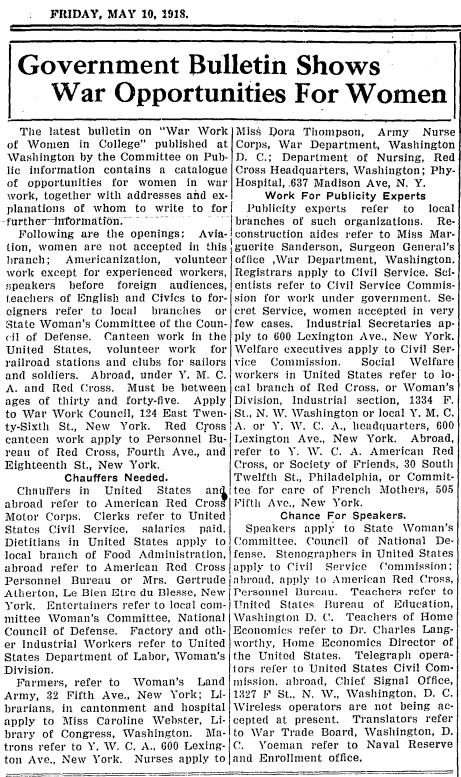
“Government Bulletin Shows War Opportunities for Women,” Daily Illini, May 10, 1918, p.5 [link]Despite coming off the heels of decades of labor conflict and milestones—in part due to the visible and invisible labor of women, including working class and immigrant women and those organizing in union auxiliary chapters—in the era of the World Wars, many middle-class women were still working in the domestic sphere.
However, the onset of war forced men overseas or into different positions. Women were employed to fill these absences, and at the same time, fill an increased demand for the production of certain goods. These realities posed a problem for American production, and, throughout the country, women were encouraged to work in traditionally male-dominated industries such as manufacturing and agriculture. Wartime also saw an emergence of new needs, and in response, women labored in ammunitions factories and built war equipment like ships, planes, and tanks, among other work.
This was not an American phenomenon, of course, as women throughout Europe were filling empty factory roles while men left to serve in the war. Many American newspapers reported on the status of British, French, and German female laborers in agriculture and factory work, such as munitions factories, as early as 1914.
Collections are one of, if not the, most important things in a library. That may seem obvious to say, but the management of a library’s collection is something that is integral to communities in a way we may not fully understand as patrons. This semester, I am in a class aptly titled “Collection Development” that aims to expose library and information science students to the processes and theories surrounding how collections are developed. As we come into Black History Month, I want to bring further awareness to the responsibility that librarians have to underrepresented groups and some of the things we should be conscious of during the collection development process.
Something I have struggled with during my time as a student here at the library is the power that librarians have over their collections. I feel uncomfortable being the person to make those decisions as I am aware of how much I could be missing. However, the alternative would be to, what, have a machine do it? I suppose as AI continues to advance I am probably not that far off, but AI will also need a human’s code behind it, telling it what to pick. So ultimately, the power of choice will most likely always be in the hands of a human, sometimes one individual. And there is a lot of responsibility that comes with that role.
The Webb Publishing Company enjoyed a quick success with the Farmer’s Wife. One driver of that success was the company’s ingenious use of market segmentation: to advertisers, they pitched the publication as half-farm newspaper and half-women’s magazine, a hybrid publication uniquely capable of providing access to a supposedly untapped market hiding at the intersection of two valuable demographics: rural Americans and women. The rural demographic was valuable both for its size and its unrealized spending power. This spending power, Webb argued, could best be exploited through the women, not the men, because the “farm women pull the purse strings” in the family.1 In other words, the Farmer’s Wife was, at least in part, a business that sold access to farm women. According to the publisher, the typical farm woman was independent, accomplished, and assertive, a person with considerable business sense and a can-do attitude. Webb contrasted the resourceful farm wife with what it portrayed as the pampered, functionless housewife of the nation’s cities.2 Farm wives acted independently of their husbands; they were the decision-makers and the money-spenders for their households. Webb repeatedly used the “purse strings” as a metonym for women’s power: contrary to expectations, the woman, not the man, controlled them. It wasn’t just that women spent the money, but that they personally determined how and where it would be spent. Continue reading “The Story of the “Farmer’s Wife” (Part 2)”→
I think she’s definitely a textbook narcissist; maybe even a psychopath. I’d have to have some concrete examples to fill in the Machiavellian part of the Dark Triad equation though. But I’m just armchair quarterbacking on the psychology here, informally trained by watching several YouTube videos on personality disorders.
Even the experts brought in to assess her, with little cooperation from Sara herself, couldn’t come to an agreement on a diagnosis. Histrionic, borderline, and/or bipolar personality disorders were listed on various reports written after meeting with her after her arrest but before her trial—before she could even be considered competent to stand for trial. Sara would not let her lawyer claim insanity or diminished mental capacity at the time of her alleged crime. Continue reading “An Infamous 50th Anniversary Just Passed”→
This probably is not the post you would expect on Halloween. My defense for this, however, is that AI is a bit of a scary topic to broach in this day and age.
I mostly mean this as a joke, but in all seriousness using AI makes me…uneasy despite the fact that I am part of the generation who should be embracing it.
As part of our work at the History, Philosophy, and Newspaper Library, staff and graduate assistants often lead classes on conducting historical research. In my first year of instruction, I generally stayed away from the topic of AI. Now that it has become obvious to me that more and more students are using AI in a variety of ways for research, it is more and more important that we address it as part of the research process.
Each year, the Illinois Newspaper Project (INP)—a joint project of the History, Philosophy, and Newspaper Library (HPNL) and the Preservation Services Unit of the University Library—participates in the Archives Bazaar, which highlights special collections, museums, archives, and other cultural heritage organizations in Champaign County and is hosted by the Champaign County Historical Archives at The Urbana Free Library.
Clipping from the Day Book, October 12, 1916, p.20
This year’s theme was the “bizarre Bazaar,” and the event was held at The Urbana Free Library on Saturday, September 20. While brainstorming newspaper content for the INP table, I initially considered conducting a deep dive of search results in the Illinois Digital Newspaper Collections for the keyword “bizarre” and highlighting how historical newspapers can be resources for mapping language evolution and trends. I eventually ruled this idea out…perhaps too boring, too academic, and not easily digestible in an open-house format.
I then considered highlighting a newspaper preserved and digitized by the Illinois Newspaper Project, The Day Book, conceived by newspaper mogul Edward Willis Scripps as an experiment in advertisement-free newspaper publishing. The Day Book often published sensational stories and wacky tabloid-like facts about people around the world. It also published many images and sketches, and visual imagery is good for newspaper outreach events. However, I ultimately decided this wasn’t bizarre enough, plus, I wanted to highlight the richness of the IDNC and its cross-search capability across all titles in the digital collection and not just highlight one specific newspaper.
So, I did what anyone would do—I pivoted to UFOs (unidentified flying objects, flying saucers, flying disks, flying discs, etc.).
Little is known about the origins of the Farmer’s Wife. It might have begun publication in 1897, but more likely 1900, in Winona, Minnesota. Its first publisher was John Halvor Johnson, who went by “J.H.” just about everywhere except his gravestone. The son of Norwegian immigrants, Johnson was a traveling salesman turned investor: he began with buying-and-selling newspapers and ended with real estate. His first big investment was the Winona Daily Herald, which he purchased in 1890 and sold ten years later.1 He then began launching new publications under the names of recently-abandoned titles. For example, in 1892 Farm, Field and Stockman changed its name to Farm, Field and Fireside, and that same year Johnson began publishing a monthly under the title Farm, Field and Stockman, which he later sold to the Model Farmer Publishing Company of Chicago. Similarly, in 1900 the weekly American Stock Farm changed its name, shortly after which Johnson began a monthly using that title as well.2
The University of Illinois Urbana-Champaign Library and the Department of History are pleased to announce a Research Travel Grant to support scholars conducting research in any of the Library’s collections.
The University Library is one of the largest research libraries in the U.S., holding more than 15 million volumes and 24 million other items and materials in all formats, languages, and subjects. Special collections include the papers of literary figures such as Marcel Proust, H.G. Wells, Carl Sandburg and Gwendolyn Brooks, extensive collections of Slavic and East European materials and of materials documenting the history of science, technology, international agricultural programs, and librarianship, the premier collection on international amateur sports and the Olympics, and a unique collection of sub-Saharan African research materials. Travel grant recipients will also have access to the Library’s digital collections (including journal subscriptions and licensed databases) during their stay. Continue reading “Call for applications: 2025-2026 Research Travel Grant”→