News

Library Fadeout

A Time Capsule

At the beginning of this school year, the Library celebrated the one hundredth anniversary of the Main Library building. Part of the celebration was the opening of a time capsule that had been placed inside the cornerstone of the building. I have, for fun, assembled a time capsule of my own: objects, documents, and memories that record what the Library was like when I was a student here, not a hundred years ago but thirty. Continue reading “Library Fadeout”

More new books by Illinois faculty

The academic year 2024-2025 has been a splendid year for publications by Illinois faculty in the the subject areas we support in the History, Philosophy, and Newspaper Library (African American Studies, History, Jewish Studies, Philosophy, and Religious Studies). Here is Part II of the already impressive list I started last November. Among other fascinating new publications, I was delighted (but not surprised!) to see another posthumous title by the late, much-missed Winton Solberg. Continue reading “More new books by Illinois faculty”

Microfiche in HPNL


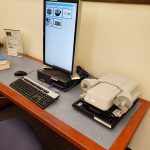
Microform workstation

HPNL is home to a large number (> 26,000 separate bibliographic records) of the library’s microfiche. It should be noted that one microfiche bibliographic record may represent 1 microfiche, it may represent 10,000 (with the same call number but are differentiated by year, volume, etc.), so the number of microfiche titles is not the same as the number of actual sheets of microfiche. Microfiche comes in one of two sizes, 3.5”x 4.25” and 4” x 5.5”. Both are stored in 6” x 4” acid free envelopes and, if more than one sheet is stored in the same envelope, separated by an acid-free slip sheet matching the size of the microfiche. Microfiche vary in thickness. Their contents are accessed using a microform (microfilm/microfiche) reader.

Anything in print can be microphotographed to create microfiche; not only books, but also large collections of serials/journals/magazines (from philosophical societies to Ladies’ Home Journal), newspapers, government documents, musical scores… you get the idea. Continue reading “Microfiche in HPNL”

AI and (Mis)Information: A New Book Review

AI has been a hot topic around the world lately. And rightfully so. Artificial intelligence is a technological development that we have all heard about and has been rapidly growing for the last decade. It was only a few years ago that my class’s syllabi started including statements on the use of AI for classes as students were continually caught submitting work they had not completed themselves. Since then, AI has become more and more and more integrated into every part of our lives. Most major search engines have AI built in and you cannot expect to interact with social media without seeing some kind of strange, AI generated content. As AI has become an unavoidable part of our day-to-day lives, debates have sprung up in multiple circles about how and when AI should be used. 

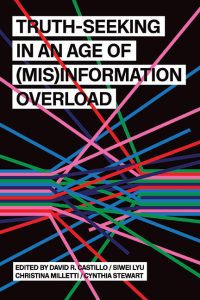
Image of the cover of Truth Seeking in an Age of (Mis)Information Overload.
Image provided by the SUNY Press

As a library and information science student I have seen how, regardless of if they are dealing with seasoned researchers, students, or the public, information professionals are seeing more and more people starting to rely on AI as a research tool. In many cases, this can be a detriment to critical research skills and encourage a spread of misinformation as people start to trust the information that AI produces more and more. Although I have been warned to expect misinformation spread by AI and seen it first hand in the form of fake citations and quotes, I know I am not an authority on the subject. So to further inform myself on this issue, I picked up a good ol’ book and got to reading.

For this blog post, I will be engaging primarily with the first part of a new book from our collection, Truth-Seeking in an  Age of (Mis)Information Overload (2024) entitled “Misinformation and Artificial Intelligence.” This section is composed of two essays: “It Is Artificial, But Is It Intelligent?” by E. Bruce Pitman and “Disinformation, Power, and the Automation of Judgments: Notes on the Algorithmic Harms to Democracy“ by Ewa Płonowska Ziarek.  Continue reading “AI and (Mis)Information: A New Book Review”

Snapshot in Time: Campus During Covid

Daily Illini Editorial entitled "Heed Travel Warnings" published in March 2020. It is hard to believe but it has been five years since the University of Illinois Urbana-Champaign campus essentially closed after spring break. During the spring 2020 semester, spring break was officially from March 14th-22nd but campus did not fully re-open for the rest of the spring semester. Reviewing the Daily Illini, the concerns about Covid-19 before break were primarily about traveling abroad. In March 2020, the Daily Illini was still a physical newspaper and with the closing of campus, its publication was halted from March 15th through June 2020.
I was working at the Undergraduate Library in March 2020 and took the spring break week off on vacation. I never could have guessed that the libraries would close, and work and classes would move online for the rest of the semester. I remember even stating that there is no way the libraries would close, because at the time, they were considered an essential unit and were very rarely closed. Continue reading “Snapshot in Time: Campus During Covid”

Read all about it! Trial access to three Oxford Research Encyclopedias

Have you been looking for something more scholarly than Wikipedia, and felt frustrated that many major reference works have become dated and have not been revised? That’s exactly how we’ve been feeling, and we are trying to do something about it.

The Library has trial access to three subject modules of the Oxford Research Encyclopedias. (We’ve also had access to the Oxford Research Encyclopedia of African History since 2022.)

The Oxford Research Encyclopedias are an ambitious project from Oxford University Press. The aim is to create “a dynamic digital encyclopedia continuously updated by the world’s leading scholars and researchers.” These articles really do function as introductory overviews. Unlike articles in many “Handbook”-type publications, all include substantive discussions of recent scholarship. All articles in history and allied fields have sections about primary sources. Continue reading “Read all about it! Trial access to three Oxford Research Encyclopedias”

Ben Fletcher: Leader in the IWW


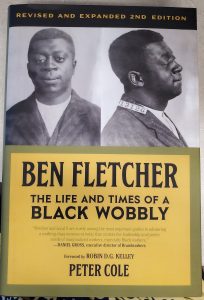
picture of the cover of Peter Cole's book, "Ben Fletcher: the Life and Times of a Black Wobbly"
The cover of Peter Cole’s book, “Ben Fletcher: the Life and Times of a Black Wobbly”

Simply put, Ben Fletcher was an African American dockworker from Philadelphia, a member of the Local 8 IWW (International Workers of the World) union in the early 1900s.

But Local 8, the IWW (known as “the Wobblies”), and Ben are not as simple as that. Fletcher became a man that “helped lead a pathbreaking union that likely was the most diverse and integrated organization (not simply union) despite the era’s rampant racism, antiunionism, and xenophobia” as stated on page one of Peter Cole’s Ben Fletcher: the Life and Times of a Black Wobbly.

Some of the existing unions Ben could have chosen to join (if they would allow a black man to join were):

Ben chose to join the Socialist Party and the IWW early on in his working life. As an international union, it attempted (and is still attempting) to unite all workers, skilled or unskilled, of any race, gender, or creed against the owners of businesses across the world. They wanted to create O.B.U. (one big union). They were anti-capitalist and believed the workers, not the businessmen should reap the rewards of their work. Continue reading “Ben Fletcher: Leader in the IWW”

Using the IDNC: Researching Black newspapers, labor, and business

The Black Press 

Chicago World (Chicago, Ill.), August 27, 1949 

In honor of Black History Month, the Illinois Newspaper Project (INP) is using the Illinois Digital Newspaper Collection (IDNC) to understand Black labor history (rights, unions, and movements) and Black-owned business in Illinois through historical newspapers. We’re highlighting the mastheads of (and people behind) Black newspapers as well as advertisements for Black-owned businesses found within newspapers. A special photograph issue (published December 5, 1943) of the Chicago Sunday Bee specifically highlights Willard S. Townsend, a Black labor leader and first African-American to hold office in a national union, and printed photographs of Black labor leaders present at a Congress of Industrial Organizations (CIO) meeting in Philadelphia.

Did you know that the Illinois Digital Newspaper Collections (IDNC) has a collection of Black newspapers? In order to preserve the cultural and print heritages of Black papers and their readers, the Illinois Digital Newspaper Project (IDNP) has centered past digitization projects around historical Black newspaper printed (primarily) in Illinois.  


Continue reading “Using the IDNC: Researching Black newspapers, labor, and business”

Accessibility Issues in the Case of Microfilm (And Why You Should Still Give it a Chance)

The History, Philosophy, and Newspaper Library (HPNL) at the University of Illinois Urbana-Champaign is home to a large collection of both newspapers and microfilm. While both are certainly collections that are still used regularly, there are many people of all generations who have never come into contact with a microfilm reel or scanner before coming here. And really, why would they have too? Everything is accessible on the internet at this point right?

Image of microfilm reel of the 1978 Daily Illini and accompanying box
Microfilm reel from HPNL’s collection of the Daily Illini

Well not exactly. 

In the past, microfilm was used as a form of preservation for more fragile objects like old books and newspapers that were printed on quickly degrading paper. There was a huge boom in the microfilming industry in the 50s and 60s when archivists and librarians became a little bit obsessed with increasing the longevity of their collections and saving space. During this process, however, they threw out many of the original copies of items that were filmed which made them only accessible on microfilm. At the time this probably seemed like a great idea (saving space and all that), but as we have transitioned into the digital age, physical-based media are seeing less and less use.

That dip in use does not reflect microfilm’s overall usefulness, however. People come into our library daily to view microfilm for a variety of reasons. But if these resources are so useful, why are they being used less and less? I can think of a few reasons: Continue reading “Accessibility Issues in the Case of Microfilm (And Why You Should Still Give it a Chance)”

HPNL Hot Blast + Our Annual Gift Guide

Everyday Newspaper Titles (Zzzzzz)

Do not waste your time counting sheep; if you’re having trouble settling in for your long winter’s nap, you might find newspaper titles as sedating as Seconal: the “Gazette,” the “Times,” the “Examiner,” the “Post,” the “Tribune,” the “Sun,” the “Star,” the “Journal,” the “News”… and then the hyphenated titles, formed by newspaper mergers: “News-Tribune,” “News-Gazette,” “Journal-Star,” “Sun-Times,” “Star-Tribune,”and on and on.

A handful of interesting exceptions do, however, cross my desk. I’m often puzzled by the “Sun-Star” and “Star-Sun” unions. Is it an unholy marriage of night with day, or a Rosicrucian signal: sun is star; star is sun; sun marries self, a terrible autogamy and its dread progeny? Imagine waking every morning, or returning home every evening, to that Yeatsian horror: “[W]hat rough beast, its hour come round at last, / Slouches towards Bethlehem to be born?”(Oh, and, Merry Christmas, if you celebrate!)
Continue reading “HPNL Hot Blast + Our Annual Gift Guide”