Developing Representative Collections

Collections are one of, if not the, most important things in a library. That may seem obvious to say, but the management of a library’s collection is something that is integral to communities in a way we may not fully understand as patrons. This semester, I am in a class aptly titled “Collection Development” that aims to expose library and information science students to the processes and theories surrounding how collections are developed. As we come into Black History Month, I want to bring further awareness to the responsibility that librarians have to underrepresented groups and some of the things we should be conscious of during the collection development process.

Something I have struggled with during my time as a student here at the library is the power that librarians have over their collections. I feel uncomfortable being the person to make those decisions as I am aware of how much I could be missing. However, the alternative would be to, what, have a machine do it? I suppose as AI continues to advance I am probably not that far off, but AI will also need a human’s code behind it, telling it what to pick. So ultimately, the power of choice will most likely always be in the hands of a human, sometimes one individual. And there is a lot of responsibility that comes with that role.
Continue reading “Developing Representative Collections”

AI in Historical Research

This probably is not the post you would expect on Halloween. My defense for this, however, is that AI is a bit of a scary topic to broach in this day and age.

I mostly mean this as a joke, but in all seriousness using AI makes me…uneasy despite the fact that I am part of the generation who should be embracing it.

As part of our work at the History, Philosophy, and Newspaper Library, staff and graduate assistants often lead classes on conducting historical research. In my first year of instruction, I generally stayed away from the topic of AI. Now that it has become obvious to me that more and more students are using AI in a variety of ways for research, it is more and more important that we address it as part of the research process.

Continue reading “AI in Historical Research”

AI and (Mis)Information: A New Book Review

AI has been a hot topic around the world lately. And rightfully so. Artificial intelligence is a technological development that we have all heard about and has been rapidly growing for the last decade. It was only a few years ago that my class’s syllabi started including statements on the use of AI for classes as students were continually caught submitting work they had not completed themselves. Since then, AI has become more and more and more integrated into every part of our lives. Most major search engines have AI built in and you cannot expect to interact with social media without seeing some kind of strange, AI generated content. As AI has become an unavoidable part of our day-to-day lives, debates have sprung up in multiple circles about how and when AI should be used. 

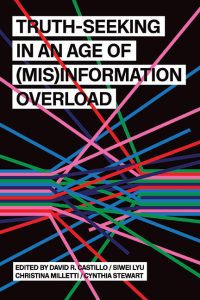
Image of the cover of Truth Seeking in an Age of (Mis)Information Overload.
Image provided by the SUNY Press

As a library and information science student I have seen how, regardless of if they are dealing with seasoned researchers, students, or the public, information professionals are seeing more and more people starting to rely on AI as a research tool. In many cases, this can be a detriment to critical research skills and encourage a spread of misinformation as people start to trust the information that AI produces more and more. Although I have been warned to expect misinformation spread by AI and seen it first hand in the form of fake citations and quotes, I know I am not an authority on the subject. So to further inform myself on this issue, I picked up a good ol’ book and got to reading.

For this blog post, I will be engaging primarily with the first part of a new book from our collection, Truth-Seeking in an  Age of (Mis)Information Overload (2024) entitled “Misinformation and Artificial Intelligence.” This section is composed of two essays: “It Is Artificial, But Is It Intelligent?” by E. Bruce Pitman and “Disinformation, Power, and the Automation of Judgments: Notes on the Algorithmic Harms to Democracy“ by Ewa Płonowska Ziarek.  Continue reading “AI and (Mis)Information: A New Book Review”

Accessibility Issues in the Case of Microfilm (And Why You Should Still Give it a Chance)

The History, Philosophy, and Newspaper Library (HPNL) at the University of Illinois Urbana-Champaign is home to a large collection of both newspapers and microfilm. While both are certainly collections that are still used regularly, there are many people of all generations who have never come into contact with a microfilm reel or scanner before coming here. And really, why would they have too? Everything is accessible on the internet at this point right?

Image of microfilm reel of the 1978 Daily Illini and accompanying box
Microfilm reel from HPNL’s collection of the Daily Illini

Well not exactly. 

In the past, microfilm was used as a form of preservation for more fragile objects like old books and newspapers that were printed on quickly degrading paper. There was a huge boom in the microfilming industry in the 50s and 60s when archivists and librarians became a little bit obsessed with increasing the longevity of their collections and saving space. During this process, however, they threw out many of the original copies of items that were filmed which made them only accessible on microfilm. At the time this probably seemed like a great idea (saving space and all that), but as we have transitioned into the digital age, physical-based media are seeing less and less use.

That dip in use does not reflect microfilm’s overall usefulness, however. People come into our library daily to view microfilm for a variety of reasons. But if these resources are so useful, why are they being used less and less? I can think of a few reasons: Continue reading “Accessibility Issues in the Case of Microfilm (And Why You Should Still Give it a Chance)”

New Life Will Rise From the Ashes… Right?: An Short Analysis of The Phoenix Complex: A Philosophy of Nature by Michael Marder in Our Current Contexts

Hurricanes continually pummel the coasts of the United States, we had record high temperatures across the country this summer, and we are biting our nails waiting for what winter may hold. When you really think about it, there is only one logical explanation for the extreme weather we have seen over the last decade: The government. 

Or at least that is what I saw some people saying on social media. 

While it may have been appalling to see people say that, it unfortunately isn’t a new train of thought. Climate change is a topic that has been debated for as long as I can remember and people around the world have always come up with any possible explanation that points the finger away from the human race’s involvement in it. If it is even a real thing at all, that is.  Continue reading “New Life Will Rise From the Ashes… Right?: An Short Analysis of The Phoenix Complex: A Philosophy of Nature by Michael Marder in Our Current Contexts”