This probably is not the post you would expect on Halloween. My defense for this, however, is that AI is a bit of a scary topic to broach in this day and age.
I mostly mean this as a joke, but in all seriousness using AI makes me…uneasy despite the fact that I am part of the generation who should be embracing it.
As part of our work at the History, Philosophy, and Newspaper Library, staff and graduate assistants often lead classes on conducting historical research. In my first year of instruction, I generally stayed away from the topic of AI. Now that it has become obvious to me that more and more students are using AI in a variety of ways for research, it is more and more important that we address it as part of the research process.
AI has been a hot topic around the world lately. And rightfully so. Artificial intelligence is a technological development that we have all heard about and has been rapidly growing for the last decade. It was only a few years ago that my class’s syllabi started including statements on the use of AI for classes as students were continually caught submitting work they had not completed themselves. Since then, AI has become more and more and more integrated into every part of our lives. Most major search engines have AI built in and you cannot expect to interact with social media without seeing some kind of strange, AI generated content. As AI has become an unavoidable part of our day-to-day lives, debates have sprung up in multiple circles about how and when AI should be used.
As a library and information science student I have seen how, regardless of if they are dealing with seasoned researchers, students, or the public, information professionals are seeing more and more people starting to rely on AI as a research tool. In many cases, this can be a detriment to critical research skills and encourage a spread of misinformation as people start to trust the information that AI produces more and more. Although I have been warned to expect misinformation spread by AI and seen it first hand in the form of fake citations and quotes, I know I am not an authority on the subject. So to further inform myself on this issue, I picked up a good ol’ book and got to reading.
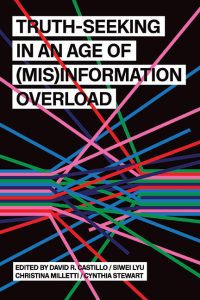
For this blog post, I will be engaging primarily with the first part of a new book from our collection, Truth-Seeking in an Age of (Mis)Information Overload (2024) entitled “Misinformation and Artificial Intelligence.” This section is composed of two essays: “It Is Artificial, But Is It Intelligent?” by E. Bruce Pitman and “Disinformation, Power, and the Automation of Judgments: Notes on the Algorithmic Harms to Democracy“ by Ewa Płonowska Ziarek. Continue reading “AI and (Mis)Information: A New Book Review”→