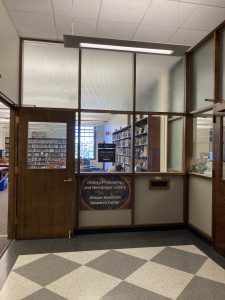
One thing I have been doing this semester is creating display boards that feature a specific subselection of the HPNL’s New Book Collection. In February, I did a display on Black History Month, in March, I did a display on Women’s History Month, and now, for April, it’s time to combine all of that for a new display on Black Women’s History Month. As the History, Philosophy, and Newspaper Library is also the African-American reference center, we have a ton of books for me to choose from to go on this display. As April is also National Stress Month, I wanted to get into something mental health-related, as stress has such an impact on a person’s mental health every day. So, I chose to find a book on mental health specifically relating to black women for this article.
The University of Illinois Urbana-Champaign Library and the Department of History are pleased to announce a Research Travel Grant to support scholars conducting research in any of the Library’s collections.
The University Library is one of the largest research libraries in the U.S., holding more than 15 million volumes and 24 million other items and materials in all formats, languages, and subjects. Special collections include the papers of literary figures such as Marcel Proust, H.G. Wells, Carl Sandburg and Gwendolyn Brooks, extensive collections of Slavic and East European materials and of materials documenting the history of science, technology, international agricultural programs, and librarianship, the premier collection on international amateur sports and the Olympics, and a unique collection of sub-Saharan African research materials. Travel grant recipients will also have access to the Library’s digital collections (including journal subscriptions and licensed databases) during their stay. Continue reading “Call for applications: 2025-2026 Research Travel Grant”→
The academic year 2024-2025 has been a splendid year for publications by Illinois faculty in the the subject areas we support in the History, Philosophy, and Newspaper Library (African American Studies, History, Jewish Studies, Philosophy, and Religious Studies). Here is Part II of the already impressive list I started last November. Among other fascinating new publications, I was delighted (but not surprised!) to see another posthumous title by the late, much-missed Winton Solberg. Continue reading “More new books by Illinois faculty”→
AI has been a hot topic around the world lately. And rightfully so. Artificial intelligence is a technological development that we have all heard about and has been rapidly growing for the last decade. It was only a few years ago that my class’s syllabi started including statements on the use of AI for classes as students were continually caught submitting work they had not completed themselves. Since then, AI has become more and more and more integrated into every part of our lives. Most major search engines have AI built in and you cannot expect to interact with social media without seeing some kind of strange, AI generated content. As AI has become an unavoidable part of our day-to-day lives, debates have sprung up in multiple circles about how and when AI should be used.
As a library and information science student I have seen how, regardless of if they are dealing with seasoned researchers, students, or the public, information professionals are seeing more and more people starting to rely on AI as a research tool. In many cases, this can be a detriment to critical research skills and encourage a spread of misinformation as people start to trust the information that AI produces more and more. Although I have been warned to expect misinformation spread by AI and seen it first hand in the form of fake citations and quotes, I know I am not an authority on the subject. So to further inform myself on this issue, I picked up a good ol’ book and got to reading.
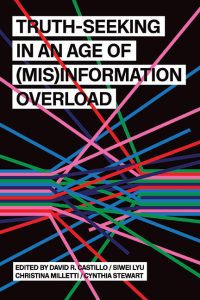
For this blog post, I will be engaging primarily with the first part of a new book from our collection, Truth-Seeking in an Age of (Mis)Information Overload (2024) entitled “Misinformation and Artificial Intelligence.” This section is composed of two essays: “It Is Artificial, But Is It Intelligent?” by E. Bruce Pitman and “Disinformation, Power, and the Automation of Judgments: Notes on the Algorithmic Harms to Democracy“ by Ewa Płonowska Ziarek. Continue reading “AI and (Mis)Information: A New Book Review”→
It is hard to believe but it has been five years since the University of Illinois Urbana-Champaign campus essentially closed after spring break. During the spring 2020 semester, spring break was officially from March 14th-22nd but campus did not fully re-open for the rest of the spring semester. Reviewing the Daily Illini, the concerns about Covid-19 before break were primarily about traveling abroad. In March 2020, the Daily Illini was still a physical newspaper and with the closing of campus, its publication was halted from March 15th through June 2020.
I was working at the Undergraduate Library in March 2020 and took the spring break week off on vacation. I never could have guessed that the libraries would close, and work and classes would move online for the rest of the semester. I remember even stating that there is no way the libraries would close, because at the time, they were considered an essential unit and were very rarely closed. Continue reading “Snapshot in Time: Campus During Covid”→
The History, Philosophy, and Newspaper Library (HPNL) at the University of Illinois Urbana-Champaign is home to a large collection of both newspapers and microfilm. While both are certainly collections that are still used regularly, there are many people of all generations who have never come into contact with a microfilm reel or scanner before coming here. And really, why would they have too? Everything is accessible on the internet at this point right?
Microfilm reel from HPNL’s collection of the Daily Illini
Well not exactly.
In the past, microfilm was used as a form of preservation for more fragile objects like old books and newspapers that were printed on quickly degrading paper. There was a huge boom in the microfilming industry in the 50s and 60s when archivists and librarians became a little bit obsessed with increasing the longevity of their collections and saving space. During this process, however, they threw out many of the original copies of items that were filmed which made them only accessible on microfilm. At the time this probably seemed like a great idea (saving space and all that), but as we have transitioned into the digital age, physical-based media are seeing less and less use.
Change of plans: no more rabbit holes. Geneaology!
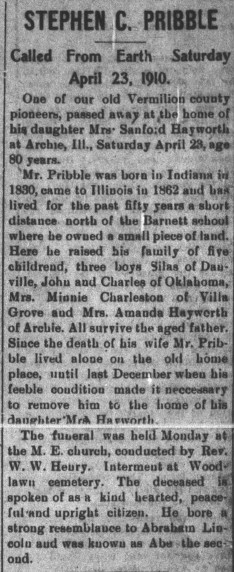
Stephen Cornett Pribble’s Obituary
Genealogy is more than just names and dates, jobs and relationships. I started in the late 1990s researching my dad’s side of the family. I live in the area that my ancestors lived in back in the 1870s. There are a lot of us (Pribbles) in the Vermilion and Champaign County area. How did I find this out? Censuses, talking to older relatives (I interviewed my great-aunt, Anna Kathryn Pribble McNeese, 98 at the time), cemetery listings and walks, and joining the Illiana Genealogical and Historical Society. I used the society’s resources which, at the time, were reference books and microfilm. I looked on sites such as Ancestry.com, which were free back then, but there was a gap between my known Pribbles and the Pribbles listed on the site. Where did we fit in to the line that came over from England as an indentured servant?
Using HPNL’s libguide entitled Geneaology Resources, I found a number of aids useful in tracking down ancestors. Ancestry.com is still available, but you must pay to access the information there now, but Family Search is free.
Through the USGenWeb Project, I accessed the ILGenWeb site and from there, the Vermilion County genealogy website. From this site, deaths, marriages, military information, newspapers, and obituaries can be accessed. I’m just looking in Vermilion county for my folk, but the ILGenWeb has a site for each county in Illinois, and the USGenWeb Project for each state. I have used this site in the past to verify deaths and marriages.
Back on the Geneaology Resources libguide page, I selected “V” under the “Illinois” sidebar on the Genealogy Resources page, and am taken to the “Where to Start” page for searching information in Vermilion county. This led me to a number of books that may contain useful information. As for my Vermilion county cousins, I was able to read about them from an entry in History of Vermilion County… (Beckwith). Yohos can still be found in the area I went to school with Henthorns in Catlin, a nearby village to Westville, Georgetown and Sidell. It is a small world. One of my West Virginia (migrated in the 1870s, settling in Ridgefarm) cousins can be read about here. Frank’s brother was named Wilbur. Go figure. Kinfolk, but definitely independent lines from a common ancestor. Continue reading “Flesh Out your Genealogical Searches with Small Town Newspapers”→
Hurricanes continually pummel the coasts of the United States, we had record high temperatures across the country this summer, and we are biting our nails waiting for what winter may hold. When you really think about it, there is only one logical explanation for the extreme weather we have seen over the last decade: The government.
Or at least that is what I saw some people saying on social media.
One of the most satisfying parts of my job as an academic librarian is to see a research project that started out as a twinkle in someone’s eye appear in the Library as a published book. Here are some new titles by University of Illinois faculty members in the subject areas we collect here in the History, Philosophy, and Newspaper Library (African American Studies, History, Jewish Studies, Philosophy, and Religious Studies) that we’ve recently acquired (a few are still on order). Congratulations, all! Continue reading “New and recent books by Illinois faculty”→
During the academic semester, HPNL is open from 9am-7pm Monday-Thursday, 9am-5pm on Fridays and 1-5pm on Sundays.
HPNL Study Space:
HPNL is a semi-quiet study space that has both large study tables that work for both individuals and small groups, as well as new individual study carrels! There is both traditional library seating as well as soft seating. The library has great natural lighting through large windows in the main reading room. If you need an even quieter space to read or study, and don’t mind a bit of cool temperatures, we also have a few seats in our microfilm stacks available for use. Continue reading “HPNL – A Great Place to Study!”→
 It is hard to believe but it has been five years since the University of Illinois Urbana-Champaign campus essentially closed after spring break. During the spring 2020 semester, spring break was officially from March 14th-22nd but campus did not fully re-open for the rest of the spring semester. Reviewing the Daily Illini, the concerns about Covid-19 before break were primarily about traveling abroad. In March 2020, the Daily Illini was still a physical newspaper and with the closing of campus, its publication was halted from March 15th through June 2020.