The Story of the “Farmer’s Wife” (Part 1)

Beclouded Beginnings and Suspicious Name Games

Little is known about the origins of the Farmer’s Wife. It might have begun publication in 1897, but more likely 1900, in Winona, Minnesota. Its first publisher was John Halvor Johnson, who went by “J.H.” just about everywhere except his gravestone. The son of Norwegian immigrants, Johnson was a traveling salesman turned investor: he began with buying-and-selling newspapers and ended with real estate. His first big investment was the Winona Daily Herald, which he purchased in 1890 and sold ten years later.1 He then began launching new publications under the names of recently-abandoned titles. For example, in 1892 Farm, Field and Stockman changed its name to Farm, Field and Fireside, and that same year Johnson began publishing a monthly under the title Farm, Field and Stockman, which he later sold to the Model Farmer Publishing Company of Chicago. Similarly, in 1900 the weekly American Stock Farm changed its name, shortly after which Johnson began a monthly using that title as well.2

Continue reading “The Story of the “Farmer’s Wife” (Part 1)”

Library Fadeout

A Time Capsule

At the beginning of this school year, the Library celebrated the one hundredth anniversary of the Main Library building. Part of the celebration was the opening of a time capsule that had been placed inside the cornerstone of the building. I have, for fun, assembled a time capsule of my own: objects, documents, and memories that record what the Library was like when I was a student here, not a hundred years ago but thirty. Continue reading “Library Fadeout”

HPNL Hot Blast + Our Annual Gift Guide

Everyday Newspaper Titles (Zzzzzz)

Do not waste your time counting sheep; if you’re having trouble settling in for your long winter’s nap, you might find newspaper titles as sedating as Seconal: the “Gazette,” the “Times,” the “Examiner,” the “Post,” the “Tribune,” the “Sun,” the “Star,” the “Journal,” the “News”… and then the hyphenated titles, formed by newspaper mergers: “News-Tribune,” “News-Gazette,” “Journal-Star,” “Sun-Times,” “Star-Tribune,”and on and on.

A handful of interesting exceptions do, however, cross my desk. I’m often puzzled by the “Sun-Star” and “Star-Sun” unions. Is it an unholy marriage of night with day, or a Rosicrucian signal: sun is star; star is sun; sun marries self, a terrible autogamy and its dread progeny? Imagine waking every morning, or returning home every evening, to that Yeatsian horror: “[W]hat rough beast, its hour come round at last, / Slouches towards Bethlehem to be born?”(Oh, and, Merry Christmas, if you celebrate!)
Continue reading “HPNL Hot Blast + Our Annual Gift Guide”

A bit of and a bite at “The Boston Evening Transcript”

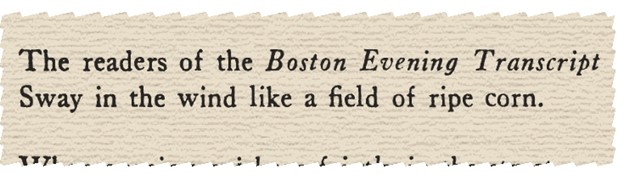
The readers of the Boston Evening Transcript / Sway in the wind like a field of ripe corn.
From: T.S. Eliot, “The Boston Evening Transcript,” Poetry 7, no. 1 (October 1915): 21.

I like these first two lines from T.S. Eliot’s poem, “The Boston Evening Transcript.” I’ve clipped them (sort of) from the issue of Poetry magazine in which the poem first was published. Probably it’s a little strange that I should like them, because I don’t think he meant them to be lovely. Continue reading “A bit of and a bite at “The Boston Evening Transcript””

The Newspaper and Its Disjecta Membra


“If scrapbooks can be distilled to one overarching interpretive theme, it is that of rupture.”

“What could be more emblematic of the fractured narratives of modernity than scrapbooks?”

“[An] excess of fragments that burst the bindings and bulge the pages.”

“How then do we read these fragments as cultural artifacts?”1

Newspaper clippings were frequently pasted into scrapbooks, and sometimes, as in the case of the scrapbook shown here, compose the entirety of the scrapbook’s contents: Continue reading “The Newspaper and Its Disjecta Membra”

Merry Christmas, Jason Donovan

Where’d You Get Your Information? (Part II)

This post is the second in a set on the British band Cornershop and their information obsession. Part two begins with their 1993 song, “Jason Donovan / Tessa Sanderson,” which is about two libel cases that received considerable publicity in the United Kingdom: Continue reading “Merry Christmas, Jason Donovan”

Where’d You Get Your Information? (Part I)

Letter from 1993, with Unexplained Anachronisms

Tjinder Singh and his post-punk band Cornershop really, really care about information—its technologies, its media, its creators, its consumers—which, for the 1990s at least, is a little unusual. Why care about anything at all when punk has bequeathed them a license to lunge pell-mell down the abyss of heedless anger, smashing up everything and replacing it with nothing? Continue reading “Where’d You Get Your Information? (Part I)”

Over 200 Illinois Newspapers Digitized

Now available: over two hundred digitized Illinois newspapers: https://go.library.illinois.edu/npcom. Access currently restricted to computers with a campus IP address, but will soon be freely available through the Illinois Digital Newspaper Collections (IDNC) to researchers everywhere. Continue reading “Over 200 Illinois Newspapers Digitized”

New Books: The Last Imperialist

The Last Imperialism dust jacketAlan Burns came from one of those families where the children all seem to have been remarkable (in personality or intellect), consequential, and ideologically irreconcilable. The Last Imperialist by Bruce Gilley might have been a nuanced study of one such family (like those captivating Mitford biographies—I think there have been almost a dozen so far). Or it could have been about the devout Roman Catholic and Anglo West Indian, from birth an establishment outsider, who made it his life mission to defend the very establishment that had rejected him. Instead, Gilley chose to write an improbable apologia of the British Empire, and while he does fold some biography into the polemic, he’s so entirely united with Burns in admiration for colonialism that the book devolves into pure encomium somewhere around page three. Continue reading “New Books: The Last Imperialist”

HPNL Presents “The Blaxtravaganza: Celebrating Black Futures” – March 2 to 8

The History, Philosophy, and Newspaper Library (HPNL) invites the community to The Blaxtravaganza: Celebrating Black Futures

This series of events highlight the research, creativity, and brilliance of Black professors on the University of Illinois Urbana-Champaign campus.

  • March 2: David Wright Foladé, Professor of English, will read from his latest novel (now out in
    paperback!) Black Cloud Rising at 4PM in Room 220 of Main Library, 1408 W. Gregory Drive.
  • March 3: Alexandra Barbier, Post-Doctoral Research Associate in the Department of Dance, whose work centers African American vernacular dance forms, will present Stations of Black Loss – Work(s) in Progress at 4PM in Room 220 of Main Library, 1408 W. Gregory Drive.
  • March 4: Courtney Becks, African American and Jewish Studies Librarian, will share a table reading of a work in progress, her play The Socialization of Love, at 4PM in Room 422 of the Levis Center, 919 W. Illinois Street.
  • March 6: Reiko Huffman, Assistant Professor of Scenic Design in the Department of Theatre, at 4PM in Room 220 of Main Library, 1408 W. Gregory Drive.
  • March 7: Nekita Thomas, Assistant Professor of Graphic Design in the School of Art + Design, will hold the interactive Design and the Black Spatial Imaginary Workshop: Creating Black-Affirming Public Spaces at 4PM in Room 220 of Main Library, 1408 W. Gregory Drive.
  • March 8: La Fête DJs N the Library. The closing celebration: a joyful jawn, with food, (non-alcoholic) drink, and the musical stylings of bla(CK)mau— the DJ collective made up of Stacey Robinson, Chris Kinson, and Kamau Grantham— at 7PM in the Music and Performing Arts Library, 1114 W. Nevada Street.

Celebrating Black Futures is supported in part by the Humanities Research Institute’s Supplemental Event Fund.

All events are free and open to the public.

Contact: Courtney Becks
bexlib@illinois.edu

Writing a book chapter about six Black College of Fine and Applied Arts faculty members in 2021 was a watershed for Prof Courtney Becks. Learning about their research processes, careers, and lives through interviews was the relationship- and community-building work well suited to her way of existing in the world.