Collections are one of, if not the, most important things in a library. That may seem obvious to say, but the management of a library’s collection is something that is integral to communities in a way we may not fully understand as patrons. This semester, I am in a class aptly titled “Collection Development” that aims to expose library and information science students to the processes and theories surrounding how collections are developed. As we come into Black History Month, I want to bring further awareness to the responsibility that librarians have to underrepresented groups and some of the things we should be conscious of during the collection development process.
Something I have struggled with during my time as a student here at the library is the power that librarians have over their collections. I feel uncomfortable being the person to make those decisions as I am aware of how much I could be missing. However, the alternative would be to, what, have a machine do it? I suppose as AI continues to advance I am probably not that far off, but AI will also need a human’s code behind it, telling it what to pick. So ultimately, the power of choice will most likely always be in the hands of a human, sometimes one individual. And there is a lot of responsibility that comes with that role.
When I was younger, I remember the concept of avoiding bias being drilled into me over and over, especially when it came to research. We were encouraged to find the most neutral point of view possible on issues to make sure we were only being presented with the facts, not someone’s opinions being fed to us as facts. It feels as though those points of view are fewer and farther between now, but even back then I questioned if it was really possible to find a completely unbiased source. As time has gone on, I have come to the conclusion that it is nearly impossible for anyone or anything to operate completely without bias.

For a large portion of my assistantship, I have been going through our purchasing platform, Gobi, to select items I think would be good for certain collections. As I have gone through the motions of picking from the Gobi recommendations, I came to wonder why these particular items were being promoted to me. On our second day of class in Collection Development, we discussed the issues surrounding exactly that. When it came to academic institutions, we discussed how academic libraries are overwhelmingly representative of white scholarship, leaving major gaps in collections in terms of who is represented and how. There are a few historical reasons for this that are rooted in the racism that has been inherent to academia for centuries, but there are a few other reasons that it has perpetuated into the modern day.
In preparation for class, I was assigned to listen to two NPR podcasts and read a New York Times article on the “American Dirt” controversy. For those who are not familiar with this story; in 2020, author Jeanine Cummins came under scrutiny for her soon-to-be and then newly released novel entitled “American Dirt” that followed a middle-class Mexican mother and her young son as they were driven from their home and forced to flee to the U.S. by the cartel. The main issue with this book comes into play when you consider that Jeanine Cummins is an American white woman. Soon after her book was released, she began to receive a large amount of criticism from Hispanic authors calling her out for (and I am paraphrasing here) using their community’s real-life traumatic experiences as a setting for an action-romance novel, commonly using the term “trauma porn” to describe it. Considering that and the fact that Cummins could not physically have experienced anything like she described while many others had, many Hispanic authors rightfully raised the question “Why was THIS the border crossing portrayal that was given hundreds of thousands of dollars for marketing and publishing?” The answer seems pretty clear if you look at who has historically been offered the largest publishing deals. If you are interested in reading more about this story, I would encourage you to listen to the NPR podcasts titled “Digging into American Dirt” and “American Dirt: A Conversation About a Controversy.”
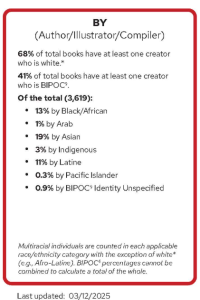
Large publishers tend to offer more opportunities to white, wealthy, already well known authors and purchasing infrastructures such as Gobi primarily promote large academic publishers. This ultimately means that a large portion of the population who have interesting stories to tell and just as much prowess are being left unpublished and unheard in major academic spaces. And you may be saying “well in this day and age you can basically self-publish and climb your way to notoriety through services like Amazon!” And even if that were universally true, how will those books be found by a wide audience without any means to properly promote them? They won’t be ending up on Oprah’s book club list or the New York Times Bestseller list or in major academic recommendation lists without anything short of a miracle.
One of the ways our interim library head and I tried to mitigate this tunnel vision created by only purchasing from major publishers was for me to go through the New York Times Book Review and pick books from there that I thought would be good for our collections. Granted this is still a source that is going to have a level of bias in who they publish and what items they feature, but it broadened the scope of materials by even the slightest bit. I hope to continue broadening our collecting scope by using lists created to elevate under-represented voices and finding other ways to try and navigate my own biases and the biases of the purchasing infrastructure around me.
All of that goes to show that we need to be sure we are conscious of the responsibilities we have and barriers we need to be aware of as librarians while picking materials for our collections. There are billions of books out there and we can’t have them all in our collections, so we need to do our best to choose materials that will be representative of and interesting to our user groups.
The book industry is a hard one to navigate. You do not want to give a platform to poorly written and poorly researched materials, but you also do not want to close your collections off to materials by BIPOC authors who are not given the same opportunities as white authors. As I develop as a professional, I hope to find ways to mitigate these issues and give a platform to those whose voices are less often heard. How I will do that exactly is a work in progress, but I encourage other library professionals to think about these issues and work to confront them in their own collections.
Make sure to check out our New Books collection for the newest additions to our collection as we continue to grow and improve!
To read more about this subject, check out some of the articles consulted for this post:
Bowers, Jennifer, Katherine Crowe, and Peggy Keeran. 2017. “‘If You Want the History of a White Man, You Go to the Library’ 1: Critiquing Our Legacy, Addressing Our Library Collections Gaps.” Collection Management 42 (3–4): 159–79.
Kim, Moon, Angel Diaz, Betsaida Reyes, Florence Mugambi, and Paolo P. Gujilde. 2025. “Building Distinctive Collections : A Survey of Association of Research Libraries’ Member Institutions Acquisitions Infrastructure.” A. Faculty Research and Publications. May 31