Black Women’s History Month: A New Book Review
One thing I have been doing this semester is creating display boards that feature a specific subselection of the HPNL’s New Book Collection. In February, I did a display on Black History Month, in March, I did a display on Women’s History Month, and now, for April, it’s time to combine all of that for a new display on Black Women’s History Month. As the History, Philosophy, and Newspaper Library is also the African-American reference center, we have a ton of books for me to choose from to go on this display. As April is also National Stress Month, I wanted to get into something mental health-related, as stress has such an impact on a person’s mental health every day. So, I chose to find a book on mental health specifically relating to black women for this article.
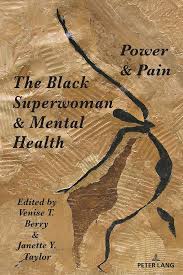
I chose the book “The Black Superwoman & Mental Health: Power and Pain,” edited by Venis T. Berry & Janette Y. Taylor, to focus on for this article. It is a beautifully written book describing the struggles that black women face during their lives. They discuss everything from fear and anxiety to spirituality to dealing with media representation. There are also several different formats in the book, including essays, short stories, poems, and research essays written by dozens of authors.
One important phenomenon that is discussed in the book is the “superwoman schema”. The superwoman schema consists of a few different things, including “perceived obligations to project strength, suppress emotions, resist feelings of vulnerability and dependence, succeed despite limited resources, and prioritize caregiving over self-care” (Superwoman Schema). An important thing to note about this book is the experiences that black women face. They are not only dealing with racism and sexism (and a host of other “isms” depending on the individual) but also with how those discriminatory practices intersect with each other.
A crucial thing talked about over and over in this book is “I am not your superwoman.” The book emphasizes this because women and black women, especially, are displayed in only a few ways in the media. They are either this badass, takes shit from no one – superwoman, a kind, caring motherly figure, or “the jezebel”. Women are not portrayed to be who they are in the media, and this extends into real life as well. Black women are forced into stereotypes because people do not see them. Being a superwoman is all great and fun until you break and are forever seen as lacking. Women do not need to be superwomen to be good people, to be positive influences, or to help their communities and the world.
Being forced into the role of the “strong black woman” makes these women feel like they cannot show weakness, they cannot ask for help, and they certainly cannot accept it. This kind of perception makes it so that these black women are more likely to suffer from (and then not get help from) “depression, anxiety, eating disorders, emotional trauma, paranoia, and other issues” (91). Dimantling the stereotype of the black superwoman or strong black women is essential to helping combat the mental struggles women go through, when their only option is to be the strong one, to not need or accept help, and to never be vulnerable. It will help stress levels decrease, which in turn will lower the effect of the previously mentioned disorders.
There are many trials and tribulations that can happen to any woman, any person, that black women are more likely to go through. Things like sexual assault, domestic violence, and stereotyping. Now, this is not dismissing what other women go through, just stating what is more likely to occur to a particular person. The books describe several instances of this occurrence from sexual assault to domestic violence to police brutality. One chapter of the book specifically talks about the healing from sexual assault; the “I’m waiting for everything to get better”. The time it took to realize what happened to her. The time it took to reclaim every part of her life that was lost after the fact. Learning how to live her life again without the intense fear and shame, and learning she was not alone in her experiences. She learned how to be herself again after the trauma she had dealt with and the impact it had on her mental health. Sharing for her was hard, but she was glad to share it because she was so thankful for the other stories survivors had shared with the world.
Police brutality is another enormous mental health concern in the black community. Black people are continuously being hurt and killed for no other reason than the rampant unchecked racism in ICE and the police force. People of color are always targeted by these forces, and being so is detrimental to their mental health. This kind of monumental stress is horrendous for mental and physical health. Protestors against ICE and police brutality are being brutalized by the police. Imagine being in a world where your right to gather and protest is being met with violence, permanent harm, and even death. That is what black people are facing in America. An author in the book describes her journey after being injured and arrested during a peaceful protest, and how she dealt with depression, anxiety, and hopelessness. Another describes the hurt and betrayal she felt after her friends backed out of going to a protest with her. She described how she felt like she could never continue the friendship with them after this. How she continues to fight for herself, her little brother, her father, and her community.
The book also describes healing from trauma, and how family can cause or help in this matter. The authors describe what they and their families have been through, and how they heal from it. One in particular describes her family’s history of being healers and asks the question, “Who heals the healers?” The author, Olisa Tolokun, describes her journey to reconnect with her family and her roots after her husband abandoned their family. She describes that connecting with her healer grandmother changed her life for the better. She became someone who wasn’t afraid of asking for help, and how she became someone to help others.
The poetry in this book is beautiful, too. The poets write of their struggles, power, lives, and love. They describe how black women are portrayed in the media, how they deal with eating disorders, what being isolated from everyone, including yourself, feels like, and “the falling dream,” a heartbreaking poem about suicide. My favorite poem in this book is called Weighted Capes by Chelsea Hicks. It describes one of the constant themes in the book, that a black woman does not have to be a superwoman. My favorite lines are “And when a sister falls; her cape becomes a part of me; Her hopes and dreams stitched to the fraying ends of mine, For we must make ends meet”. Every person we lose becomes a part of us, their “hopes and dreams” stitched to ours. Learning how we can honor those we have lost. Chelsea Hicks writes this beautiful poem from a place that I will never be. A place of heartbreak against a world that doesn’t appreciate her or any other black woman or POC. I cannot relate to the experiences in this book, and I know that my perspective on it means very little. However, I have enjoyed getting to know the experiences these women have gone through, albeit a very small part of their lives, in these short stories and poems. I thank every one of them for having the strength to share their personal stories with the world. The book ends with a poem titled “A Rainbow After the Storm” by Jamillah Witt, a lovely poem describing that even when things get hard, there is nothing like a rainbow after the storm.
This book has dozens of black women authors in it describing their journeys of self-reflection and discovery, of traumatizing events, and of stereotypes and stigmas. It tells of racism in every aspect of their lives, from health care to the media to the people who are supposed to protect them. Black Superwoman gives insight into what it means to be a black woman in today’s day and age, how they suffer and heals, and how they cope and help each other. This book tells the stories of black women whose lives were forever changed by the world we live in.
For more on the Superwoman Schema, check out this article.
Woods-Giscombe, Cheryl, Millicent Nicolle Robinson, Dana Carthon, Stephanie Devane-Johnson, and Giselle Corbie-Smith. “Superwoman Schema, Stigma, Spirituality, and Culturally Sensitive Providers: Factors Influencing African American Women’s Use of Mental Health Services.” Journal of best practices in health professions diversity : research, education and policy, 2016. https://pmc.ncbi.nlm.nih.gov/articles/PMC7544187/.