March is Women’s History Month and to celebrate, this month’s HPNL blog post explores an aspect of women’s history through the use of digitized newspapers.
As Illinois is a state rich with labor history, I was originally going to focus this post on women in Illinois labor movements and their roles in pioneering and supporting the organization of, and participation in, labor strikes in Illinois. Women’s roles in labor rights, union organization, and reform are well known in this state, and figures such as Jane Addams and “Mother” Mary Jones are sufficiently represented in historical newspapers. Alongside these figures, I wanted to consider the many unnamed women, such as those who fought for rights during the 1910 Chicago Garment Strike, as there are many articles about them, but then my interests turned elsewhere…
Using the Illinois Digital Newspaper Collections, this blog post highlights how women’s labor evolved during the first and second world wars.
Women’s labor in wartime
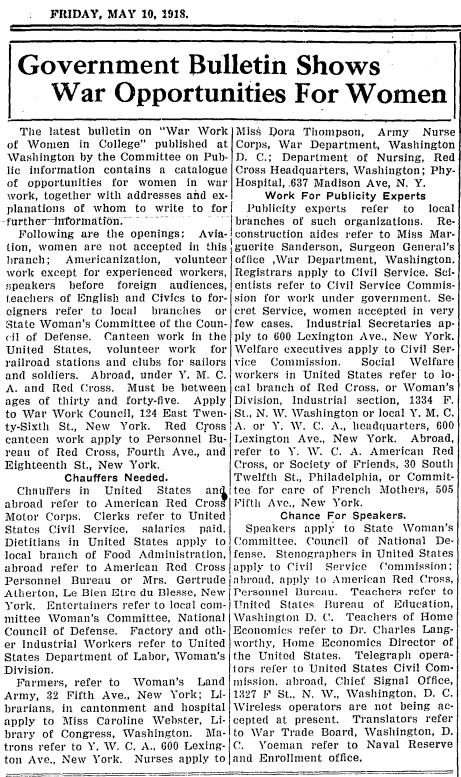
However, the onset of war forced men overseas or into different positions. Women were employed to fill these absences, and at the same time, fill an increased demand for the production of certain goods. These realities posed a problem for American production, and, throughout the country, women were encouraged to work in traditionally male-dominated industries such as manufacturing and agriculture. Wartime also saw an emergence of new needs, and in response, women labored in ammunitions factories and built war equipment like ships, planes, and tanks, among other work.
This was not an American phenomenon, of course, as women throughout Europe were filling empty factory roles while men left to serve in the war. Many American newspapers reported on the status of British, French, and German female laborers in agriculture and factory work, such as munitions factories, as early as 1914.
In America, over 1 million women worked in war industries during WWI, and over 6 million worked in war industries during WWII.
The Woman’s Land Army of America

The Woman’s Land Army (WLA) was a civilian organization founded in Britain in 1917. By December 1917, the Woman’s Landy Army of America (WLAA), modeled after the WLA, was formed in New York. American colleges and universities promoted the WLAA to female students, who, once enlisted, underwent 2-3 weeks training before living and working on a farm for the summer or after graduation. The WLAA primarily consisted of middle- and upper-class women, and these volunteers were called “farmerettes.” By 1918, the WLAA spread to over 30 states and the District of Columbia, each with their own state divisions. Between 15,000 and 20,000 women enlisted in the WLAA nationwide.
After WWI, the WLAA momentum slowed but continued to fill seasonal labor shortages on farms, according to an article in the Cairo Bulletin published March 26, 1919, particularly in fourteen states (Oregon, California, New Mexico, Michigan, Ohio, North Carolina, Virginia, Maryland, D.C., New Jersey, New York, Pennsylvania, Vermont, and New Hampshire). In Illinois, courses continued as a means of educating more women in the agricultural and domestic sciences industries:
The Woman’s Land Army of America resurfaced during WWII under the United States Crop Corps, a program within the U.S. Department of Agriculture. Between 1943 and 1945, an estimated 1.5 million women enlisted in the program. These women milked cows, grew crops, canned vegetables, drove tractors, picked fruit, and trucked produce, ensuring that the American food system continued to operate through the war.


- “Mrs. Blake Here to Work for Woman’s Land Army,” The Champaign Daily News, 30 May 1918, p.7 (link)
- “The Land Army of America: Women as Farm Hands” by Jesse Lynch Williams, published in the Cairo Bulletin, 23 June 1918, p.2 (link)
- “Women’s Land Army of America,” Ohio Farmer, 20 July 1918, p.19 (link)
- “Women the Only Solution of Farm Labor Problem,” Chicago Packer, 31 August 1918, p.12 (link)
- “California Women on Farms Successfully Execute Work Formerly Left to Their Men,” The Monmouth Daily Atlas, 30 September 1918, p.3 (link)
- “Woman Land Army to Keep on the Job,” Free Trader-Journal, 3 January 1919, p.2 (link)
- “I Was a Land-Army Farmerette: It Was Good Work and I Shall Always Be Happy When I recall the Fine Spirit of the Squads,” by Marguerite Wilkinson, Farmer’s Wife, 1 May 1919 (link)
- “Mrs. Roosevelt’s Plan for U.S. ‘Farmerettes’,” Manhattan American (Manhattan, Ill.), 18 December 1941, p.2 (link)
- “Women Suggested to Replace Men in Farm Work,” Daily Illini, 23 January 1942, p.2 (link)
IDNC keywords:
- “Land Army”
- “farmerette”
- “Woman’s Land Army”
- “Woman Land Army”
- “Women’s Land Army”
Women in wartime factories
Much like in the agricultural sector, in WWI and WWII, American women stepped into factory roles left vacant by men serving abroad or in other wartime capacities. This, paired with an increase in defense demand, meant an increase in production—necessitating more workers in specialized factories—a call to which American women responded. In addition to the production of common goods such as garments and food, women were employed in munitions factories, ordnance plants, and factories building ships and plane parts.

Woman Ordnance Workers at the Sangamon Ordnance Plant
Woman ordnance workers, or WOWs, came onto the scene in during WWII. Although women worked in similar factories prior to WWII, 1940s media ramped up the glamorization of WOWs in order to recruit more workers. Today, most people have an idea of who the cultural icon, Rosie the Riveter, was and what she represented.
Near the University of Illinois Urbana-Champaign, in a town called Illiopolis just off I-72, lies remnants of an ordnance plant. As I drive to my hometown to visit family, I pass the bunker-like cement arcs, and years of curiosity led me down an internet trail to figure out what had existed on the land.
The Sangamon Ordnance Plant employed WOWs starting at its inception in 1942. Unfortunately, I couldn’t find many articles about this specific plant in the newspapers available in the IDNC, but I did find one article:


- “Munitions Factories Increase Number of Women,” The Broad Ax, October 5, 1918, p.2 [link]
- IMAGE: No Ammunition?, Daily Calumet, January 12, 1944, p.2 [link]
- “Women Workers Increase,” Daily Illini, December 13, 1942, p.1 [link]
IDNC keywords and search queries:
- WOWS
- “ordnance” AND “women”
- “women munition workers” ~10 [or, however many words apart you’d want these words in a result]
- “women war industries” ~10 [or, however many words apart you’d want these words in a result]
- “women” AND “war industries” [use this for widening a search than the one above]
- “munitionettes” [not terribly common, but visit Chronicling America for more results]
Women in service
Some women joined the WWI war services through nursing in the army or Red Cross, serving as a “marine corps girl,” or serving as a “yeomanette” in the Navy. These numbers skyrocketed by WWII, in due part to the increase in opportunities to serve and the roles in which women could contribute. (According to one article I found in the Daily Illini from October 3, 1917, WAACS–or, as it was printed, Waacs–existed in WWI, though it is more commonly associated with WWI.)
WAAC and WAVES
In WWII, women began to serve in the armed forces in special capacities, such as within the auxiliary unit of the US Army called the Army’s Women’s Army Auxiliary Corps (WAAC, later the Women’s Army Corps, or WAC) and in the Women Accepted for Volunteer Emergency Service (WAVE), part of the US Navy. WAACs served primarily in non-combat roles such as switchboard and radio operators, mechanics, nurses and hospital workers, ordnance specialists, stenographers, photographers, and postal clerks, among other roles. Women in WAVES were responsible for clerical work, hospital work, engineering, and weather forecasting.

Young women signed up for WAACs and WAVES as a means of gaining employment experience but also in order to serve their country and support the war efforts. By the end of WWII, more than 350,000 women enlisted in WAACS and WAVES. Both groups demobilized after the war, however, in 1948, the Women’s Armed Services Integration Act was established, allowing women to enter the Army and Navy branches.

- “Waacs No Longer a Novelty in France,” Daily Illini, October 3, 1917, p.6 [link]
- “Women to Work in Plants Considered Non-Essential is Labor Board Plans,” East St. Louis Daily Journal, September 23, 1918, p.1 [link]
- “Woman’s Army Corps is Active in Many Important Jobs,” The Naperville Clarion, March 2, 1944, p.7 [link]
- “WAVES and WAACS,” Farmers’ Weekly Review, August 26, 1942, p.2 [link]
- “WAAC Officer Visits Dean, Col. Sparks,” Daily Illini, March 19, 1943, p.2 [link]
- “Roosevelt Congratulates WAACs on Birthday,” Daily Illini, May 16, 1943, p.1 [link]
IDNC keywords:
- yeomenettes
- Wacs
- Waacs
- WAC
- WAACS
- WAVES
- Woman’s Army Corps
- Women’s Army Auxiliary Corps
Advancement of women in the workforce
While wartime advanced women’s labor in the sense that many middle- and upper-class women were paid to work outside the home, these events were not reported on without the occasional use of sexist ideas and pushback suggesting that such work was bad for women’s health (as reported on in the Monmouth Daily Atlas, March 2, 1918), or rendered them unable to bear children (as briefly mentioned in the Chicago Live Stock World issue from July 31, 1916), or that they were unfit to fulfill certain jobs that only men could conduct.
However, wartime enhanced the opportunities for women to work outside the home, and provided an opportunity to shatter previous barriers or misconceptions of women in roles traditionally held by males. In fact, newspapers printed some articles boasting that women can do men’s work better than men, like this one from the Lacon Home Journal, published June 13, 1918 (albeit with a few gender conceptions):

Additional Sources:
Guepet, Haley. The WAVES of the US Navy. The National WWII Museum. 30 October 2024. https://www.nationalww2museum.org/war/articles/waves-us-navy
Maloney, Wendi. WWI: The Women’s Land Army. Library of Congress. Blog post. March 26, 2018. https://blogs.loc.gov/loc/2018/03/world-war-i-the-womens-land-army/
Reft, Ryan. The Women’s Land Army ‘Farmettes’ [sic] for Suffrage During World War I. PBS SoCal. October 13, 2015. https://www.pbssocal.org/history-society/the-womens-land-army-farmettes-for-suffrage-during-world-war-i
WAVES (United States Naval Women’s Reserve). National Park Service. n.d. https://www.nps.gov/articles/000/waves-united-states-naval-women-s-reserve.htm