Librarianship Under McCarthy: Mary Knowles’ Experience During the Red Scare

In the spring of 1953, Mary Knowles was fired from her position at the South Norwood Branch Library outside of Boston. Previously, Knowles had been called before the United States’ Senate Internal Security Subcommittee (SISS) and questioned about alleged communist activities during her 1945-1947 tenure at the Samuel Adams School for Social Studies, an institution on the US Attorney General’s list of subversive organizations.[1] Knowles invoked her fifth amendment right and refused to answer the subcommittee’s questions; although no action was taken against her by SISS, the South Norwood Branch Library terminated Knowles’ employment due to her refusal to testify.[2]

Continue reading “Librarianship Under McCarthy: Mary Knowles’ Experience During the Red Scare”
ALA Hidden Figures: Carrie Robinson

On May 14, 1969, Carrie Coleman Robinson, a Black school librarian in Alabama, brought a landmark case to the US District Court. After being passed over for a promotion, Robinson sued Alabama’s Department of Education alleging that she had been denied equal protection as a department employee because of her race. Robinson’s case, and long career as a librarian, reveals much about the Jim Crow South and librarianship in the civil rights era.

Continue reading “ALA Hidden Figures: Carrie Robinson”

Herb and Mary Biblo: “A Very Active Husband and Wife Team in Librarianship”

Despite missing Valentine’s Day, the ALA Archives can’t let the month of February go by without talking about Mary and Herbert “Herb” Biblo, one of the great couples in American Library Association history. Between the two of them, they contributed decades of service to ALA and established themselves as advocates for social justice within the association and the profession of librarianship. In an interview with Herb, Art Friedman, a friend, succinctly and accurately, summed Herb and Mary up as “a very active husband and wife team in librarianship.”

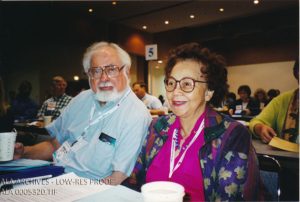
Herb and Mary Biblo sitting at a table.
Herb and Mary Biblo at the Council meeting during the 2001 ALA Annual Conference.

Continue reading “Herb and Mary Biblo: “A Very Active Husband and Wife Team in Librarianship””

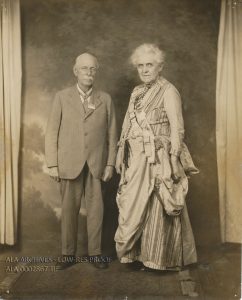
Henry and Edith Carr, ALA’s Golden Couple

Henry and Edith Carr pose for a photo ca. 1910, in fancy dress.

With Valentine’s Day fast approaching, the ALA Archives can’t help but think of love. The spirit of the holiday compels us to remember possibly the most famous ALA couple of all time, Henry and Edith Wallbridge Carr. Married for 43 years and active in the American Library Association for even longer, the Carrs were well-known within the library community of the late nineteenth and early twentieth century. Where did the romance of these two librarians begin? At an ALA conference, of course!

Continue reading “Henry and Edith Carr, ALA’s Golden Couple”

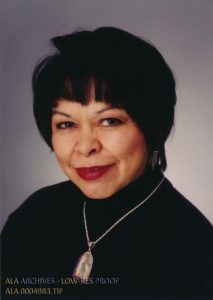
Elizabeth Martinez, ALA Executive Director

Portrait of Elizabeth Martinez, 1995
Portrait of ALA Executive Director Elizabeth Martinez
Found in 12/1/4, Box 2, Folder: Martinez, Elizabeth, 1995-97

Who was one of the first Mexican American librarians in California? Who was one of the co-founders of REFORMA, the National Association to Promote Library & Information Services to Latinos and the Spanish Speaking? Who was the first Mexican American women to hold the office of ALA Executive Director? If you answered, “Elizabeth Martinez,” you’d be correct!

Elizabeth Martinez was born on April 14, 1943 in Pomona, California. Growing up in Orange County, she always wanted to promote cultural understanding no matter what field she worked in. Martinez didn’t originally focus on working in libraries, but they held a special place in her heart since she was a child, as she often went to her local public library. However, while pursuing her Bachelor’s degree in Latin American studies at UCLA, she took a course in children’s literature to fulfill a credit. This course opened her eyes to the world of librarianship and her goal was set. She then graduated from the University of Southern California with a Master’s in Library and Information Science in 1966, becoming one of California’s first Mexican American librarians.[1]


Continue reading “Elizabeth Martinez, ALA Executive Director”

Committee on the Status of Women in Librarianship

Blog post by Lauren Quinlan

Librarianship is a field that has long been dominated by women. According to a fact sheet published by the Department for Professional Employees, women compromise 81% of enrollment in graduate library science programs, 82.8% of all librarians, and 75.9% of all library workers [8]. However, this dominance in terms of numbers has historically not translated to true equity in other dimensions.

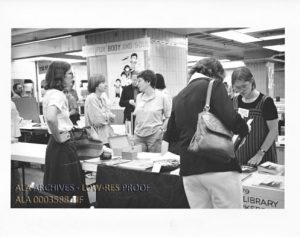
Conference attendees at the COSWL exhibit tables at the 1980 Annual Conference in New York (Record Series 81/2/10, Box 4)

According to a 1967 study of academic librarians, median salary differences between male and female librarians tend to widen as experience in the field increases – even when levels of education between the two groups are equal [4]. This study emerged at a time when roughly four out of five librarians in the United States were female, and the discipline of librarianship was gaining legitimacy, with some concerned that “librarianship cannot upgrade itself without upgrading opportunities for women… Nor should it expect to gain the public esteem that it seeks by tactically endorsing inequality of opportunity, and furthering, by its own inaction, the all-too-familiar image of librarianship as a passive, unchallenging, and low-paid profession” [4]. Continue reading “Committee on the Status of Women in Librarianship”

Publications: The Newsletters of Women in Libraries and Women Library Workers

Since 1970 the Women in Libraries Newsletter (and Women Library Workers Journal,1975-1993) have provided information resources for women working in libraries. Older issues are still information rich for current and future readers.

Read on to learn more about the art and history of Women in Libraries and Women Library Workers Newsletters!

Continue reading “Publications: The Newsletters of Women in Libraries and Women Library Workers”

The ALA Mexican Border Traveling Library Service

While most of the American Library Association Library War Service’s efforts were concentrated in camps and hospitals in the United States and Europe, there was also a need for books for the soldiers stationed along the Mexican border. Chalmers Hadley, the librarian of the Denver Public Library, surveyed the desire for books among soldiers at the border and found them wanting.

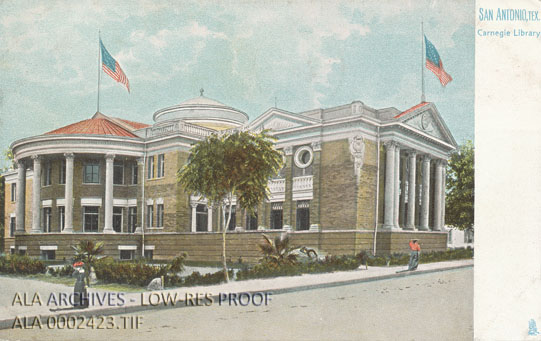
In early 1918, Hadley observed that, “It is vastly different to find thousands of men requesting books, and hanging on a promise of some … It will be a great misfortune to the men and a lost opportunity to the A.L.A. if the traveling libraries are not provided.” [1] To satisfy the demand for books, two traveling libraries were established by the ALA and headquartered in the San Antonio Carnegie Library and at the El Paso Public Library in Texas.

Continue reading “The ALA Mexican Border Traveling Library Service”

The Gift of Literacy: Lutie E. Stearns

In the middle of all of the holiday cheer, December is also a month for librarians across the country to think back on those who gave back to their communities.  The late Lutie Eugenia Stearns, born on September 13, 1866, influenced many within the field of librarianship.  With the holiday season upon us, who better to write about than a woman who selflessly dedicated her life to advocate for those whose voices went unheard?

Lutie Stearns began her career as a teacher in the Milwaukee Public Schools.  With her apt skills in book collecting, she soon caught the eye of the Milwaukee Public Library’s, Minnie M. Oakley.  After Minnie’s death in 1895, Stearns was then appointed head Librarian. Continue reading “The Gift of Literacy: Lutie E. Stearns”

Activism and Advocacy in ALA: Women’s Organizations

Found in RS 99/1/13
Theresa West Elmendorf, the first female president of ALA, elected in 1911.

There are several units within the American Library Association that support women in the library profession and as a whole. Many of these groups arose during the second wave of feminism in the 1960s-80s in response to political and social movements outside of the ALA. Women in librarianship wanted the predominately-female profession to be regarded with the same respect and pay scale as other professions as well as more equity in ALA leadership.

One of the first major committees that is still around today is the Committee on the Status of Women in Librarianship (COSWL). This committee came about after several years of advocating by ALA members and the eventual approval at the 1976 Centennial Conference in Chicago.[1] Initially, a proposal was presented during the 1974 Annual Conference[2] and then discussed by Council during the 1975 Midwinter Meeting.[3] The ALA Executive Board endorsed a set of guidelines put forward in 1976, drafted by a standing committee appointed by the ALA president.[4] The committee has a list of seven responsibilities, all of which support the growth of women inside and outside of the field of librarianship. COSWL also sponsors several research projects, publications, and subcommittees related to women in libraries, such as the Advance Women in Library Management, Minority Women Oral History Project, and the COSWL Study. ALA currently maintains a list of resources on the COSWL homepage related to women’s issues.

Continue reading “Activism and Advocacy in ALA: Women’s Organizations”