Mr. Linderfelt’s Trouble: Restoration to the Record, Part 2

“This isn’t a hoax, is it?”

That is what American Libraries editor, Arthur Plotnik, asked Professor Wayne Wiegand after receiving Wiegend’s unsolicited manuscript about disgraced and forgotten ALA President, Klas August Linderfelt.[1]

It was not a hoax. Wiegand became interested in Linderfelt’s story while researching his book, The Politics of an Emerging Profession: The American Library Association, 1876-1917.[2] Prior research on Linderfelt’s story was thin and incomplete, so Wiegand wrote a more vigorously investigated article. “The Wayward Bookman” ran in two parts in the March and April 1977 issues of American Libraries and remains one of the most complete histories of Linderfelt’s downfall.[3]

Continue reading “Mr. Linderfelt’s Trouble: Restoration to the Record, Part 2”
Mr. Linderfelt’s Trouble: ALA’s Lost President, Part 1

On April 28, 1892, the first librarian of the Milwaukee Public Library (MLP), Klas August Linderfelt, was summoned to a meeting with library trustees and Mayor Peter J. Somers. There, Linderfelt was accused of embezzling $4,000, to which he admitted guilt and was subsequently arrested.

Linderfelt’s arrest came as a shock to the library profession. Not only was he the head of the MLP, but he was also the president of both the American Library Association (ALA) and the Wisconsin Library Association (WLA). A longtime and active member of ALA, Linderfelt was well liked by his colleagues, leaving them reeling at his arrest. The news spread quickly in both the local and national press, with newspapers as far away as California, proclaiming, “Linderfelt in a Cell. The Public Librarian of Milwaukee Uses the City’s Cash.”[1]

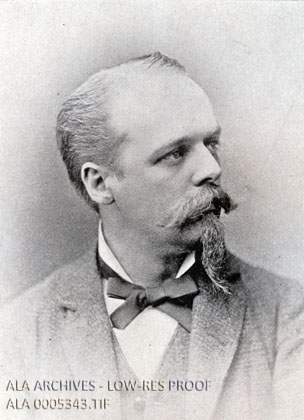
Klas A. Linderfelt
Portrait of Klas A. Linderfelt. Image ALA0005343.

Continue reading “Mr. Linderfelt’s Trouble: ALA’s Lost President, Part 1”

Herb and Mary Biblo: “A Very Active Husband and Wife Team in Librarianship”

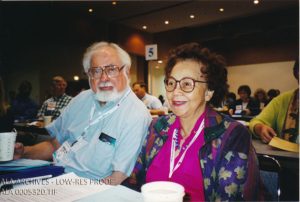
Despite missing Valentine’s Day, the ALA Archives can’t let the month of February go by without talking about Mary and Herbert “Herb” Biblo, one of the great couples in American Library Association history. Between the two of them, they contributed decades of service to ALA and established themselves as advocates for social justice within the association and the profession of librarianship. In an interview with Herb, Art Friedman, a friend, succinctly and accurately, summed Herb and Mary up as “a very active husband and wife team in librarianship.”

Herb and Mary Biblo sitting at a table.
Herb and Mary Biblo at the Council meeting during the 2001 ALA Annual Conference.

Continue reading “Herb and Mary Biblo: “A Very Active Husband and Wife Team in Librarianship””

Exhibit: ALA and School Librarians

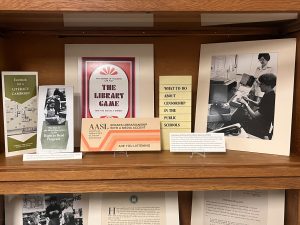
(From left to right) AASL pamphlets, cover of “The Library Game,” school librarians operating the DIALOG system


The ALA Archives has an exhibit this month curated by Ella McDonald in the Center for Children’s Books  at the School of Information Sciences. The exhibit opens on October 4th for the Association of Illinois School Library Educators (AISLE) conference and explores the history of school librarians and the role of the American Association of School Librarians (AASL), a division of the American Library Association. You can see a preview of the exhibit here but make sure to stop by the Center for Children’s Books to view the exhibit. You can also visit the American Library Association Archives to find more materials about school librarians in the United States. Continue reading “Exhibit: ALA and School Librarians”

Henry and Edith Carr, ALA’s Golden Couple

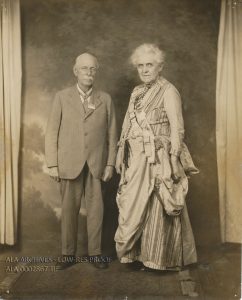
Henry and Edith Carr pose for a photo ca. 1910, in fancy dress.

With Valentine’s Day fast approaching, the ALA Archives can’t help but think of love. The spirit of the holiday compels us to remember possibly the most famous ALA couple of all time, Henry and Edith Wallbridge Carr. Married for 43 years and active in the American Library Association for even longer, the Carrs were well-known within the library community of the late nineteenth and early twentieth century. Where did the romance of these two librarians begin? At an ALA conference, of course!

Continue reading “Henry and Edith Carr, ALA’s Golden Couple”

15 Years of Fear: The ALA and the Patriot Act

This blog post is part of a series exploring the important events and people in ALA’s history for the celebration of the 150th anniversary of ALA in 2026.

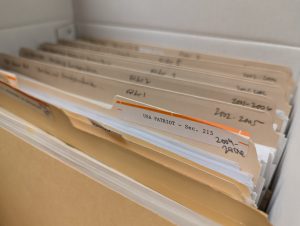
Folders about the USA PATRIOT Act from the ALA Office for Intellectual Freedom Subject File at the ALA Archives.
USA PATRIOT Act files in the Office for Intellectual Freedom Subject File at the ALA Archives.

October 26, 2001, marked the beginning of a 15-year-long struggle for the privacy rights of library users as a result of the USA PATRIOT Act being signed into law by President Bush. The Uniting and Strengthening America by Providing Appropriate Tools Required to Intercept and Obstruct Terrorism Act, colloquially known as the Patriot Act, expanded surveillance and investigation capabilities of law enforcement to combat terrorism after the attack on September 11th.[1] Included in the bill was Section 215, which became known as the “library provision” as it allowed intelligence agencies to “obtain information about members of the public, including library records, based on a minimal submission to a secret court.”[2]

Continue reading “15 Years of Fear: The ALA and the Patriot Act”

Harry Clemons: The ALA in Siberia

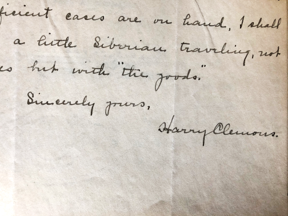
Harry Clemons signature.

During World War I, most ALA operated libraries were stationed in US based military camps. However, a small number of librarians were sent overseas to help distribute books and run libraries. Harry Clemons was one such librarian.

In November 1918, M. L. Raney, director of the Library War Service’s overseas service, sent a cable message to Professor Harry Clemons with a simple question, “Will you accept appointment [of] official representative [of the] American Library Association … to develop library service for American forces in Russia? Books being shipped steadily.”

Clemons replied, “Will attempt library service starting when you direct.” Continue reading “Harry Clemons: The ALA in Siberia”

It Runs in the Family

This month saw the passing of Satia Marshall Orange, former director of what is now ALA’s Office for Diversity, Literacy and Outreach Services (ODLOS). I had the good fortune to meet Orange early in my career, back in 2015, when she donated her father’s papers to the University of Illinois Archives. The then Assistant University Archivist, Chris Prom, planned to make the trip up to Chicago to see Orange and review her father’s papers. I asked to tag along as the ALA Archivist after hearing that Orange was a retired ALA staff member and that her late father was a librarian. She welcomed both of us into her home and was delighted to look through her father’s papers with us, share family stories, and was eager to preserve the legacy of her family.

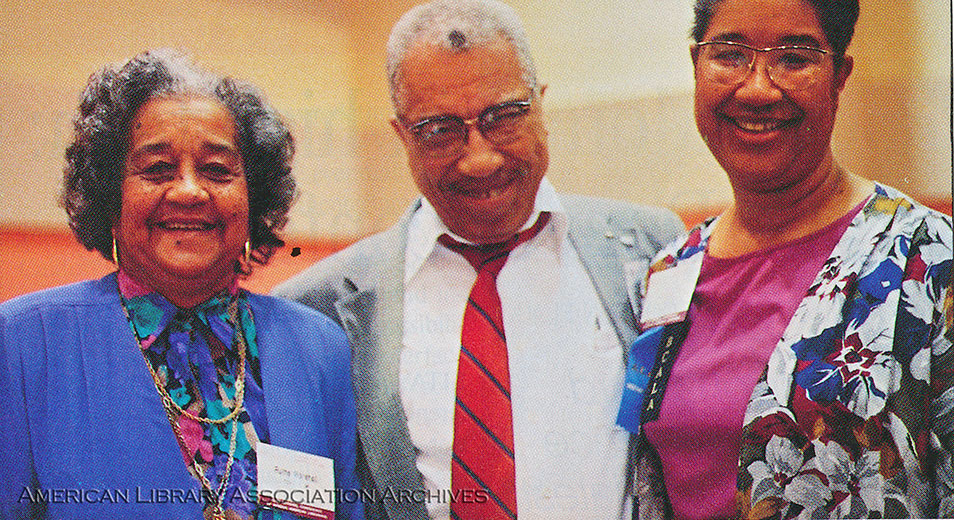
Ruthe and A.P. Marshall with their daughter, Satia Marshall Orange, at the 1992 National Conference of African American Librarians.

Continue reading “It Runs in the Family”

Eldon Ray James Oral History

Starting early this fall, as the ALA Archives Graduate Assistant, I had the privilege of transcribing the oral history of Eldon Ray James, retired librarian, formerly incarcerated person, and advocate for the rights of incarcerated people. After transcribing over three hours of dialogue between Ray James and Deputy County Librarian at the Alameda County Library, Deb Sica, I believe I just got paid to listen to the most interesting story I’ve ever heard.

Ray James, before becoming a figurehead in the movement to secure information access for incarcerated people in the United States, served in Germany during the Vietnam War, ran for office in the Colorado House of Representatives, won awards for his amazing journalism in multiple publications, and was reportedly a part of the (unconfirmed) first interracial double date in Baylor University history. He did all of this before being sentenced to 70 months in prison for aiding in the distribution of cocaine and methamphetamines. Continue reading “Eldon Ray James Oral History”

The Rabbits’ Wedding: Emily W. Reed and the Freedom to Read

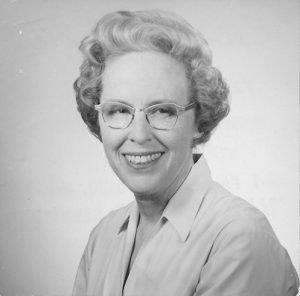
Black and white portrait of Emily Wheelock Reed
Emily Wheelock Reed

The Rabbits’ Wedding, by Garth Williams, is a children’s book about two rabbits getting married in a forest. While there doesn’t seem to be much to object about the book, in 1959, Alabama State Senator E.O. Eddins wanted it removed from Alabama public libraries. The reason was because the rabbits in the story were of different fur colors, black and white, and he viewed it as “integration propaganda.”

Emily Wheelock Reed, the Director of the Public Library Service Division of Alabama, met with Eddins and the Alabama State Senate Interim Taxation Committee to discuss the upcoming budget in March of 1959. Eddins, however, wanted to speak about several books in the public libraries that he thought dealt with segregation and communism. Reed deflected, but she was confronted by Eddins again several months later and he demanded The Rabbits’ Wedding be removed from the libraries. Reed refused to abide by his demands [1]. Continue reading “The Rabbits’ Wedding: Emily W. Reed and the Freedom to Read”