Mr. Linderfelt’s Trouble: ALA’s Lost ALA President, Part 1

On April 28, 1892, the first librarian of the Milwaukee Public Library (MLP), Klas August Linderfelt, was summoned to a meeting with library trustees and Mayor Peter J. Somers. There, Linderfelt was accused of embezzling $4,000, to which he admitted guilt and was subsequently arrested.

Linderfelt’s arrest came as a shock to the library profession. Not only was he the head of the MLP, but he was also the president of both the American Library Association (ALA) and the Wisconsin Library Association (WLA). A longtime and active member of ALA, Linderfelt was well liked by his colleagues, leaving them reeling at his arrest. The news spread quickly in both the local and national press, with newspapers as far away as California, proclaiming, “Linderfelt in a Cell. The Public Librarian of Milwaukee Uses the City’s Cash.”[1]

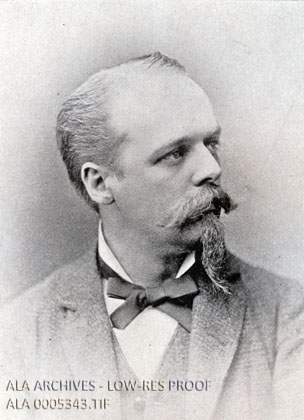
Klas A. Linderfelt
Portrait of Klas A. Linderfelt. Image ALA0005343.

Letters between ALA leaders reveal that Linderfelt’s resignation as ALA President was immediately on their mind. Newberry librarian, William F. Poole, an intimate friend of Linderfelt, wrote to Melvil Dewey on May 1, “I hope that Mr L[inderfelt] will send his resignation in the asso. before the 16th. That it will be quietly accepted and Mr. Fletcher be made full President.”[2] Dewey agreed with the idea and noted that it would be for the best if the topic of the “dreadful episode” was avoided at the ALA conference just weeks away.[3]

The ALA Executive Committee moved quickly on the matter and by May 2, convening at the house of the ALA Secretary, Frank P. Hill. There they would discuss “Mr. Linderfelt’s trouble.”[4] Weeks later, on May 22, Hill reported that he had received Linderfelt’s resignation and that it would “take effect from the time of election.” W. I. Fletcher, the librarian of Amherst College and an ALA vice-president, was then recorded as ALA President for the entire term 1891-1892 term, thus erasing Linderfelt’s presidency. Professor Wayne Wiegand observed that, “The matter was handled so expeditiously that it was apparent the committee had already decided on a course of action at its ‘unofficial’ May 2 meeting at Hill’s house.”[5] The consequences of these actions was that Linderfelt would not be documented as a past president and his name was stricken from ALA’s official records.

Linderfelt and his arrest were not brought up in the proceedings for the 1892 annual conference, an event he would have presided over. Though Fletcher, his replacement, alluded to the incident in his presidential address, “The peculiar circumstances under which I assume this position will, I am sure, be sufficient to excuse the desultoriness of the few remarks which, on so short notice, I have been able to throw together for your consideration this evening.”[6] In his address, he mentioned a couple times that he had only a few days to assume the duties as president, but otherwise did not bring up his predecessor. While ALA had washed their hands of Linderfelt, outside of association business, his librarian friends had not given up on him. Leaders in the profession wrote letters on his behalf that would later be used in his defense, and he was offered a position at Library Bureau, a company founded by Dewey, in Boston, if he was cleared of his charges.[7]

ALA wasn’t the only library association impacted by Linderfelt’s disgrace. He also left the WLA leaderless only a year into its founding and caused the WLA to skip holding annual conferences in 1892 and 1893, putting the association in crisis.[8]

Group gathered in the woods.
ALA members at the Wisconsin Dells, including Klas A. Linderfelt. Image ALA0003557.

That July, Linderfelt appeared in court for his embezzlement. However, despite his confession, he would see no prison time for stealing what ended up being over $9,000 (over $326,000 in 2026), over double what was previously estimated.[9] Instead, the judge gave him a suspended sentence and Linderfelt walked out of the courthouse as a free man. There was immediate outrage in Milwaukee over the lack of punishment and the District Attorney quickly moved to file new charges against Linderfelt.[10]

On July 16, Linderfelt was in Boston to take the job offered to him at Library Bureau.[11] A couple of days later, the order for his arrest was issued in Boston, but the librarian was nowhere to be found. By July 20, The Boston Globe was asking “Where is Linderfelt? Visited Public Library Saturday and Has Since Disappeared.”[12] Somehow, Linderfelt discovered the orders for his arrest and this time decided to flee the country to Europe.

With his flight from justice, Linderfelt disappeared from the lives of his librarian friends and, with his name stricken from the record, he also disappeared from the memory of the profession. Almost.

To be continued.


For a more detailed and the most rigorously researched account of Linderfelt’s trouble, read Wayne Wiegand’s “The Wayward Bookman” in American Libraries volume 8, issues 3 and 4 (March and April 1977).

[1] “Linderfelt in a Cell,” The San Francisco Examiner (San Francisco, California), April 29, 1892, p. 1.

[2] William F. Poole to Melvil Dewey, May 1, 1892, W.L. Williamson – William F. Poole Research Papers, Midwest-MS-Williamson, Box 5, Folder: 1892 Correspondence, The Newberry Library – Modern Manuscripts and Archives Repository.

[3] Melvil Dewey to William F. Poole, May 5, 1892, NL Archives 03/01/01/01, Box: 7, Folder: 414 – Dewey, Melvil. Newberry Library Archives, NL-Archives. The Newberry Library – Modern Manuscripts and Archives.

[4] Frank P. Hill to George W. Cole, April 30, 1892, George W. Cole Papers, series 2/3/20, Box 1, Folder: Correspondence, 1891-1893, American Library Association Archives.

[5] Wayne Wiegand, “The Wayward Bookman,” American Libraries 8, no. 3 (March 1977): 137.

[6] W. I. Fletcher, “President’s Address,” Papers and Proceedings of the Fourteenth General Meeting of the American Library Association (Boston: 1892): 1.

[7] Wayne Wiegand, “The Wayward Bookman, Part II,” American Libraries 8, no. 4 (April 1977): 198

[8] Larry T. Nix, “Disaster Strikes the News Created Wisconsin Library Association,” Wisconsin Library Heritage Center, March 24, 2016: https://heritage.wisconsinlibraries.org/entry/disaster-strikes-the-newly-created-wisconsin-library-association/

[9] Wiegand, 197.

[10] Ibid, 197-198.

[11] “May Come to Boston,” The Boston Globe, July 14, 1892, p. 4.

[12] “Where is Linderfelt?” The Boston Globe, July 20, 1892, p. 5.

Librarianship Under McCarthy: Mary Knowles’ Experience During the Red Scare

In the spring of 1953, Mary Knowles was fired from her position at the South Norwood Branch Library outside of Boston. Previously, Knowles had been called before the United States’ Senate Internal Security Subcommittee (SISS) and questioned about alleged communist activities during her 1945-1947 tenure at the Samuel Adams School for Social Studies, an institution on the US Attorney General’s list of subversive organizations.[1] Knowles invoked her fifth amendment right and refused to answer the subcommittee’s questions; although no action was taken against her by SISS, the South Norwood Branch Library terminated Knowles’ employment due to her refusal to testify.[2]

Continue reading “Librarianship Under McCarthy: Mary Knowles’ Experience During the Red Scare”

ALA Hidden Figures: Carrie Robinson

On May 14, 1969, Carrie Coleman Robinson, a Black school librarian in Alabama, brought a landmark case to the US District Court. After being passed over for a promotion, Robinson sued Alabama’s Department of Education alleging that she had been denied equal protection as a department employee because of her race. Robinson’s case, and long career as a librarian, reveals much about the Jim Crow South and librarianship in the civil rights era.

Continue reading “ALA Hidden Figures: Carrie Robinson”

Herb and Mary Biblo: “A Very Active Husband and Wife Team in Librarianship”

Despite missing Valentine’s Day, the ALA Archives can’t let the month of February go by without talking about Mary and Herbert “Herb” Biblo, one of the great couples in American Library Association history. Between the two of them, they contributed decades of service to ALA and established themselves as advocates for social justice within the association and the profession of librarianship. In an interview with Herb, Art Friedman, a friend, succinctly and accurately, summed Herb and Mary up as “a very active husband and wife team in librarianship.”

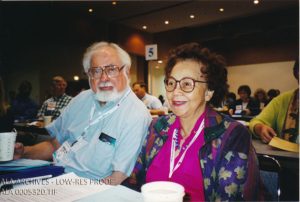
Herb and Mary Biblo sitting at a table.
Herb and Mary Biblo at the Council meeting during the 2001 ALA Annual Conference.

Continue reading “Herb and Mary Biblo: “A Very Active Husband and Wife Team in Librarianship””

“The Gross Misrepresentation”: An Accusation of Communism in Punxsutawney

In late 1955, the American Legion John Jacob Fisher Post in Punxsutawney, Pennsylvania, attacked the local library in their newsletter and in a letter presented to the borough council. The catalyst for this attack was the adoption of the Library Bill of Rights by Punxsutawney Free Library’s board.

In the December 1955 issue of the Legion News published by the John Jacob Fisher Post, Legion member Pete Wehrle wrote an editorial attacking ALA as a communist front. The editorial questioned if the American Legion Post would stand for the library board to “tie up with a Red Front organization” such as the ALA, to which it said no. The editorial used combative language against the library board, saying: “In short folks we are going to do a job on this matter. We will pick the field and the time and place of the fray. We will also pick the method – these things are always the prerogative of the assult (sic) force.”[1] Continue reading ““The Gross Misrepresentation”: An Accusation of Communism in Punxsutawney”

International Origins in Williamstown

In 1949, a petition was brought to ALA Council during the Midwinter Meeting to form the Round Table on Library Service Abroad. The petition was approved and thus officially began what was later known as the International Relations Round Table (IRRT). However, IRRT’s origins can be traced to a year earlier in 1948 to the (confusingly named) International Relations Round Table on Library Service Abroad, a conference held at Williams College in Williamstown, Massachusetts. Also called the Williamstown Conference, its resounding success laid the foundation for IRRT.

In February 1948, the ALA International Relations Office (IRO) sent out a questionnaire to librarians on its Foreign Library Service Roster. The last question asked, “Would you be willing to attend, at your own expense, a ‘guinea pig’ session, devoted to the international aspects of library work …?”[1] 100 librarians affirmed their unreserved interest in the “guinea pig” session, while others noted their interested dependent upon funding.[2] With a strong response to the question, Helen Wessells, associate director of IRO, started planning. Continue reading “International Origins in Williamstown”

1876 Librarians’ Conference Scrapbook

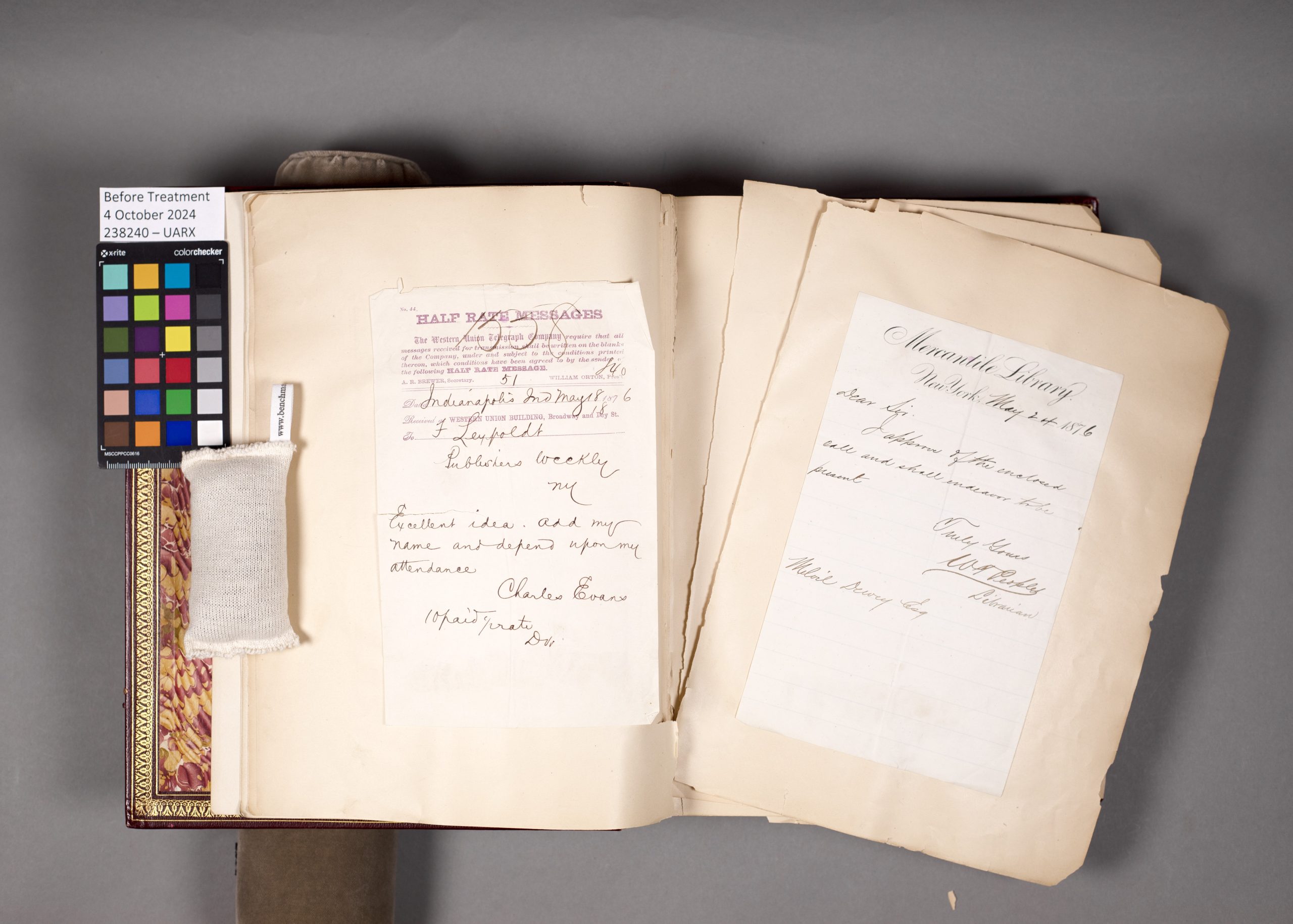
In 1926, during the fiftieth anniversary of the American Library Association, the Boston Public Library presented ALA with a scrapbook of letters, postcards, and documents tracing the origins of the Librarians’ Conference of 1876, the start of the association. The letters were kept by Melvil Dewey and Justin Winsor, prominent organizers of the conference, and later assembled into a scrapbook by someone at the Boston Public Library (BPL) in 1877, where Winsor had served as superintendent.[1] Preceding ALA’s fiftieth anniversary, Charles Belden, then director of BPL, convinced the BPL trustees to have the scrapbook rebound and transferred to ALA during its anniversary celebrations, for which Belden was the presiding president.[2]

Scrapbook with detached pages.
The scrapbook in its original binding with detached pages.

Continue reading “1876 Librarians’ Conference Scrapbook”

Librarians Go on a Road Trip! The 1926 Foreign Delegate Post-Conference Excursion

A group of foreign delegates in Atlantic City during the ALA Fiftieth Anniversary Conference, October 1926.

In early October 1926, almost sixty librarians from twenty-five countries gathered in Atlantic City and Philadelphia to celebrate the fiftieth anniversary of the American Library Association along with over two thousand American librarians.[1] By all accounts, the conference was a great success.[2] The international delegates held sessions on foreign librarianship and participated in discussions about improving international relations among librarians. But the best part of this all-expenses-paid trip to the US didn’t happen during the actual meeting: when the conference ended, about thirty international delegates went on a multi-state excursion, visiting twelve cities in the span of two weeks. From Atlantic City to Boston, Chicago to Washington, D.C., the delegates traveled by bus, train, car and steamer to see as much of the US as possible—and as many libraries as possible—ensuring they would return home with minds brimming full of library innovations and international amity.

Continue reading “Librarians Go on a Road Trip! The 1926 Foreign Delegate Post-Conference Excursion”

“No Censorship at Any Time”: The 1953 Westchester Conference

In early May 1953, a group of 25 representatives from the American Library Association, the American Book Publishers Council (later the Association of American Publishers), and other associated citizens, met in Rye, New York to discuss the fundamental freedom to read. This “Westchester Conference,” named after the Westchester Country Club meeting place, was a resounding success. Out of this conference grew one of the most important and well-known policies of the American Library Association: the Freedom to Read Statement. Continue reading ““No Censorship at Any Time”: The 1953 Westchester Conference”