On August 25, 1899, Robert Kilbourn of the H. Parmelee Library Company wrote to ALA President Reuben G. Thwaites, alerting him that a small commercial traveling library was operating under the name “The American Library Association.” Kilbourn noted that while the traveling library was not outright fraudulent, it was “of a bad character, and deceives the people who patronize it.” He described the owner as a “a person of questionable character and unsavory reputation. Authorities advise us that his not to be trusted.”[1]
The questionable character and unsavory reputation was Reverand George F. Nason, of Franklin, Kentucky. He made himself known to the H. Parmelee Library Company by asking to become one of their agents, but the company declined his services.[2] Afterwards, Nason established his own traveling library company while helping himself to ALA’s name and lifting content from H. Parmelee Library Company’s own publications.[3] Worried about the poor quality of the materials Nason sold to communities and the potential damage to the reputation of traveling library companies as a whole, Kilbourn brought the matter to ALA’s attention.
ALA Secretary Henry Carr reached out to Nason about the infringement of using ALA’s name for his company. Carr noted that ALA was generally well known and that “therefore it seems hardly possible that any one [sic] would undertake to assume our name unless intending to mislead, or to carry on something not legitimate.”[4] Nason immediately pled ignorance about the existence of another American Library Association. He tried to reassure Carr that he was operating a legitimate business and that he had no desire to “sail under false colors.” He then proposed to change his company’s name to the “National Library Association.” [5]
Carr wrote back, expressing that he didn’t want to question Nason’s good faith in saying that he didn’t know about ALA, but found it difficult to understand considering that ALA had been established for over twenty years and their work with the public. Still, Carr said that the ALA Executive Board didn’t object to his business, but they did take umbrage of the use “Library Association” in the proposed company name. Carr rightfully pointed out that Nason’s business was not a library association and as a commercial company, could not be one.[6]
In a letter to H. Parmelee dated the same day as his letter to Nason, Carr further expressed his doubts about Nason. He wrote, “This plea it seems to us rather hard to take much stock in, but his good faith will be shown by what he may do in the immediate future. If he is inclined to ‘see the error of his ways,’ and cease to use the Association name, we shall have to be content, I presume.”[7]
Nason did not take Carr’s response kindly:
We think you adopt a rather “high and might” style in both of your letters to us. This last letter seems to be full of insinuations and inuendos [sic] for which you have absolutely no ground. It has more for a style of a judge reprimanding and passing sentence on a criminal than that of a business letter from one party to another.[8]
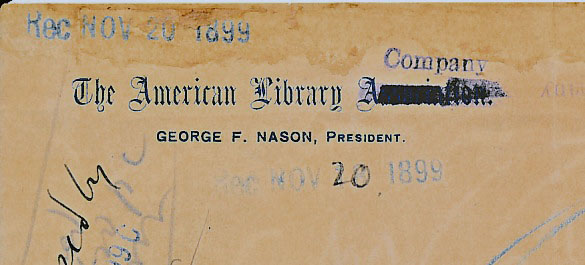
He nonetheless recognized ALA’s right to its name and said that his company’s name was changed to the “American Library Company,” saying that “There can be no sane challenge to our right to this name.”[9] In his closing remarks, he wrote that if Carr wished for any further correspondence, which he did not, that Carr should “kindly enclose stamp for reply.” In the header of Nason’s letter, one can see The American Library Association with the Association blotted out and a stamped Company above it.[10]
Carr merely acknowledged his response and trusted this was the end of the matter. He did not seem to enclose a stamp for Nason’s reply.[11]
Thwaites found humor in the situation, writing to Carr, “Your Kentucky correspondence is truly delightful. For imprudence, and downright mendacity, he is monumental; he is an artist in his line, as witnesseth his closing sentence in letter of Nov. 17, in which he waves you off in the manner of Micawber spurning the contact of a creditor.”[12]
Thus ended the curious case of the two American Library Associations.
All letters found in record series 2/4/20, Henry J. Carr Papers, 1889, 1898-1904, 1906, Box 3, Folder: Thwaites, 1898-1900, American Library Association Archives.
[1] Robert Kilbourn to Reuben Thwaites, August 25, 1899.
[2] Robert Kilbourn to Henry Carr, October 3, 1899.
[3] Ibid.
[4] Henry Carr to George Nason, October 10, 1899.
[5] George Nason to Henry Carr, October 13, 1899.
[6] Henry Carr to George Nason, November 14, 1899.
[7] Henry Carr to H. Parmelee, November 14, 1899.
[8] George Nason to Henry Carr, November 17, 1899.
[9] Ibid.
[10] Ibid.
[11] Henry Carr to George Nason, November 20, 1899.
[12] Reuben Thwaites to Henry Carr, December 5, 1899.