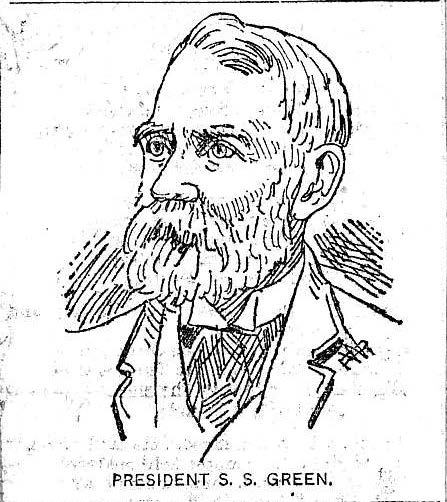
Sketch of S. S. Green from the Los Angeles Times, Oct 24, 1891.
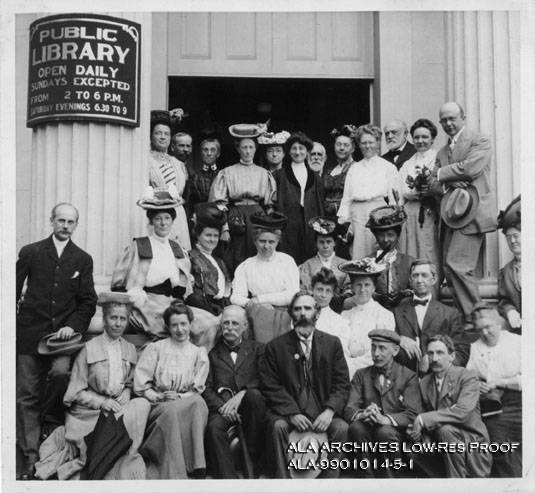
In October 12-16 of 1891, the first ALA Annual Conference in San Francisco was held. It was the first conference to be held on the Pacific Coast and 83 people were in attendance, with Samuel Swett Green presiding as president. Even after over a hundred years, some of the topics discussed during the sessions would not be out of place at the 2015 Annual Conference. ALA members talked about library architecture, library administration, the use of libraries in schools, library legislation, and public support for public libraries. Continue reading “Tour of the ALA to the Pacific Coast”→
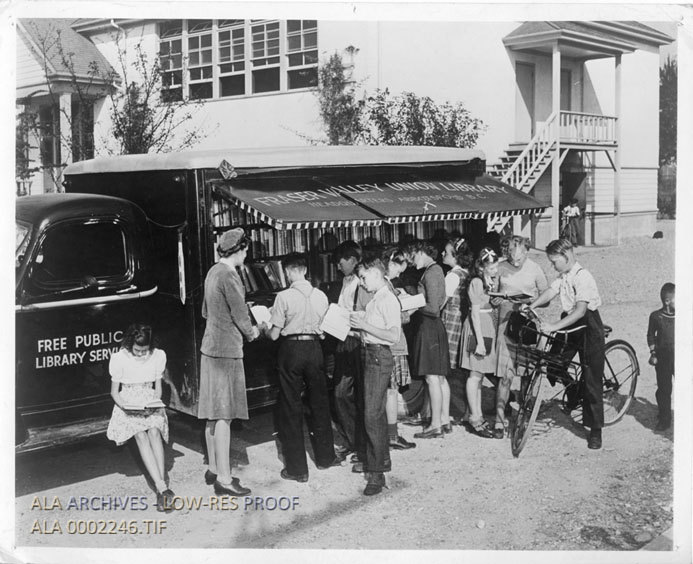
Fraser Valley Union Library Bookmobile. Found in record series 18/1/57, Box 5, Folder: Bookmobile – Outside Shelving, 1939-1976
A relatively new addition to National Library Week, the first National Bookmobile Day was celebrated in 2010, to recognize over one hundred years of service that bookmobiles and direct-delivery outreach services have contributed to bringing information, technology, and resources to all readers.[1]
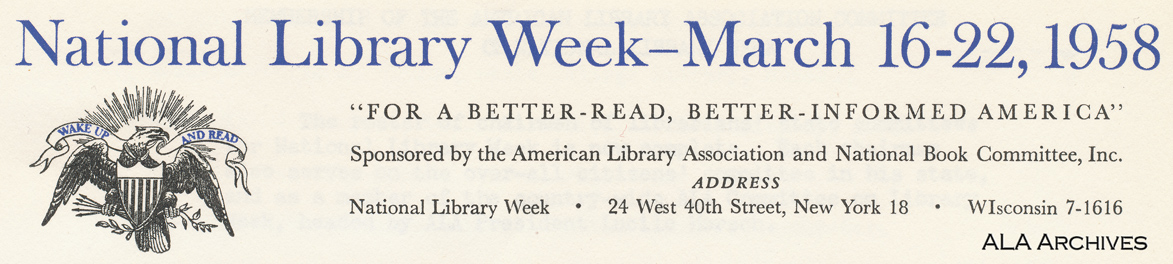
Sponsored by the National Book Committee, Inc., and in cooperation with the American Library Association, the first National Library Week was launched on March 16-22, 1958. Citing a 1957 survey showing that only 17% of Americans polled were reading a book, the inaugural National Library Week slogan was “Wake Up and Read!” The National Library Week initiative was the first nationwide effort to promote literacy for personal and national improvement, to celebrate the role of libraries in making reading materials accessible to everyone, and to highlight the varied career opportunities available within the library profession.[1]
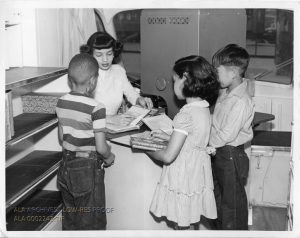
Original caption: “LOS ANGELES, October, 1949 – Elementary school pupils William Bias, Elizabeth Coggins and Jerry Sekido think it’s pretty interesting to watch Nellie Greene charge out their library books with the new Recordak charger on the Children’s Traveling Branch, operated by the Los Angeles Public Library.”
In the midst of the Civil Rights era in America, librarians were battling for and against segregated libraries in the South, however they were also battling over integration within their own ranks. Integration of the library profession was a long process that started in the early 20th century. Continue reading “Action, Not Reaction: Integrating the Library Profession”→
Party like it’s 1906! Image from the F. W. Faxon Collection
A recent acquisition to the archives is a small packet containing the bylaws and related documents of the ALA Players (“ALAP”). As described in the ALA Archives transmittal form, the ALAP was established when a huge snowstorm descended during the Midwinter conference of 1978, causing the group to be snowed in and looking for ways to occupy their time. The documents reflect the playful attitude of the members during their confinement. The ALA Players “continued for many years with dancing on Tuesday (or other) nights of each conference.” Continue reading “Snowed in at Midwinter: the ALA Players”→
Today marks the 45th anniversary of the ALA founding the Freedom to Read Foundation, a non-profit organization that defends the First Amendment as it relates to libraries, books, the Internet, and library users. An off-shoot of the ALA’s Office of Intellectual Freedom (itself founded only two years prior), the Freedom to Read Foundation focuses its efforts primarily on defending librarians, book publishers, teachers, and other people who are in court due to controversial material, while the Office of Intellectual Freedom focuses on outreach, advocacy, and raising awareness of First Amendment issues. Continue reading “Freedom to Read Foundation: 45 Years”→
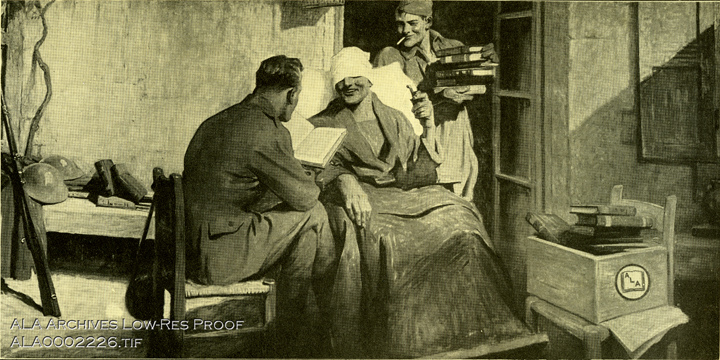
Painting by Denman Fink, commissioned by the ALA for the United War Work Campaign, 1919. Record Series 89/1/60, Box 1, Folder: “ALA Library War Service Special Publications (1919)”
“[T]he blind soldier is the spirit of war, of the battlefront, of France,” said Jerry O’Connor, a blinded Cantigny veteran from World War I, during his award-winning speech titled The Duty of the Blind Soldier to the Blind Civilian at the Red Cross Institute for the Blind’s Public Speaking Contest in 1920. “We have the mud of the trenches upon our feet, gold chevrons upon our sleeves, and the scars of War upon our faces. Whether we deserve it or not, people stare at us, send us gifts, invite us to their homes, give us sympathy. Such circumstances place the blind soldier in a position where, when he speaks, he can be heard. Consequently, if the conditions of the blind can be improved, the blind soldier should speak – and be heard.” Identifying two major obstacles for blind people as “the habit of the public to look upon the blind man as incapable, sensitive, and helpless” and the lack of educational opportunities for the adult blind person, O’Connor called for public programs to address these obstacles for the blind. One of the institutions responding to this call for action would be the American Library Association. Continue reading “Library Service for the Blind”→
Burton Egbert Stevenson (1872-1962) was surprised to find himself named the foremost ALA representative in Europe for the Library War Services campaign during the first World War. A college dropout from Princeton University and aspiring novelist, he fell into the library profession after marrying Chillicothe Public Librarian, Elisabeth Shephard Butler and accepting a librarian position at the same library in 1899. Continue reading “Burton E. Stevenson: ALA Representative in Europe”→
Reference librarians on duty at the Library/USA exhibit
Three years before the founding of OCLC, and seven years before Michael Hart typed the first ebook for Project Gutenberg, the public got a tangible introduction to the potential use of computers in libraries at the New York World’s Fair. Even more uniquely, the Library/USA exhibit did not introduce people to the first commonly-spread use of computer technology in libraries, the online catalog, but instead to some of the library computer applications that would come much later, such as online encyclopedias and subject bibliographies. How did the ALA orchestrate this little slice of the future? Continue reading “Library/USA Exhibit at the 1964-5 New York World’s Fair”→
In 1962, the Knapp Foundation, Inc., provided a $1,130,000 grant administered to the American Association of School Librarians (AASL), a division of ALA, to raise the standards of school libraries. At that time, school libraries in the United States were noted to be substandard. While federal funds helped to fund school libraries in 1958, the AASL realized that school libraries needed more than money to fix their problems. Improvements were needed in collection development, updates in technology, more staff, and renovations in facilities.
A busy school library at Central Park Road School in Plainview, NY. RS: 99/1/18
The five year Knapp School Libraries Project started in 1963. The project had four objectives: The first was to demonstrate the educational value of school libraries. The second was to promote improved understanding and use of library resources by teachers and administrators. The third objective was to guide other libraries to develop their own programs by having them observe the demonstration schools. And the last objective was to increase interest and support for school library development by producing and circulating information about the program and the demonstration schools.[1] Continue reading “Knapp School Libraries Project”→