Continuing our coverage of ALA during World War I, this post will highlight the now very rare uniforms of the first military librarians. The Library War Service was not unique in having a uniform, as many volunteer groups active in World War I had their own distinctive uniforms, notably the Red Cross and the Salvation Army. However, World War I was the first war when many women had the opportunity to wear a uniform while serving their country, and these particular uniforms are especially interesting: as they embody a time in which women were were first starting to get official status within the military, as well as beginning to exert more power in the leadership of librarianship in general and ALA in particular.
Blog
New Accessions at the Archives

The ALA Archives has been busy working on large accessions of records sent to us by American Libraries magazine and the ALA Library. These new accessions will total up to 40 bankers boxes once all of them have been shipped over, and the archives staff is excited to receive them.
The archives staff is currently working on boxes sent to us from the ALA Library. These records are a rich collection of photograph vertical files that not only document the history of the ALA, but of the librarian profession itself. There are of course photos and negatives of various ALA conferences, events, and staff, but there are also photographs of bookmobiles, libraries, exhibits, various library technologies, and even book trucks! Continue reading “New Accessions at the Archives”
Library War Service slides collection now online and browsable
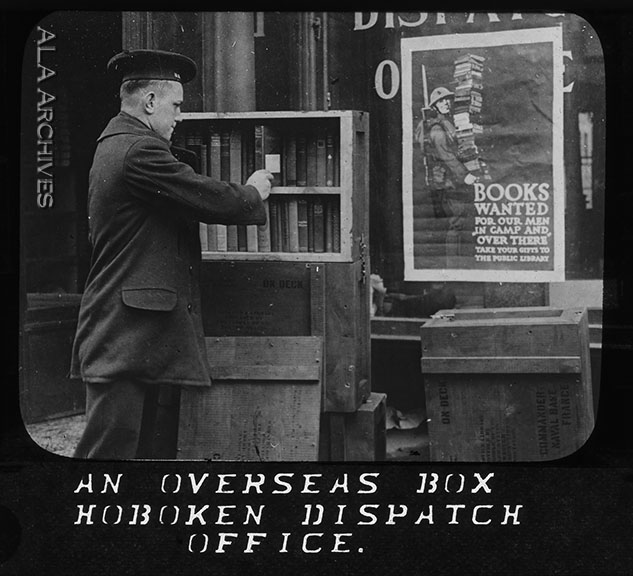
While the battles, uniforms, and weapons that made up a World War I serviceman’s life are very well documented in the history books, the day-to-day monotony of a soldier’s life doesn’t often get as much attention. The ALA Archives has recently migrated our collection of digitized lantern slides from World War I into the CONTENTdm system, which shows one way these men filled their downtime: reading.
View the complete Library War Service images collection here.
Continue reading “Library War Service slides collection now online and browsable”
Audiovisual Collections at the ALA Archives
Often when we think of archives, we automatically think of the paper items which document the decisions and actions of an organization or individual; be they correspondence, agendas, or photographs. But the ALA Archives also contains audiovisual materials, which can bring can bring a living action to past events.
Within the ALA Archives, we have many historic films on library services and literacy such as “Help Yourself,” a 1950 film about library services by the Cambria County Public Library. This and other films can be found in Record Series 18/1/13.
One of the most recently processed acquisitions was from the Public Relations Office (Record Series 12/3/63), which included videos and films promoting the @ Your Library campaign, interviews with ALA Presidents, public service announcements featuring celebrities such as Whoopi Goldberg and Patrick Stewart, and the American Library Association as featured on local and national news broadcast.
Another recently digitized item in our collection is “Loss and Recovery: Librarians Bear Witness to September 11, 2001,” oral histories by New York Librarians describing their experience during the terrorist attacks of September 11, 2001 from Record Series 18/2/13.
Although the challenge most often faced when accessing audiovisual material is the ability to navigate obsolete media formats, these materials are preserved with the goal of access. We are currently working with the University of Illinois Library Media Preservation Program to digitize our materials by request, and will be happy to assist you in accessing our holdings.
To browse more of our audiovisual collection, please click the following links:
ALA Archives database search: “audiovisual”
ALA Archives database search: “video”
“Give the Next Man a Chance!” The Circulating Books of World War I
If you’re a dedicated reader of our blog, you may know that during World War I the ALA sent over 10 million books and magazines to camp libraries and overseas for the use of servicemen. The collection development of these libraries was focused on having material that could help the men prepare for a job back home, such as books about business, engines, plumbing, carpentry, cement, and trains, but they also recognized that the servicemen needed entertainment, and stocked the libraries with magazines and “good, live fiction.” These library services still supported the servicemen after the armistice as well.
But what happened to all those books when the servicemen came home? The post-war life of the War Service books was very practical: ALA-managed libraries were transformed into military-managed libraries after the war. And as these military librarians eventually weeded them out of the collection or otherwise discarded them, War Service books were sold into private hands or distributed to public libraries for further use.
The ALA Archives holds a small selection of former War Service books as examples of how these books were marked and circulated during this important early ALA campaign. Here are a few pictures from the books in our collection:
Continue reading ““Give the Next Man a Chance!” The Circulating Books of World War I”
Announcing Digitized Chinese-American Librarian Association Newsletters!

The American Library Association Archives is pleased to announce the digitization of the Chinese American Librarians Association newsletters and conference programs!
Within the newsletters (1982-2000) are messages from the President; chapter, committee, and individual member announcements; administrative updates; essays on Chinese and East-Asian librarianship; narratives of CALA events; obituaries and tributes; conference itineraries; job and scholarship postings; and publication announcements and reviews.
The CALA newsletters, membership directories, and conference programs are found at the ALA Archives in Record Series 85/4/30
These digitized documents can be found here.
Chinese-American Librarians Association website
Library Buildings: Altgeld Hall, University of Illinois
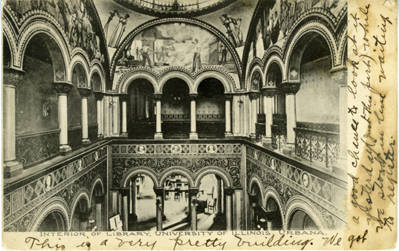
Another significant collection at the American Library Association Archives is the Library Building Photographs, Record Series 99/1/15.
Compiled from numerous creators and spanning over one hundred years of documentation, these images offer both a broad geographic and historical perspective of libraries. These buildings range from magnificent classic libraries to quirky traveling book mobiles.
As a graduate student at the University of Illinois, I was intrigued to find a photograph of the University Library.
With sweeping columns and arches, it bears no resemblance to our current Library. Was it before a remodel? According to the Mathematics Department’s history page, the University Library moved to its new building (our current Library) in 1926 and Altgeld Hall was divided between the Department of Mathematics and the Law School, before completely transferring to the Mathematics Department in the mid-1950s.[2]
Undergoing several additions and renovations, the original stained glass dome of the rotunda was replaced in the early forties by a plaster dome inscribed with the names of U. S. Chief Justices of the Supreme Court to that date. In the final 1956-57 addition, additional classrooms were added, “resulting in the blocking of many windows of the original structure and the enclosure of the East Reading Room. The skylight that had been over the stained glass dome was also removed at that time.” The Librarian’s Office was also converted to a Men’s Room and hallway.[3] Although compromising the original opulence of the building, the renovations itself serve as a testament to functional demands of a growing university.
For more information:
Department of Mathematics’ History of Altgeld Hall
http://www.math.illinois.edu/History/
Altgeld Past and Present Interior and Exterior Photographs http://www.library.illinois.edu/mtx/altgeld.html
Library Building Photographs Digital Collection at the ALA Archives
Other Digital Collections at the ALA Archives
Early ALA Posters now Digitized and Online
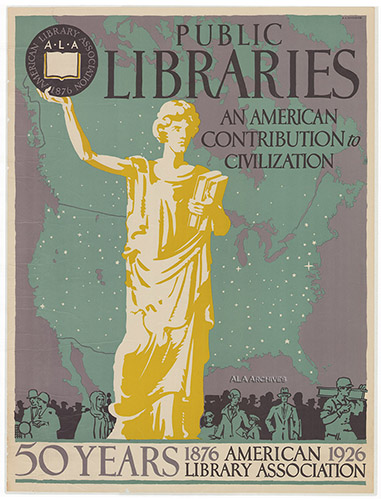
Posters used by the ALA during its early history are now digitized for long-term preservation and access copies are available for viewing online. [Database currently down, 3/8/2019] Subjects covered in these posters include the ALA’s work with the Library War Service to the American military during World War I, the importance of the freedom to read used during World War II, celebrating the ALA 50 Year Anniversary (in 1926) and the Carnegie Centenary (in 1935), as well as librarianship recruitment and general library promotion during the early twentieth century. These posters provide important documentary evidence of both the work of the ALA and how the presentation of American libraries and librarianship has changed over the past century.
Continue reading “Early ALA Posters now Digitized and Online”
After the Eleventh Hour
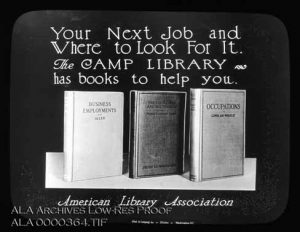
Veterans Day honored the signing of the armistice on November 11, 1918, bringing an end to the fighting of the Great War. Angela Jordan has already detailed the work done by the American Library Association during the war, however the ALA’s role did not end on the eleventh hour of the eleventh day of the eleventh month. The time after the signing of the armistice would actually account for one of the busiest periods for the ALA during the war. Continue reading “After the Eleventh Hour”
“Lots of Love (of both the revolutionary and non-revolutionary kind)”: the History of the ALA’s GLBT Round Table
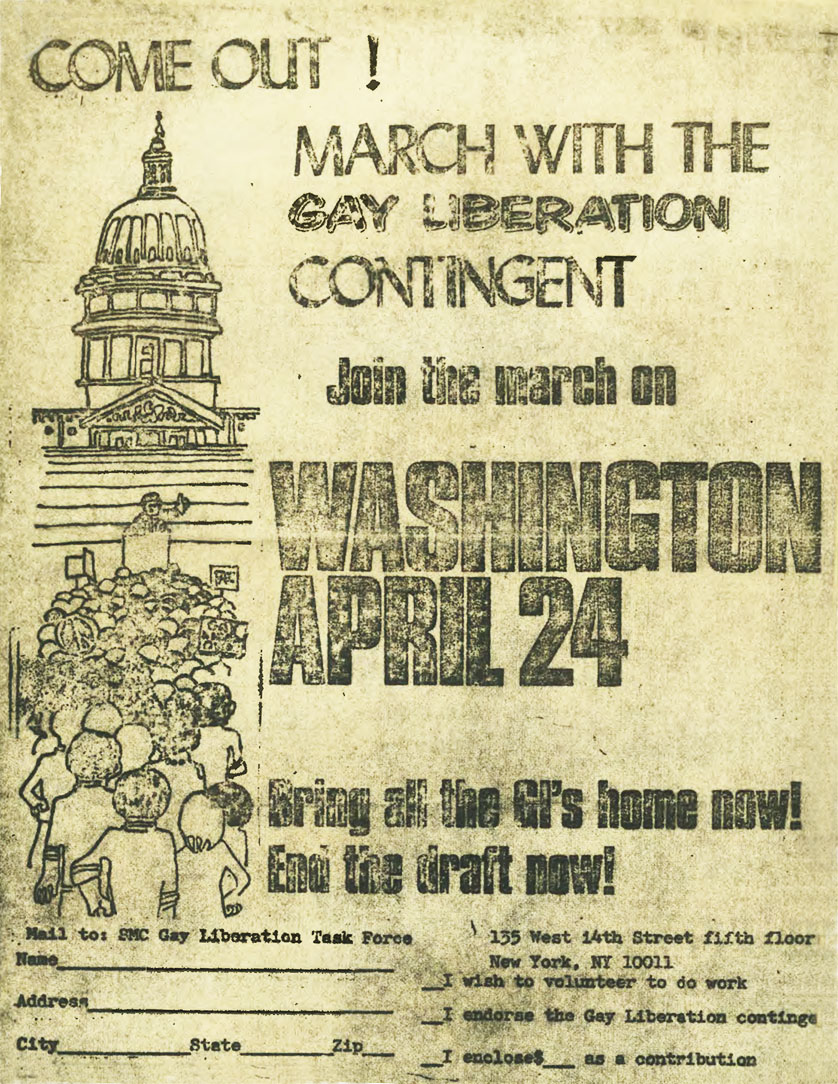
The GLBT Round Table is a group with a lot of firsts. Formed during the 1970 Annual Conference in Chicago as the “Gay Liberation Task Force,” a part of the larger Social Responsibilities Round Table, they were the first profession-based gay organization. [1] The next year, they established the first award for gay literature, now called the Stonewall Award. That same year they also published the first gay bibliography, which was a response to the lack of gay-positive books in libraries.