America’s interest in Hawaiian culture began during the last two decades of the nineteenth century and reached its peak during the Great Depression. Some scholars, including John Troutman, have suggested Hawaiian music performance during of the 1930s provided the country with temporary escapes from the daily economic uncertainties of the Depression.
By this time, slack-key guitar performances utilizing altered tunings and intricate finger picking techniques had become part of America’s mainstream music culture. This style of guitar performance was first popularized in Hawaii by Portuguese sugar cane workers, who were brought to the Pacific islands in the late 1870s.
During the 1880s, performers like Joseph Kekuku adapted their new slack-key methods to acoustic guitars by laying their instruments on their laps and sliding a steel or wooden bar over the guitar’s fretted neck. Americans first heard Kekuku’s new performance style in 1893, when the annexed territory of Hawaii staged an exhibit at the 1893 World’s Columbian Exhibition in Chicago.
Two of America’s leading Hawaiian guitar performers, innovators, and music educators in the 1930s and 40s were Letritia Kandle (1915-2010) and Eddie Alkire (1907-1981). Kandle’s first encounter with the acoustic guitar was through Warner Baxter’s performance as the Cisco Kid in the film, In Old Arizona (1928). However, after watching George Kealoha Gilman’s theatrical reenactments of Polynesian life and music during the 1933 Century of Progress Exhibition in Chicago, Kandle convinced Gilman to mentor her studies of Hawaiian music, dance, and language in 1934.

The following year she formed an all-women’s steel guitar ensemble called the Kohala Girls. The band quickly became regular performers of Hawaiian music and dance throughout Chicago during the 1930s and 40s. In 1937, Paul Whiteman invited her to perform with his jazz band during his weekly WGN radio show broadcasts from Chicago’s Drake Hotel. During these shows she performed on a one-of-a-kind instrument of her own design that Whiteman dubbed the “Grand Letar.”
During the 1920s Eddie Alkire taught himself to play the steel guitar by enrolling in a series of correspondence courses and was performing guitar and tenor banjo for a dance band called the Rhythm Kings. Prior to this, he was employed as an electrician in Turtle Creek, Pennsylvania working for Westinghouse Electrical building switch-gear apparatuses.
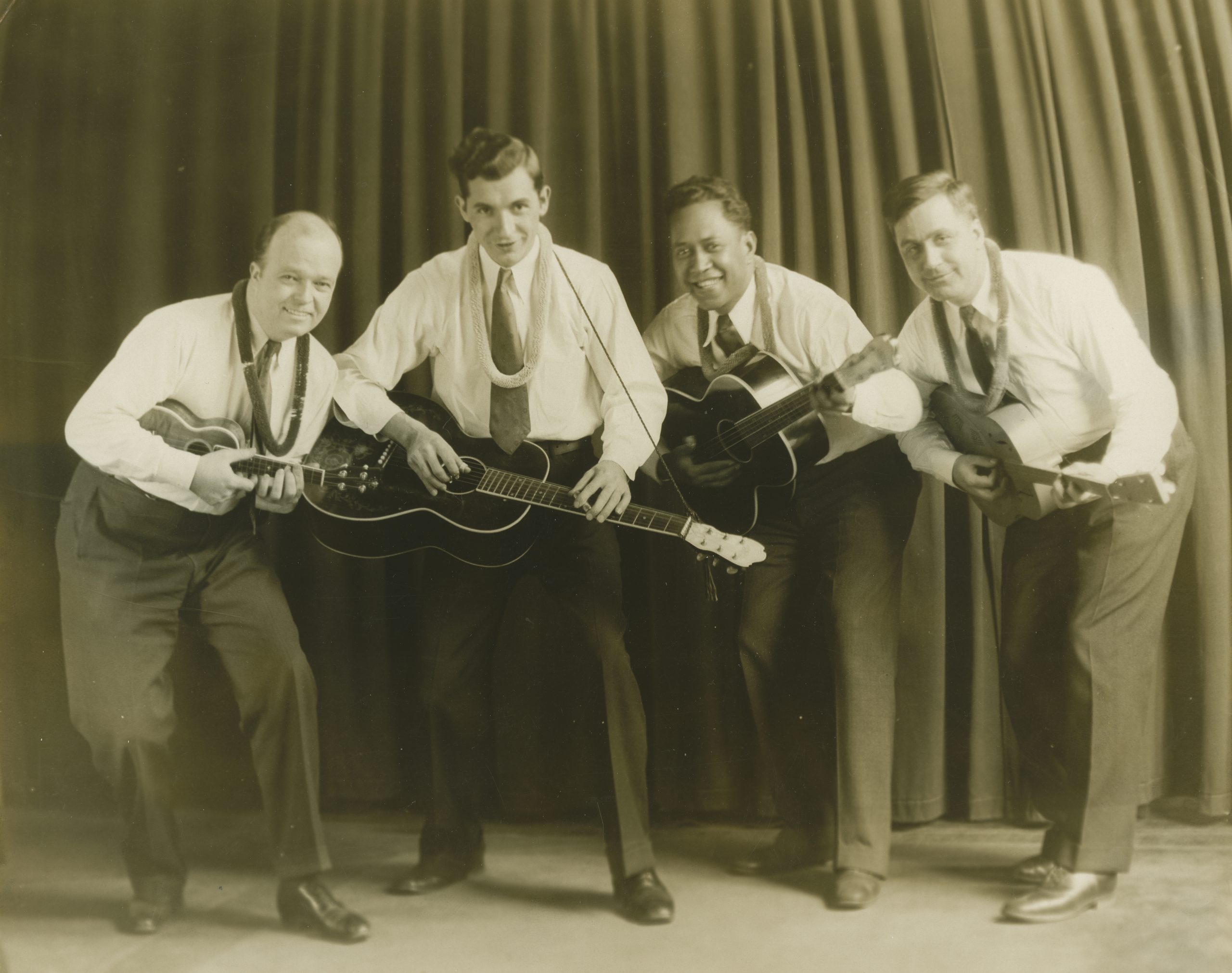
In 1930, Alkire moved to Cleveland, Ohio where he became a teacher and composer for the Oahu Music Company. Between 1930 and 1934, Alkire acted as the music director for the music company’s Oahu Serenaders, an ensemble that performed on over 1000 coast-to-coast, nationally syndicated N.B.C and C.B.S. radio broadcasts. As the ensemble’s lead performer, Alkire experimented with new tunings that enabled him to play four-part harmonies and rapid melodic passages that helped grow the Serenaders’ national fan base during the early 1930s.
In 1934, Alkire and his new wife Margaret moved to Easton, Pennsylvania and formed his own music publishing company. Building upon his music correspondence course experiences learning the Hawaiian guitar and the publishing experience he gained while working for the Oahu Music Company, Alkire created a series of progressive music lessons that taught beginning and intermediate players how to play Hawaiian and Spanish guitar through mail-in lessons. His correspondence courses continued publishing learn-by-mail lessons well into the 1960s.
In 1936, Alkire utilized his knowledge of electrical engineering to create an experimental 15-string electric Hawaiian guitar. By 1939, he had solicited renowned electric guitar maker George Beauchamp to help him cast the first 10-string Hawaiian Guitar, which he called the E-Harp (pronounced ay-harp). Alkire eventually patented his new instrument’s design in 1950, and it continues to be one of the music industry’s most innovative designs for the Hawaiian guitar.
So, if you are looking for ways to imagine yourself in warmer locales during January’s arctic Midwest days or just want to learn more about Eddie and Letritia, then visit the Sousa Archives and Center for American Music at Eddie Alkire and Letritia Kandle or email schwrtzs@illinois.edu.