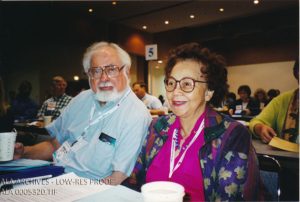
Despite missing Valentine’s Day, the ALA Archives can’t let the month of February go by without talking about Mary and Herbert “Herb” Biblo, one of the great couples in American Library Association history. Between the two of them, they contributed decades of service to ALA and established themselves as advocates for social justice within the association and the profession of librarianship. In an interview with Herb, Art Friedman, a friend, succinctly and accurately, summed Herb and Mary up as “a very active husband and wife team in librarianship.”
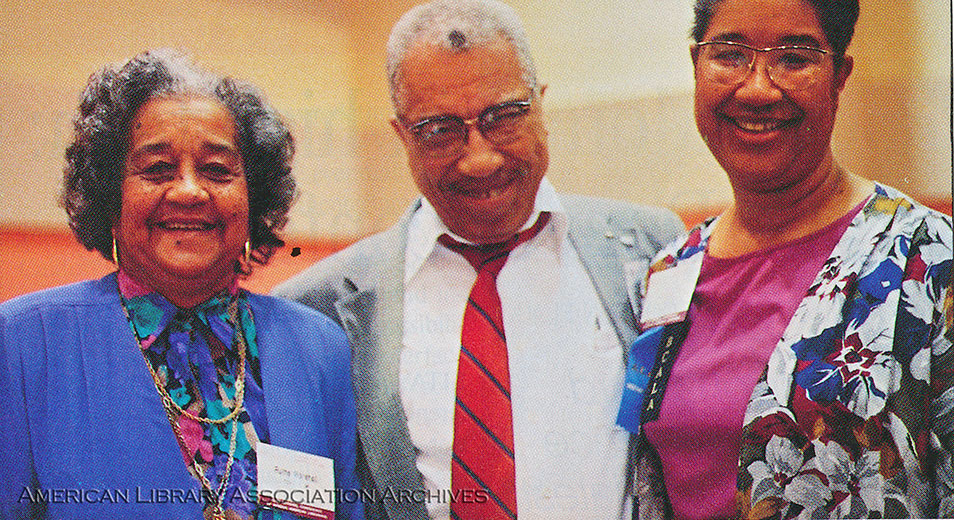
Herb and Mary Biblo at the Council meeting during the 2001 ALA Annual Conference.
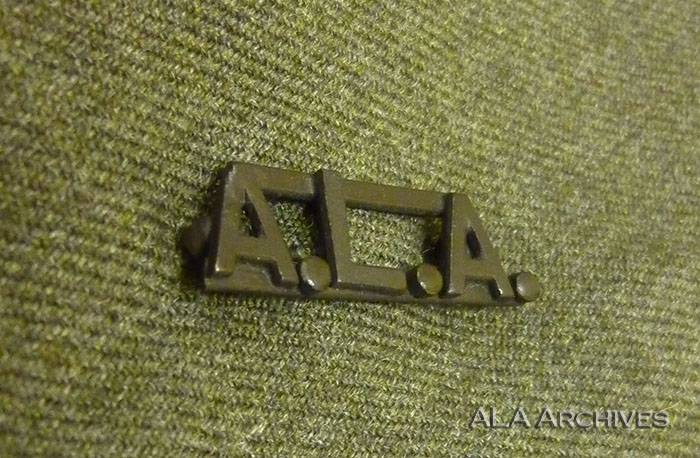
As the American Library Association launched its Library War Service during World War I, the first of many ALA logos appears. Created for librarian uniforms, a simple A.L.A. insignia pin was used by camp librarians and representatives. In a March 1918 circular letter, Library War Service director, Herbert Putnam, announced the distribution of the bronze insignia pins for use.[1] By November of the same year, the simple A.L.A. design was replaced with an open book with “A.L.A.” inside.[2] Even after the war, this design would be used in ALA publications, conference programs, and letterhead for matters unconnected to the Library War Service. Even the ALA Board of Education for Librarianship would use the logo in its correspondence.
Original version of the pin, replaced by open-book style in 1918.
In late 1955, the American Legion John Jacob Fisher Post in Punxsutawney, Pennsylvania, attacked the local library in their newsletter and in a letter presented to the borough council. The catalyst for this attack was the adoption of the Library Bill of Rights by Punxsutawney Free Library’s board.
In the December 1955 issue of the Legion News published by the John Jacob Fisher Post, Legion member Pete Wehrle wrote an editorial attacking ALA as a communist front. The editorial questioned if the American Legion Post would stand for the library board to “tie up with a Red Front organization” such as the ALA, to which it said no. The editorial used combative language against the library board, saying: “In short folks we are going to do a job on this matter. We will pick the field and the time and place of the fray. We will also pick the method – these things are always the prerogative of the assult (sic) force.”[1]Continue reading ““The Gross Misrepresentation”: An Accusation of Communism in Punxsutawney”→
In 1949, a petition was brought to ALA Council during the Midwinter Meeting to form the Round Table on Library Service Abroad. The petition was approved and thus officially began what was later known as the International Relations Round Table (IRRT). However, IRRT’s origins can be traced to a year earlier in 1948 to the (confusingly named) International Relations Round Table on Library Service Abroad, a conference held at Williams College in Williamstown, Massachusetts. Also called the Williamstown Conference, its resounding success laid the foundation for IRRT.
In February 1948, the ALA International Relations Office (IRO) sent out a questionnaire to librarians on its Foreign Library Service Roster. The last question asked, “Would you be willing to attend, at your own expense, a ‘guinea pig’ session, devoted to the international aspects of library work …?”[1] 100 librarians affirmed their unreserved interest in the “guinea pig” session, while others noted their interested dependent upon funding.[2] With a strong response to the question, Helen Wessells, associate director of IRO, started planning. Continue reading “International Origins in Williamstown”→
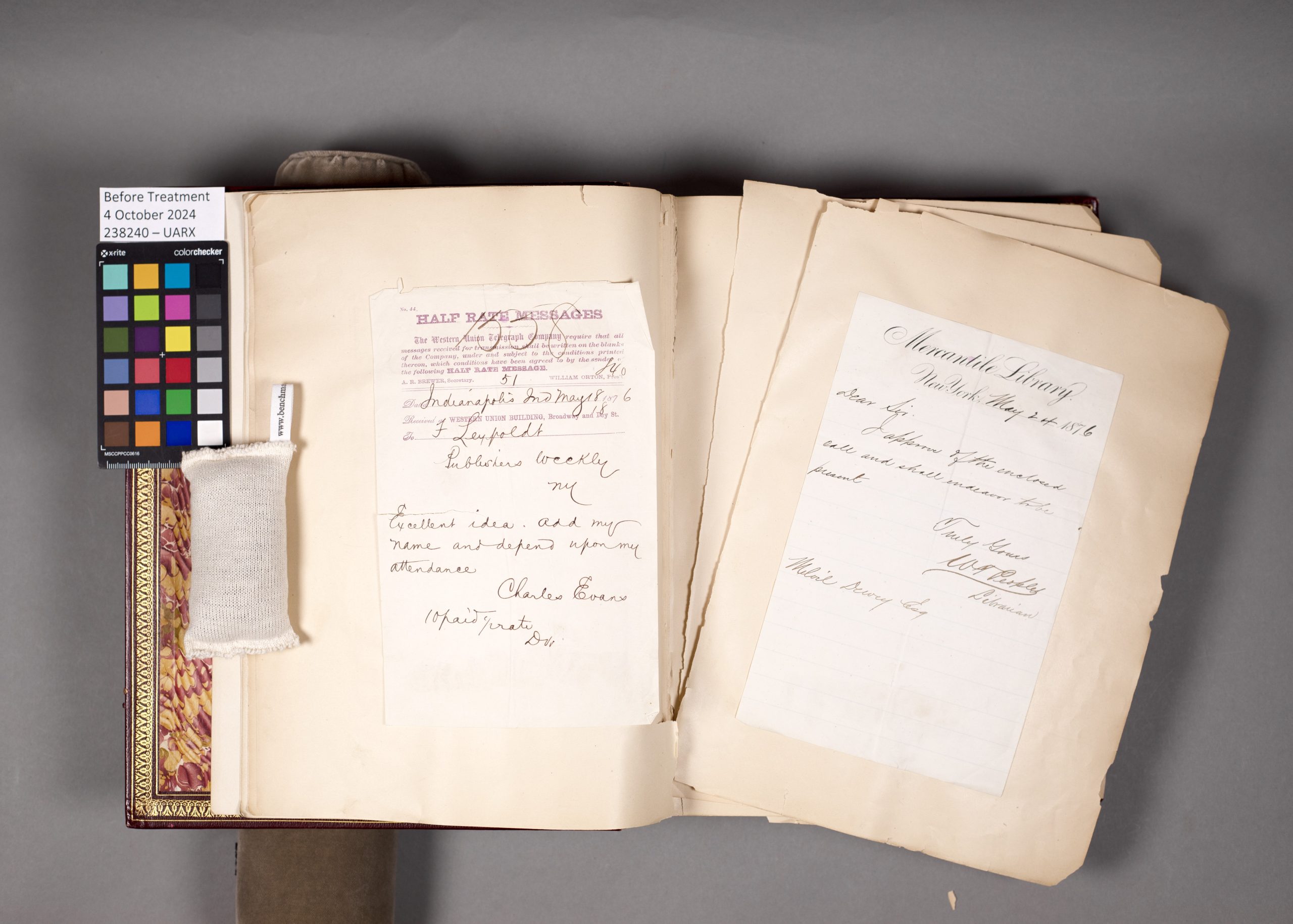
In 1926, during the fiftieth anniversary of the American Library Association, the Boston Public Library presented ALA with a scrapbook of letters, postcards, and documents tracing the origins of the Librarians’ Conference of 1876, the start of the association. The letters were kept by Melvil Dewey and Justin Winsor, prominent organizers of the conference, and later assembled into a scrapbook by someone at the Boston Public Library (BPL) in 1877, where Winsor had served as superintendent.[1] Preceding ALA’s fiftieth anniversary, Charles Belden, then director of BPL, convinced the BPL trustees to have the scrapbook rebound and transferred to ALA during its anniversary celebrations, for which Belden was the presiding president.[2]
The scrapbook in its original binding with detached pages.
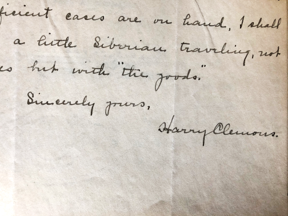
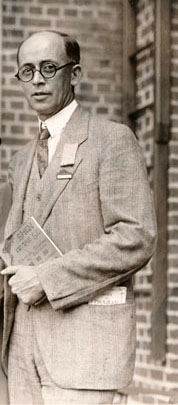
During World War I, most ALA operated libraries were stationed in US based military camps. However, a small number of librarians were sent overseas to help distribute books and run libraries. Harry Clemons was one such librarian.
In November 1918, M. L. Raney, director of the Library War Service’s overseas service, sent a cable message to Professor Harry Clemons with a simple question, “Will you accept appointment [of] official representative [of the] American Library Association … to develop library service for American forces in Russia? Books being shipped steadily.”
During the Spring 2024 semester, I worked at the ALA Archives and gained valuable archival experience. For MSLIS students at the University of Illinois Urbana-Champaign like myself, a practicum is a credit-earning field experience supervised by our selected information organization. Given my interest in both archival careers and the history of libraries and librarianship, I couldn’t think of a more suitable practicum site than the ALA Archives.
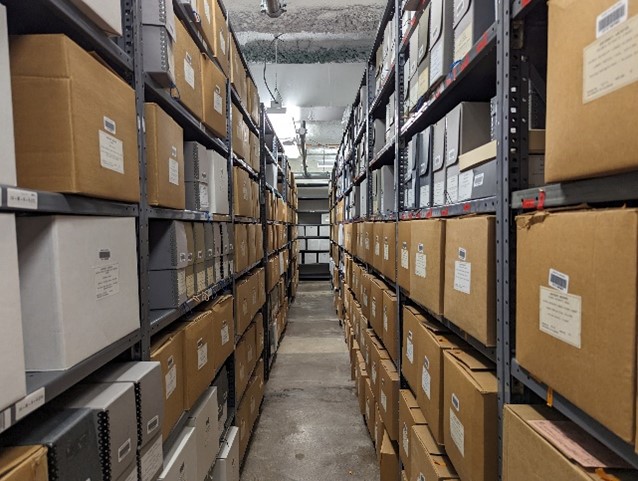
Climate-controlled records storage at the Archives Research Center, Horticulture Field Laboratory, University of Illinois
I am very thankful to my site supervisor Cara Bertram, the ALA’s Archives Program Officer, for offering me a well-round experience. Cara thoughtfully assigned me projects that sequentially built my knowledge and skills in archival processing. I started with interfiling (adding new items to existing records) and updating finding aids, gradually advancing to arranging and describing an entire record series. Throughout the semester, I participated in a variety of tasks, including inventorying backlog materials, writing biographical notes, digitizing photographs, organizing born-digital materials, creating metadata for digital collections, and collecting information for the archives’ reference services. Working in a small unit means one has the opportunity to handle all aspects of archival work, which is the most beneficial part for practicum students. Continue reading “My Practicum Experience at the ALA Archives”→
This month saw the passing of Satia Marshall Orange, former director of what is now ALA’s Office for Diversity, Literacy and Outreach Services (ODLOS). I had the good fortune to meet Orange early in my career, back in 2015, when she donated her father’s papers to the University of Illinois Archives. The then Assistant University Archivist, Chris Prom, planned to make the trip up to Chicago to see Orange and review her father’s papers. I asked to tag along as the ALA Archivist after hearing that Orange was a retired ALA staff member and that her late father was a librarian. She welcomed both of us into her home and was delighted to look through her father’s papers with us, share family stories, and was eager to preserve the legacy of her family.
Ruthe and A.P. Marshall with their daughter, Satia Marshall Orange, at the 1992 National Conference of African American Librarians.
As we look forward to book award ceremonies at the ALA Annual Conference this summer, we’re taking a moment to reflect on the history of one of the most prestigious children’s book awards, the Caldecott Medal. Established in 1937 to recognize the most distinguished American picture book for children, the first medal was awarded in 1938 to Dorothy P. Lathrop for the book, Animals of the Bible. However, the idea was first presented in 1935 in a letter by Frederic G. Melcher.
Melcher established the Newbery Medal in 1921 for “the most distinguished contribution to American literature for children.” While the medal was met was great enthusiasm, some felt that the award excluded books for younger children. Writing on behalf of the Association for Childhood Education, Professor May Hill Arbuthnot of Western Reserve University communicated this concern to Elizabeth Briggs, the Newbery Committee chair, in 1935. Continue reading “The Caldecott Medal: “A Hasty Idea Thrown Out””→
Due to communist hysteria before and after World War II, many organizations and publications were under suspicion of being affiliated with or promoting the Communist party. One curious suspect of this scrutiny was Consumers Union, publisher of Consumer Reports, the product testing and consumer advocacy magazine. In the late 1930s, Consumers Union faced unsubstantiated accusations of communism.[1] Despite the fruitless claims, Consumers Union was placed on a list of subversive organizations by the House Un-American Activities Committee in 1944.
In 1951, representatives from the Better Business Bureaus drew attention to Consumer Union’s status on the House Committee’s list. As a result, Ohio schools banned the use of Consumer Reports in the classroom.[2] While the Ohio schools ban of the magazine was short-lived, the questions about it were not and the ALA Intellectual Freedom Committee (IFC) noticed the attempts to ban the publication. Continue reading ““Nothing Could Have Astonished Me More”: The Challenge of Consumer Reports”→