Blog

International Origins in Williamstown

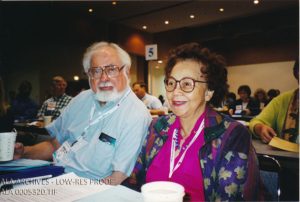
In 1949, a petition was brought to ALA Council during the Midwinter Meeting to form the Round Table on Library Service Abroad. The petition was approved and thus officially began what was later known as the International Relations Round Table (IRRT). However, IRRT’s origins can be traced to a year earlier in 1948 to the (confusingly named) International Relations Round Table on Library Service Abroad, a conference held at Williams College in Williamstown, Massachusetts. Also called the Williamstown Conference, its resounding success laid the foundation for IRRT.

In February 1948, the ALA International Relations Office (IRO) sent out a questionnaire to librarians on its Foreign Library Service Roster. The last question asked, “Would you be willing to attend, at your own expense, a ‘guinea pig’ session, devoted to the international aspects of library work …?”[1] 100 librarians affirmed their unreserved interest in the “guinea pig” session, while others noted their interested dependent upon funding.[2] With a strong response to the question, Helen Wessells, associate director of IRO, started planning. Continue reading “International Origins in Williamstown”

1876 Librarians’ Conference Scrapbook

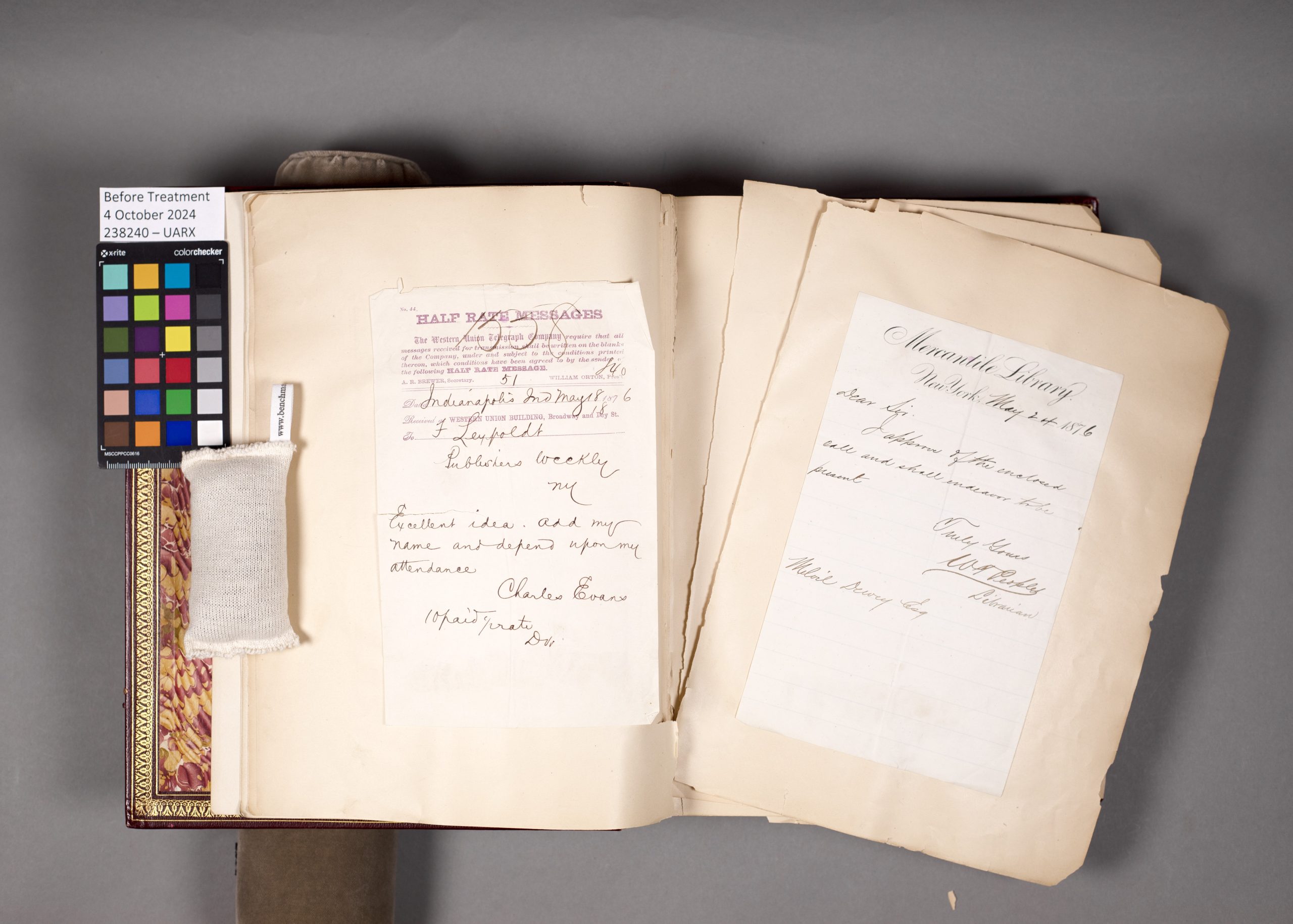
In 1926, during the fiftieth anniversary of the American Library Association, the Boston Public Library presented ALA with a scrapbook of letters, postcards, and documents tracing the origins of the Librarians’ Conference of 1876, the start of the association. The letters were kept by Melvil Dewey and Justin Winsor, prominent organizers of the conference, and later assembled into a scrapbook by someone at the Boston Public Library (BPL) in 1877, where Winsor had served as superintendent.[1] Preceding ALA’s fiftieth anniversary, Charles Belden, then director of BPL, convinced the BPL trustees to have the scrapbook rebound and transferred to ALA during its anniversary celebrations, for which Belden was the presiding president.[2]

Scrapbook with detached pages.
The scrapbook in its original binding with detached pages.

Continue reading “1876 Librarians’ Conference Scrapbook”

Exhibit: ALA and School Librarians

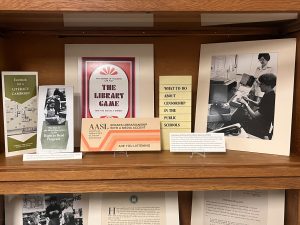
(From left to right) AASL pamphlets, cover of “The Library Game,” school librarians operating the DIALOG system


The ALA Archives has an exhibit this month curated by Ella McDonald in the Center for Children’s Books  at the School of Information Sciences. The exhibit opens on October 4th for the Association of Illinois School Library Educators (AISLE) conference and explores the history of school librarians and the role of the American Association of School Librarians (AASL), a division of the American Library Association. You can see a preview of the exhibit here but make sure to stop by the Center for Children’s Books to view the exhibit. You can also visit the American Library Association Archives to find more materials about school librarians in the United States. Continue reading “Exhibit: ALA and School Librarians”

Librarians Go on a Road Trip! The 1926 Foreign Delegate Post-Conference Excursion

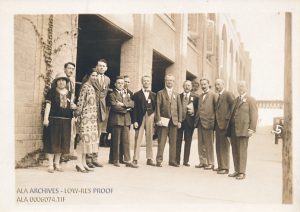
A group of foreign delegates in Atlantic City during the ALA Fiftieth Anniversary Conference, October 1926.

In early October 1926, almost sixty librarians from twenty-five countries gathered in Atlantic City and Philadelphia to celebrate the fiftieth anniversary of the American Library Association along with over two thousand American librarians.[1] By all accounts, the conference was a great success.[2] The international delegates held sessions on foreign librarianship and participated in discussions about improving international relations among librarians. But the best part of this all-expenses-paid trip to the US didn’t happen during the actual meeting: when the conference ended, about thirty international delegates went on a multi-state excursion, visiting twelve cities in the span of two weeks. From Atlantic City to Boston, Chicago to Washington, D.C., the delegates traveled by bus, train, car and steamer to see as much of the US as possible—and as many libraries as possible—ensuring they would return home with minds brimming full of library innovations and international amity.

Continue reading “Librarians Go on a Road Trip! The 1926 Foreign Delegate Post-Conference Excursion”

“No Censorship at Any Time”: The 1953 Westchester Conference

In early May 1953, a group of 25 representatives from the American Library Association, the American Book Publishers Council (later the Association of American Publishers), and other associated citizens, met in Rye, New York to discuss the fundamental freedom to read. This “Westchester Conference,” named after the Westchester Country Club meeting place, was a resounding success. Out of this conference grew one of the most important and well-known policies of the American Library Association: the Freedom to Read Statement. Continue reading ““No Censorship at Any Time”: The 1953 Westchester Conference”

Henry and Edith Carr, ALA’s Golden Couple

Henry and Edith Carr pose for a photo ca. 1910, in fancy dress.

With Valentine’s Day fast approaching, the ALA Archives can’t help but think of love. The spirit of the holiday compels us to remember possibly the most famous ALA couple of all time, Henry and Edith Wallbridge Carr. Married for 43 years and active in the American Library Association for even longer, the Carrs were well-known within the library community of the late nineteenth and early twentieth century. Where did the romance of these two librarians begin? At an ALA conference, of course!

Continue reading “Henry and Edith Carr, ALA’s Golden Couple”

Fighting Censors and Book Bans: Establishing the ALA Office for Intellectual Freedom

This blog post is part of a series exploring the important events and people in ALA’s history for the celebration of the 150th anniversary of ALA in 2026.

Almost 60 years ago, the Intellectual Freedom Committee (IFC) of the American Library Association needed a partner in the fight for intellectual freedom. The 1960s brought concerns about censorship, freedom of the press, the freedom to read – and the impact on librarians who sought to uphold the values within the Library Bill of Rights and the Freedom to Read Statement. The ALA’s Office for Intellectual Freedom (OIF) was the solution, providing support and education on intellectual freedom to librarians and the public.[1] Little did they know how vital the OIF would become to the fight against book challenges and censorship and to the support of librarianship and the freedom to read everywhere. Continue reading “Fighting Censors and Book Bans: Establishing the ALA Office for Intellectual Freedom”

Librarians, Segregated: The 1936 ALA Annual Conference

This blog post is part of a series exploring the important events and people in ALA’s history for the celebration of the 150th anniversary of ALA in 2026.

The Advance Attendance Register for the Richmond Conference displayed a rendering of the White House of the Confederacy.

Wilson Bulletin editor, Stanley J. Kunitz, called it the “The Spectre at Richmond” – but the racial discrimination at the 1936 ALA Annual Conference was no ghostly apparition.[1] The conference was held in Richmond, Virginia, a city with Jim Crow era racial segregation laws. While the American Library Association itself had no segregation or discriminatory policies, up until 1936 they had not established any ruling against holding a conference in a segregated city where members would be subject to discrimination. Thus, “the Spectre” marched into the halls of the hotels and auditoriums, reminding all librarians present that there was still work to be done. Continue reading “Librarians, Segregated: The 1936 ALA Annual Conference”

15 Years of Fear: The ALA and the Patriot Act

This blog post is part of a series exploring the important events and people in ALA’s history for the celebration of the 150th anniversary of ALA in 2026.

Folders about the USA PATRIOT Act from the ALA Office for Intellectual Freedom Subject File at the ALA Archives.
USA PATRIOT Act files in the Office for Intellectual Freedom Subject File at the ALA Archives.

October 26, 2001, marked the beginning of a 15-year-long struggle for the privacy rights of library users as a result of the USA PATRIOT Act being signed into law by President Bush. The Uniting and Strengthening America by Providing Appropriate Tools Required to Intercept and Obstruct Terrorism Act, colloquially known as the Patriot Act, expanded surveillance and investigation capabilities of law enforcement to combat terrorism after the attack on September 11th.[1] Included in the bill was Section 215, which became known as the “library provision” as it allowed intelligence agencies to “obtain information about members of the public, including library records, based on a minimal submission to a secret court.”[2]

Continue reading “15 Years of Fear: The ALA and the Patriot Act”

Library 21: ALA at the 1962 Seattle World’s Fair

This blog post is part of a series exploring the important events and people in ALA’s history for the celebration of the 150th anniversary of ALA in 2026.

Photograph of the entrance to the Library 21 exhibit, showing the bridge into the first circle.
Overhead view of the entrance to Library 21 and the main exhibit space.

The ALA predicted the future 62 years ago in Seattle – the future of libraries, that is. They called their premonition “Library 21,” an exhibition at the 1962 World’s Fair. The “automated” library of the future would blend traditional library services with advancements in information technology. Partnered with companies including Remington Rand-UNIVAC, Xerox, RCA, IBM, and Encyclopaedia Britannica, Library 21 explored the importance of library services in daily life and how “electronics and information technology will have great impact on the methods we use for storing, retrieving, and communicating knowledge in the libraries of tomorrow.”[1]

The 9,000 square foot exhibit space was the first exhibit on the ground floor of the Washington State Coliseum, which drew large crowds during the Fair’s run from April 21 through October 21, 1962.[2] An estimated 1.8 million people visited Library 21 – almost 20% of the total attendance of the Fair.[3] Designed by Vance Jonson of Los Angeles and constructed by the firm Daniel, Mann, Johnson and Mendenhall, the exhibit structure itself was quite impressive. The futuristic exhibit consisted of two large circles connected to form a figure eight, with stairs from the second circle leading to the colorful Children’s World below. The circles were lit from above and surrounded by reflecting pools. Visitors approached via a bridge into the first circle, which included the UNIVAC computer, the Ready Reference Center, and the adult reading area. The second circle contained the Xerox Theater, Learning Resources Center, and other electronic exhibits. Continue reading “Library 21: ALA at the 1962 Seattle World’s Fair”