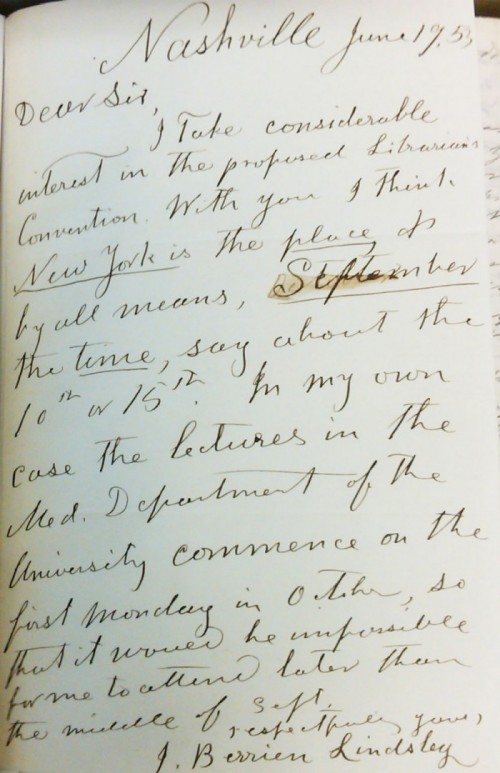
Before the first American Library Association Conference in 1876, there was the 1853 Librarians’ Convention. The idea was first presented in 1852, in Charles Norton’s Norton’s Literary Gazette and Publisher’s Circular, though it would take another year for the idea to take root. After much correspondence a group of librarians put out an official proposal for a convention in May of 1853. The proposal, “Call for a Convention of Librarians”, was published in Norton’s Literary Gazette, stating: Continue reading ““The First Convention of the Kind”: The 1853 Librarians’ Convention”→
Sometimes in the archives you look for one thing and find something completely different, but wonderfully fascinating. A letter for the Harvey Dunn Poster Campaign is one of those great and random finds in the archives. The letter, dated June 26, 1923, was a call for librarians to hang up a poster of a man reading a book in a factory, the image of the poster was originally from a painting by Harvey Dunn. Carl Milam, then Secretary of the ALA, stated that the, “Harvey Dunn poster … speaks directly to the people who need to learn of the hidden treasures which are theirs for the asking.”[1] Continue reading ““Develop the Power that is Within You”: The Harvey Dunn Poster Campaign”→
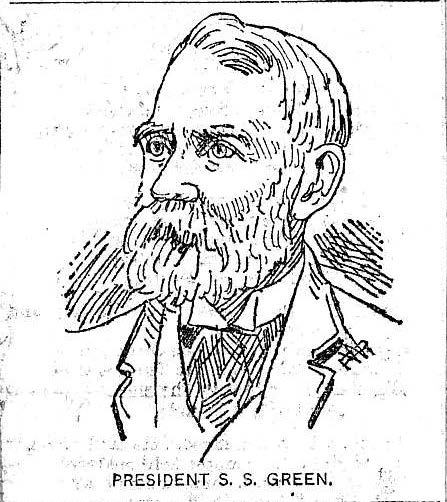
Sketch of S. S. Green from the Los Angeles Times, Oct 24, 1891.
In October 12-16 of 1891, the first ALA Annual Conference in San Francisco was held. It was the first conference to be held on the Pacific Coast and 83 people were in attendance, with Samuel Swett Green presiding as president. Even after over a hundred years, some of the topics discussed during the sessions would not be out of place at the 2015 Annual Conference. ALA members talked about library architecture, library administration, the use of libraries in schools, library legislation, and public support for public libraries. Continue reading “Tour of the ALA to the Pacific Coast”→
For Veteran’s Day, the ALA Archives wanted to share how books can sometimes take us to strange and wonderful places. James Whittaker’s We Thought We Heard the Angels Sing (a book about soldiers during WWII who survived a plane crash over the Pacific and were stranded on a life raft for weeks) took Suzanne Kelley and her students on a pursuit of knowledge that connected them with the WWII veterans from the book. These veterans became a part of the students’ lives for years to come. This is Ms. Kelley’s letter to the American Library Association from this past September: Continue reading “We Thought We Heard the Angels Sing”→
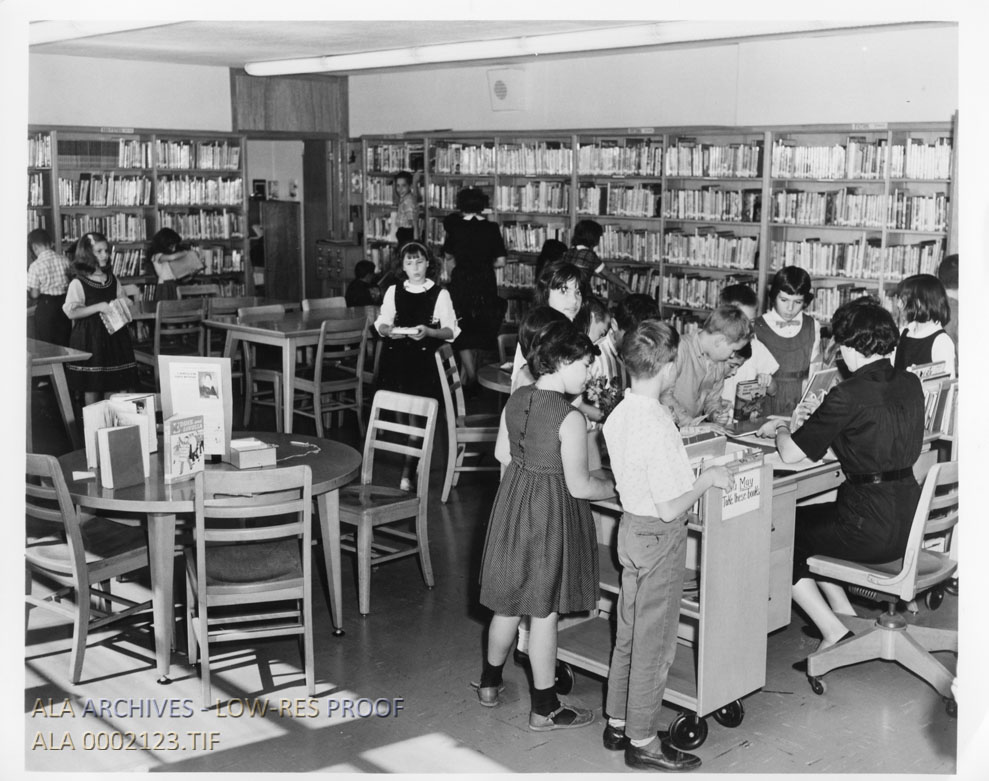
In 1962, the Knapp Foundation, Inc., provided a $1,130,000 grant administered to the American Association of School Librarians (AASL), a division of ALA, to raise the standards of school libraries. At that time, school libraries in the United States were noted to be substandard. While federal funds helped to fund school libraries in 1958, the AASL realized that school libraries needed more than money to fix their problems. Improvements were needed in collection development, updates in technology, more staff, and renovations in facilities.
A busy school library at Central Park Road School in Plainview, NY. RS: 99/1/18
The five year Knapp School Libraries Project started in 1963. The project had four objectives: The first was to demonstrate the educational value of school libraries. The second was to promote improved understanding and use of library resources by teachers and administrators. The third objective was to guide other libraries to develop their own programs by having them observe the demonstration schools. And the last objective was to increase interest and support for school library development by producing and circulating information about the program and the demonstration schools.[1] Continue reading “Knapp School Libraries Project”→
The American Library Association Annual Conference is often a much anticipated event for librarians. In 1876, 103 people attended the first conference in Philadelphia; last year alone over 26,000 people attended the Annual Conference in Chicago.[1] Needless to say, the conference has grown a bit.
Amongst all of the exhibits, sessions, speakers, and free swag, there is one item that is essential to get around any conference: the program. The program is the guide that allows people to navigate the conference, select which events to go to, which speakers to listen to, and where to obtain a free lunch. Throughout the years, the Annual Conference Program has become thicker as the conference has expanded, and it has changed its appearance. Early conference programs continue to be a valuable resource to the archives, but they were not nearly as aesthetically pleasing as the ones the ALA produces today. Continue reading “Ode to the Conference Program”→
In 1904, the Washington County Free Library in Hagerstown, Maryland, outfitted a wagon with bookshelves to serve as a mobile library unit to reach people who could not normally make it to the library. A few times a week, the book wagon was able to reach rural areas of the county and deliver books to residents.
Pamphlet by the ALA, 1921, RS: 29/7/4
The Washington County Free Library book wagon would meet a tragic end in 1910 when it was struck by a freight train at a railway crossing. This event would suspend the county’s library extension service as there were no funds to purchase a new wagon. However, in 1912, a generous donation of $2,500 by William Kealhofer, Esq. allowed the library to replace the book wagon. Instead of getting another horse drawn wagon, the library purchased a truck that could be fitted with shelves to hold 300 books.[1] The truck allowed the library to extend its reach by being able to add more routes. Continue reading “Books on Wheels”→
Interns Gabrielle Barr and Lisa Lorenzo hard at work to preserve ALA history! Photo courtesy of American Libraries.
The ALA Archives has been busy working on large accessions of records sent to us by American Libraries magazine and the ALA Library. These new accessions will total up to 40 bankers boxes once all of them have been shipped over, and the archives staff is excited to receive them.
The archives staff is currently working on boxes sent to us from the ALA Library. These records are a rich collection of photograph vertical files that not only document the history of the ALA, but of the librarian profession itself. There are of course photos and negatives of various ALA conferences, events, and staff, but there are also photographs of bookmobiles, libraries, exhibits, various library technologies, and even book trucks! Continue reading “New Accessions at the Archives”→