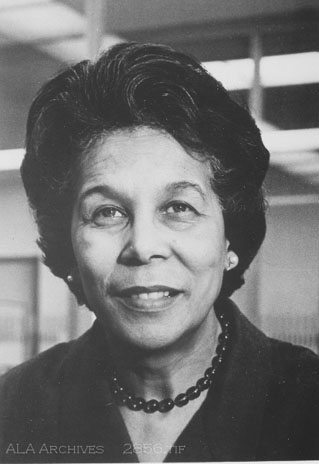
Clara S. Jones: “Awareness is Not Burdened with Repression; It is Liberating”

ALA0002856
Clara Stanton Jones

During the 1975 American Library Association Annual Conference, Clara Stanton Jones was announced as the Vice-President and President-Elect of the American Library Association. Her term as President would start during the ALA’s 1976 Centennial Conference, a fitting celebration for the first African American President of the ALA.

Her experience as Director of the Detroit Public Library and personality made her well suited for the position of ALA President. E.J. Josey noted that: “Her years of service in the trenches in Detroit before being appointed director of the library system provided her with management skills as well as a desire to love and serve her fellow human beings.”[1] Jones’ career took her all over the world, but most of her activities were community driven, working on the revitalization and cultural development of Detroit.[2] Continue reading “Clara S. Jones: “Awareness is Not Burdened with Repression; It is Liberating””
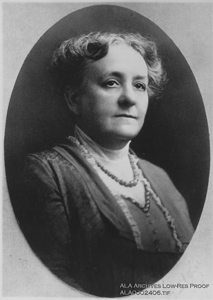
Mary Wright Plummer

To continue our blog series highlighting pioneering women librarians, this next post will focus on Mary Wright Plummer (1856-1916).  A member of Melvil Dewey’s first class in librarianship at Columbia College, Plummer went on to establish an impressive career in librarian education, children’s librarianship, and international librarianship, and served as the ALA’s 2nd female president from 1915-1916.

Born to a Quaker family, Plummer attended Wellesley College from 1881-1882, studying languages and creative writing.  Her librarianship career began when she enrolled at the age of 30 in “the first class in library science on the planet”[1], Melvil Dewey’s 1887 class in the School of Library Economy at Columbia College.  Distinguishing herself immediately in her studies, she was selected to present her experience in library school at the American Library Association’s 1887 meeting (“The Columbia College School of Library Economy from a Student’s Standpoint,” printed in Library Journal, September-December 1887). Continue reading “Mary Wright Plummer”

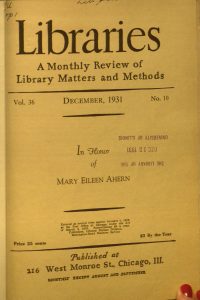
Miss “Public Libraries” Mary Eileen Ahern

Last issue of Libraries magazine.
The last issue of Libraries magazine.

Festschrifts are a common way to honor someone in academia, and line the shelves of many academic libraries. They typically contain academic essays related to the person’s life work, contributed traditionally by the person’s former doctoral students and colleagues. But what about a Festschrift that’s instead full of nothing but praise for the person being honored gathered from common workers in their field, and furthermore isn’t for an academic, but instead for a public-service librarian? This is the final issue of Libraries magazine, honoring one Mary Eileen Ahern. Continue reading “Miss “Public Libraries” Mary Eileen Ahern”

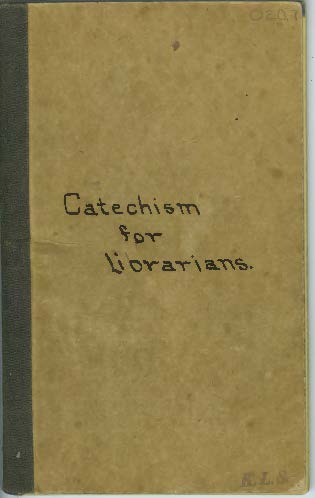
Have you a card catalog? Katharine L. Sharp’s Catechism for Librarians

Cover of "Catechism for Librarians"
Cover of “Catechism for Librarians”

The more things change, the more they stay the same, or so you will think when you look at this laundry list of key considerations Katherine L. Sharp outlines for someone setting up a library in her writing “Catechism for Librarians.” Unlike a religious Catechism, she outlines not what to believe but a series of questions a librarian must answer for herself. Despite being only 3 by 5 inches in size, 24 pages long, and never published, these 180 questions still provide a reasonable guide to someone setting up a library today. And their relevance is still more interesting when you consider that this was written in 1891, with no knowledge of the sweeping changes in librarianship and technology that were to come. A few of the more prescient questions are presented here in their modern context:  Continue reading “Have you a card catalog? Katharine L. Sharp’s Catechism for Librarians”

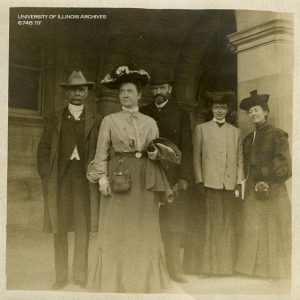
“The Best Man in America is a Woman”: Katharine L. Sharp and the First “Lady Librarians”

Katharine Sharp with Melvil Dewey and other librarians
Katharine Sharp and other librarians at an unknown event, c. 1900. Caption on the back reads: “Mr. Brunden, our host, Miss ‘Public Libraries’ Ahern; Mr. Dewey (with the Placid look upon his face); Miss K. L. Sharp; Miss M. McIlvaine.”

For an educated woman at the turn of the century, there were few options for a intellectually satisfying career, as Katharine L. Sharp discovered as a newly minted college graduate in 1885. She taught foreign languages at a high school in Illinois for two years, but then she took a position as Assistant Librarian at the Scoville Institute and seems to have found her calling. Believing so strongly in the burgeoning field of professional librarianship, she enrolled in the new New York State Library School in 1889, where she studied under Melvil Dewey. [1]  Continue reading ““The Best Man in America is a Woman”: Katharine L. Sharp and the First “Lady Librarians””