National Library Week: “For a Better-Read, Better-Informed America”

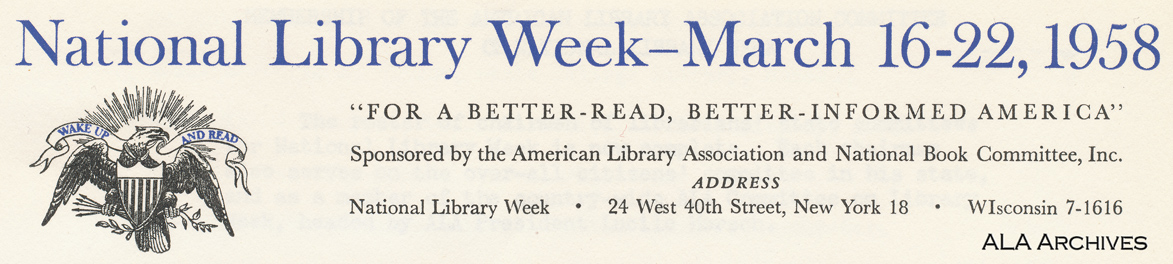
National Library Week 1958 letterhead

Sponsored by the National Book Committee, Inc., and in cooperation with the American Library Association, the first National Library Week was launched on March 16-22, 1958.  Citing a 1957 survey showing that only 17% of Americans polled were reading a book, the inaugural National Library Week slogan was “Wake Up and Read!”  The National Library Week initiative was the first nationwide effort to promote literacy for personal and national improvement, to celebrate the role of libraries in making reading materials accessible to everyone, and to highlight the varied career opportunities available within the library profession.[1]

Continue reading “National Library Week: “For a Better-Read, Better-Informed America””
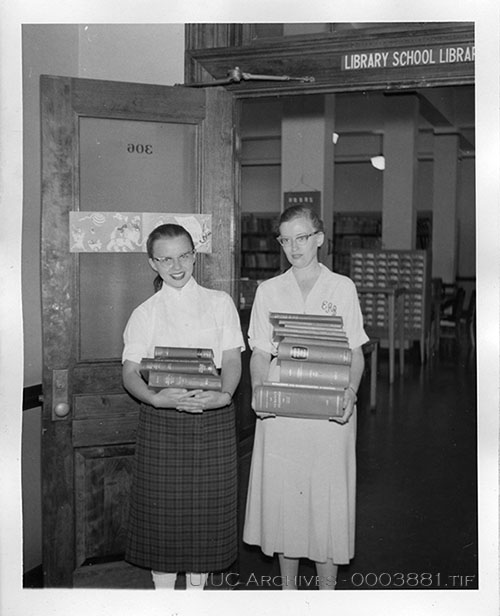
The Library Science Library at the University of Illinois, 1944-2009

Two library students stand just outside of the Library School Library, holding stacks of books.

People go to librarians when they need help researching, but where do librarians go when they need help with their own research? This post will explore the history of the Library Science Library at the University of Illinois, one of a few dedicated library science collections in the United States.

Continue reading “The Library Science Library at the University of Illinois, 1944-2009”

Have Books, Will Travel

The beginning of the Twentieth century marked the start of expansion for American libraries. A nationwide movement to establish county library systems began in 1898.  This coincided with the spread of branch libraries, which began to appear in large cities in the early 1890s. The growing number of library buildings was due in large part to Andrew Carnegie, who built libraries in 1,412 communities. The first part of the century also saw a broader range of services as librarians reached out to groups that had previously been ignored by the library: children, immigrants, minorities, soldiers, the sick and the handicapped, the working class, and isolated rural community dwellers. Continue reading “Have Books, Will Travel”