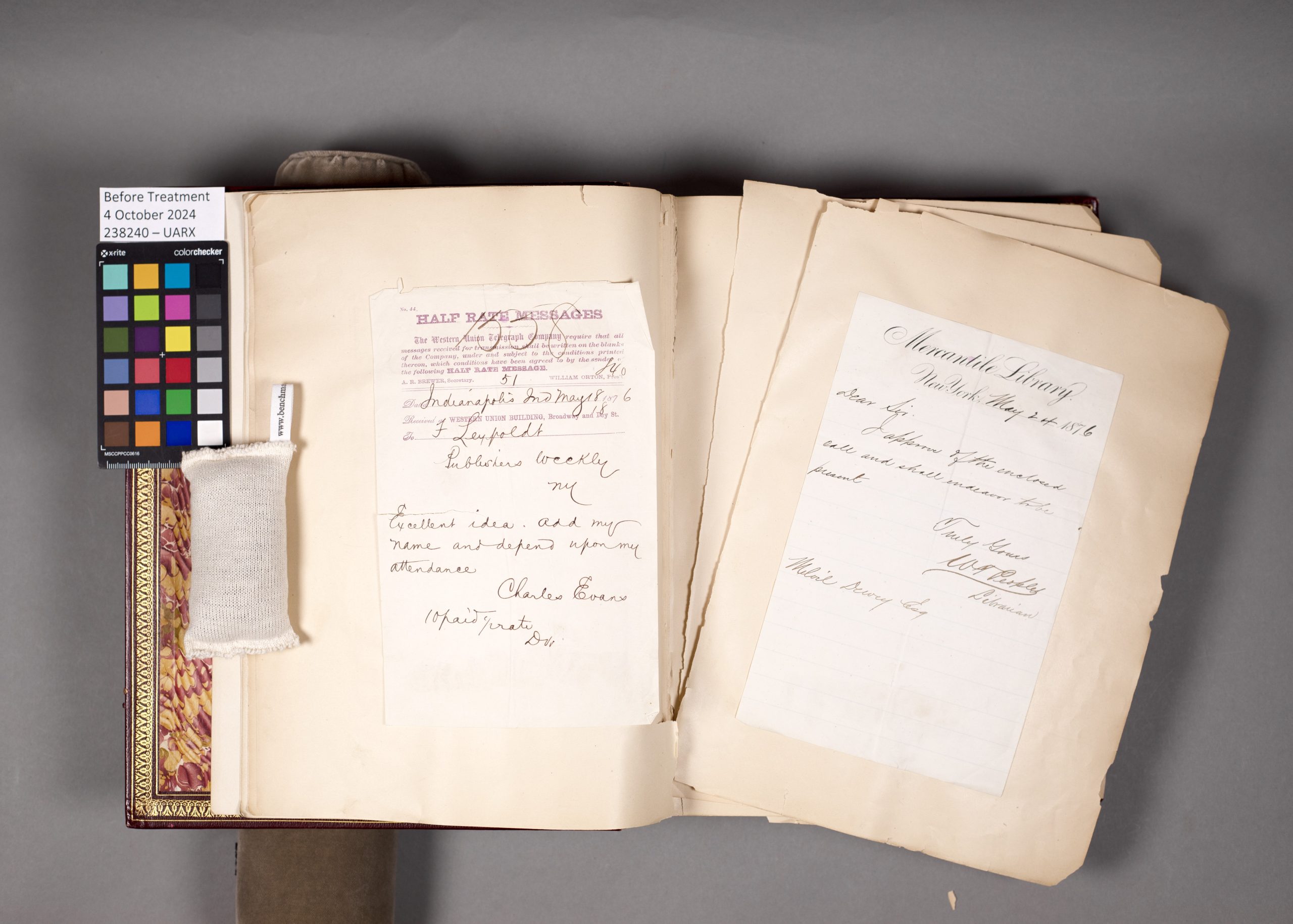
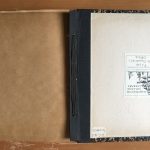
In 1926, during the fiftieth anniversary of the American Library Association, the Boston Public Library presented ALA with a scrapbook of letters, postcards, and documents tracing the origins of the Librarians’ Conference of 1876, the start of the association. The letters were kept by Melvil Dewey and Justin Winsor, prominent organizers of the conference, and later assembled into a scrapbook by someone at the Boston Public Library (BPL) in 1877, where Winsor had served as superintendent.[1] Preceding ALA’s fiftieth anniversary, Charles Belden, then director of BPL, convinced the BPL trustees to have the scrapbook rebound and transferred to ALA during its anniversary celebrations, for which Belden was the presiding president.[2]
The scrapbook in its original binding with detached pages.
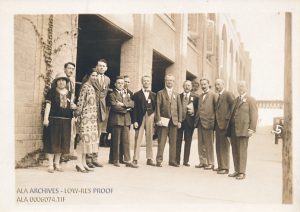
A group of foreign delegates in Atlantic City during the ALA Fiftieth Anniversary Conference, October 1926.
In early October 1926, almost sixty librarians from twenty-five countries gathered in Atlantic City and Philadelphia to celebrate the fiftieth anniversary of the American Library Association along with over two thousand American librarians.[1] By all accounts, the conference was a great success.[2] The international delegates held sessions on foreign librarianship and participated in discussions about improving international relations among librarians. But the best part of this all-expenses-paid trip to the US didn’t happen during the actual meeting: when the conference ended, about thirty international delegates went on a multi-state excursion, visiting twelve cities in the span of two weeks. From Atlantic City to Boston, Chicago to Washington, D.C., the delegates traveled by bus, train, car and steamer to see as much of the US as possible—and as many libraries as possible—ensuring they would return home with minds brimming full of library innovations and international amity.
This blog post is part of a series exploring the important events and people in ALA’s history for the celebration of the 150th anniversary of ALA in 2026.
Almost 60 years ago, the Intellectual Freedom Committee (IFC) of the American Library Association needed a partner in the fight for intellectual freedom. The 1960s brought concerns about censorship, freedom of the press, the freedom to read – and the impact on librarians who sought to uphold the values within the Library Bill of Rights and the Freedom to Read Statement. The ALA’s Office for Intellectual Freedom (OIF) was the solution, providing support and education on intellectual freedom to librarians and the public.[1] Little did they know how vital the OIF would become to the fight against book challenges and censorship and to the support of librarianship and the freedom to read everywhere. Continue reading “Fighting Censors and Book Bans: Establishing the ALA Office for Intellectual Freedom”→
This blog post is part of a series exploring the important events and people in ALA’s history for the celebration of the 150th anniversary of ALA in 2026.
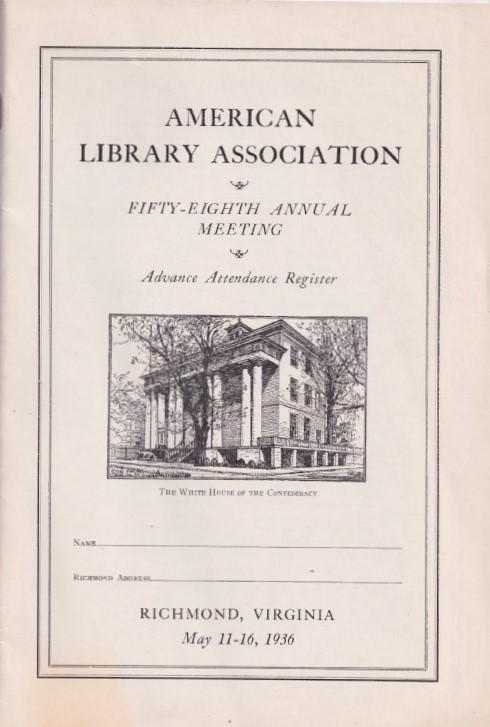
The Advance Attendance Register for the Richmond Conference displayed a rendering of the White House of the Confederacy.
Wilson Bulletin editor, Stanley J. Kunitz, called it the “The Spectre at Richmond” – but the racial discrimination at the 1936 ALA Annual Conference was no ghostly apparition.[1] The conference was held in Richmond, Virginia, a city with Jim Crow era racial segregation laws. While the American Library Association itself had no segregation or discriminatory policies, up until 1936 they had not established any ruling against holding a conference in a segregated city where members would be subject to discrimination. Thus, “the Spectre” marched into the halls of the hotels and auditoriums, reminding all librarians present that there was still work to be done. Continue reading “Librarians, Segregated: The 1936 ALA Annual Conference”→
This blog post is part of a series exploring the important events and people in ALA’s history for the celebration of the 150th anniversary of ALA in 2026.
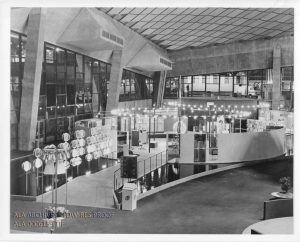
Overhead view of the entrance to Library 21 and the main exhibit space.
The ALA predicted the future 62 years ago in Seattle – the future of libraries, that is. They called their premonition “Library 21,” an exhibition at the 1962 World’s Fair. The “automated” library of the future would blend traditional library services with advancements in information technology. Partnered with companies including Remington Rand-UNIVAC, Xerox, RCA, IBM, and Encyclopaedia Britannica, Library 21 explored the importance of library services in daily life and how “electronics and information technology will have great impact on the methods we use for storing, retrieving, and communicating knowledge in the libraries of tomorrow.”[1]
The 9,000 square foot exhibit space was the first exhibit on the ground floor of the Washington State Coliseum, which drew large crowds during the Fair’s run from April 21 through October 21, 1962.[2] An estimated 1.8 million people visited Library 21 – almost 20% of the total attendance of the Fair.[3] Designed by Vance Jonson of Los Angeles and constructed by the firm Daniel, Mann, Johnson and Mendenhall, the exhibit structure itself was quite impressive. The futuristic exhibit consisted of two large circles connected to form a figure eight, with stairs from the second circle leading to the colorful Children’s World below. The circles were lit from above and surrounded by reflecting pools. Visitors approached via a bridge into the first circle, which included the UNIVAC computer, the Ready Reference Center, and the adult reading area. The second circle contained the Xerox Theater, Learning Resources Center, and other electronic exhibits. Continue reading “Library 21: ALA at the 1962 Seattle World’s Fair”→
Libraries of all kinds have suffered damages and loss due to environmental disasters like earthquakes, hurricanes, and floods. As hurricane season comes to a close (officially June 1 to November 30), it’s a good time to reflect on disaster planning. Hurricanes Florence and Michael caused significant damage in the United States this year, and Puerto Rico is still rebuilding following last year’s Hurricane Maria.
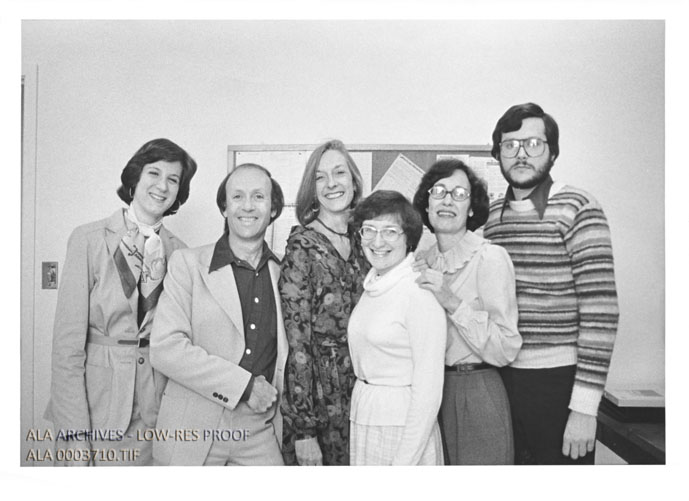
Arthur Plotnik (second to the left) and other members of American Libraries editorial staff.
This spring, the American Library Association Archives acquired a generous donation of photographs from Arthur Plotnik, a photographer, journalist, writer, and librarian. Plotnik is the former editor of ALA’s flagship magazine, American Libraries, and his career with the American Library Association spanned over twenty years. Before coming to ALA, Plotnik worked at the H.W. Wilson Company, the Library of Congress, was a staff writer and reviewer at Albany’s Times-Union, and served in the US Army reserve. He is married to artist, Mary Phelan, who has claim to University of Illinois Library fame for her portraits of University Librarians Hugh Atkinson and Robert Downs. Continue reading “Library Life: The Arthur Plotnik Photographs”→
Forty two years ago, at the 1976 Midwinter Convention, the recently established Jewish Librarians Caucus (now Jewish Information Committee) also founded a publication which would serve as an information rich resource on world issues from a Jewish perspective and issues affecting Jewish librarians and their communities. Other archival holdings also document a history of Jewish librarian leadership.
Read on to learn more about the Jewish Caucus Newsletter!
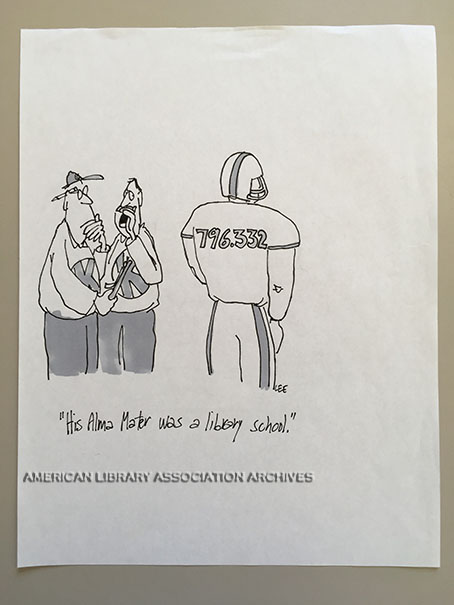
The ALA Archives holds many treasures in unexpected places. The Issue Photographs files of American Libraries magazine in one such place, holding materials like original art and illustrations, such as original cartoons by Richard Lee. Lee’s cartoons for American Libraries are a treasure trove of classic and original library humor and were mostly published in the 1990s and 2000s, though many of the jokes are still relevant to libraries today. Continue reading “Richard Lee’s Cartoons: Illustrations of Librarian Humor”→
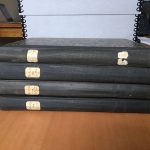
We have recently processed the materials of a particularly interesting record series, The Nathaniel L. Goodrich Scrapbooks, 1881-1902 (97/1/77). Born in 1880, Nathaniel L. Goodrich was the Librarian at Dartmouth University for 38 years—from 1912 until he retired in 1950—and was granted full professorship in 1943. He passed away on April 30, 1957, exactly 60 years ago. The record series includes four scrapbooks dating back to the early twentieth century, which had been discarded from the Dartmouth College Library in Hanover, New Hampshire. In the scrapbooks, Goodrich had collected and arranged an assortment of materials relating to library buildings.