Despite missing Valentine’s Day, the ALA Archives can’t let the month of February go by without talking about Mary and Herbert “Herb” Biblo, one of the great couples in American Library Association history. Between the two of them, they contributed decades of service to ALA and established themselves as advocates for social justice within the association and the profession of librarianship. In an interview with Herb, Art Friedman, a friend, succinctly and accurately, summed Herb and Mary up as “a very active husband and wife team in librarianship.”
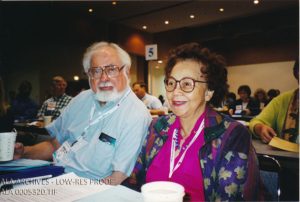
Herb and Mary met in Indiana and Herb said that he pursued Mary and after “[making] myself impossible, she agreed to marry me.” Herb and Mary, an interracial couple, had to get married in Illinois as Indiana still had anti-miscegenation laws at the time and could not marry in Mary’s home state. Not long afterwards, the couple moved to Chicago.[1]
While in Chicago, Herb started teaching grade school and when a school librarian position opened, and went unfilled, he took the role. This was the start of Herb’s career in librarianship, and he would later work at the John Crerar Library and the Illinois Institute of Technology, before becoming director of the Long Island Library Resources Council (LILRC) for 35 years.[2] Mary worked as the Head Librarian of the University of Chicago Laboratory School from 1970-1998. When Herb took the job with LILRC, located in New York, he said that he thought he and Mary were in agreement, but he realized that Mary was not going to leave her job at the University of Chicago. He said for 17 years they had a “commuting marriage” until Mary retired in 1998.[3]
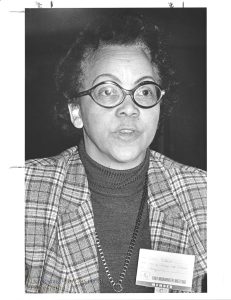
In an American Libraries article, Mary said that she started her membership in ALA the 1970s and in midst of The Speaker controversy. The film, produced by the Intellectual Freedom Committee and promoting the freedom of speech by protecting controversial topics, left members accusing ALA of racism. Mary, a Black librarian, in reflection of the event in 2014, stated that, “This is what got me started and I haven’t stopped since.”[4] Within the Social Responsibilities Round Table (SRRT), Mary served on the Dr. Martin Luther King, Jr. Holiday Task Force, which brought about the Sunrise Celebration, previously a fixture of the ALA Midwinter Meeting. She also served on the Coretta Scott King Book Award Task Force (now its own Round Table), celebrating and honoring Black authors and illustrators in children’s literature. She was active in the American Association of School Librarians, the Intellectual Freedom Round Table, and the Black Caucus of the American Library Association, along with other library groups and associations. One of Mary’s most enduring legacies is her work on ALA Council, serving 42 consecutive years.
In an interview, Herb said that his first ALA Conference was in Atlantic City (1969). He claimed that there were so many veterans who had come into the profession and were making demands of ALA that the association was not used to, that the following year ALA hired its first parliamentarian.[5] He would become inspired by upcoming progressive leaders within the profession. In 1978, Herb would submit the SRRT’s Affirmative Action Resolution, seconded by E. J. Josey, urging ALA Council to reaffirm its position on affirmative action.[6] He would also protest apartheid in South Africa, citing it as a motivator for his involvement in the International Federation of Library Associations.[7] From 1980-1984, Herb served as the ALA Treasurer.
While Mary and Herb lived apart for 17 years, their work within ALA brought them together. Both Mary and Herb were active members of SRRT, becoming members in the round table’s early years. They served together on ALA Council, and Herb noted that at one point, he, Mary, and their daughter, Lisa, had all served on Council at the same time. Together, they worked towards bringing social justice and addressing controversial issues within ALA.
Herb passed on March 30, 2018, shortly after his retirement. In Council’s memorial resolution, his work in social justice was acknowledged and that “engaged in struggles for workers and civil rights, against apartheid in South Africa, and in many other US and international causes through his engagement” in ALA and IFLA.[8] In 2020, Mary was honored by ALA in a tribute resolution, recognizing her decades of outstanding service, her advocacy for school libraries, and acknowledging her as a “mentor and inspiration for countless councilors and all library workers.”[9]
A tribute to Herb can be found in the Library History Round Table’s digital memorial, Librarians We Have Lost, in the ALA Institutional Repository: https://hdl.handle.net/11213/23951.
[1] Herb Biblo, “Episode 37 – An Evening with Herb Biblo of LILRC,” March 16, 2018, The Library Pros: https://www.thelibrarypros.com/episode-37-an-evening-with-herb-biblo-of-lilrc/. This interview is also preserved in the ALA Archives as Herbert Biblo Interview, March 16, 2018, record series 97/1/78.
[2] Ibid.
[3] Ibid.
[4] “Resurrecting the Speaker,” American Libraries, July 1, 2014: https://americanlibrariesmagazine.org/blogs/the-scoop/resurrecting-the-speaker/
[5] Biblo, The Library Pros.
[6] Social Responsibilities Round Table, “Affirmative Action Resolution,” 1978: https://hdl.handle.net/11213/23260
[7] Ibid.
[8] Mary W. Ghikas, “Memorial Resolution for Herbert Biblo (1924-2018),” adopted by ALA Council, June 16, 2018.
[9] ALA Council, “A Tribute Resolution Recognizing Mary Biblo for 42 Years of Service as an ALA Councilor-At-Large and 49 Years of Service as an ALA Member,” June 8, 2020.