News and Events

Shining a Light on Distinguished Alumni: 滋賀重列 SHIGA Shigetsura

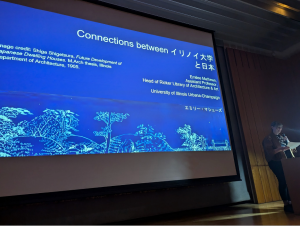
Presenting at the 美術アーカイブと図書館における国際連携 / International Collaboration in Art Archives and Libraries, Tokyo National Research Institute for Cultural Properties, Tokyo, Japan in October, 2024

From Emilee Mathews–

I have already mentioned elsewhere that I went to Japan last fall as part of a trip organized by the Art Libraries Society of North America. We were a total of 16 U.S. art librarians and participated in site visits and tours across a number of notable Japanese art libraries and museums.

I want to spent some time on the presentation I gave at the Tokyo National Research Institute for Cultural Properties (Tobunken), which involved exploring connections between University of Illinois and Japan / イリノイ大学 と日本 (Irinois Daigaku to Nihon). The least known person I spoke about was  滋賀重列 SHIGA Shigetsura, and so I want to take an opportunity to put out the new information I was able to synthesize from a couple sources.

I first learned about Shiga-san when I asked the University Archives for early material about Japan at the University, and they pointed me to this excellent post by former employee Salvatore De Sando. I was able to use this article as a jumping
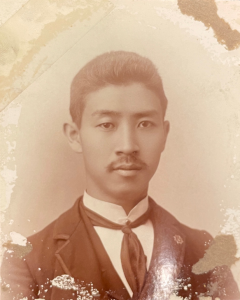
Portrait of Shiga-san as a student

off point to track down more information and follow up some leads, which I want to capture here in this post. I also want to capture my delight at being able to visit Shiga-san’s last remaining building he designed in Tokyo! More about that below.

Japanese students began to matriculate into the University within a few years of the school’s founding, there are several we know about as documented in The Daily Illini. The first Japanese student who not only attended but also graduated from University of Illinois is Shiga Shigetsura in 1893 (pictured left), who also earned his degrees in architecture!

Shiga-san’s undergraduate thesis was on the effect of oil upon lime mortar, and his master’s thesis from 1905 is, Future Development of Japanese Dwelling Houses. You can see it is approved by none other than Nathan Clifford Ricker (pictured right), one of our most notable
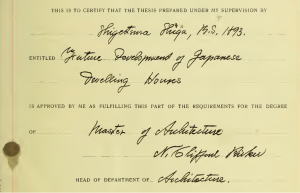
Signature page of Shiga-san's thesis showing Ricker's signature
Signature page of Shiga-san’s thesis showing Ricker’s signature

alumni, who graduated in 1867 and was the very first student to graduate from an American architecture program. Ricker went on to become a professor in the architecture program, and later was the department head and dean of the college of Engineering (which Architecture was a part of at the time). We here at Ricker Library are always interested to see what our namesake got up to in his lifetime, and how he connects with other figures in the University of Illinois’ early history.


In his master’s thesis Shiga-san postulated that in the contemporaneous period of
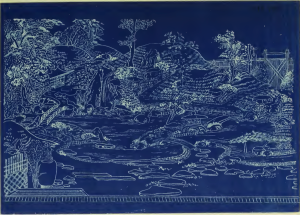
Drawing of Japanese domestic landscape in Shiga-san's thesis
Drawing of Japanese domestic landscape in Shiga-san’s thesis

Western influence and increased trade, Japan had the opportunity as a nation to rethink a core yet under-considered aspect of its building typology: that of domestic architecture. He had several recommendations for strategically introducing Western-influenced building programs, materials, and techniques into Japanese housing. As he is writing for an American audience, he discusses and illustrates the fundamental characteristics of Japanese dwellings, and typical Japanese gardens and temples.

Shiga-san made an impact both on campus and for the University of Illinois’ broader reputation, which the Illini Everywhere article documents quite well. He was elected vice president of the Architectural Club in 1892. He wrote articles in campus publications about his journey from Japan to California,
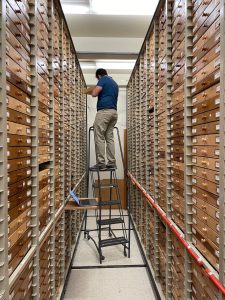
Dr. Tommy McElrath searching for Shiga-san's insects in the Insect Collection at the Natural History Survey.
Dr. Tommy McElrath searching for Shiga-san’s insects in the Insect Collection at the Natural History Survey.

Japanese temples, Japanese women, and the history of exchange between Japan and Europe.

He also worked with the burgeoning Illinois Natural History Survey whose mission was, and still is, to conduct a scientific study of local ecology, and spent several summers traveling around Illinois collecting insect specimens.

I wanted to see for myself some of the insects Shiga-san collected, so I visited the Natural Resources Building and collection on campus (only two buildings south from Ricker in the Architecture Building!). I met Dr. Tommy McElrath who is an entomologist and is in charge of the INHS Insect Collection, which numbers in the millions. He told me that Shiga-san collected over 1,400 specimens for the insect collection.
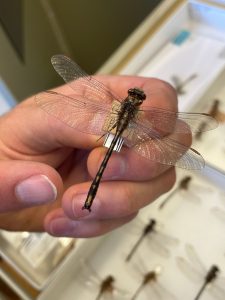
Club-tailed dragonfly captured by Shiga-san during insect collection trip.
Club-tailed dragonfly captured by Shiga-san during insect collection trip. Information from the log: Species: Gomphus graslinellus. Location: Cedar Lake, Illinois. Category: Insects on or near water. Date of collection: June 20, 1892.

I was surprised to hear that insects collected 130 years ago are still very much used today. I learned there are several reasons why historical specimens are useful and important. For example, at the time of my visit, several of Shiga-san’s collected insects were out on loan for a research project to compare insect body size over time to determine the impact of climate change. Two, the specimens were collected before industrial agricultural practices became commonplace in the state. For example, another specimen, the 9-Spot Lady Beetle, was plentiful at the time of collection but is currently extirpated in the state and on the federal endangered species list. Last, insect identification and classification is very much still ongoing.  For example in just beetles alone, there are over 400,000 identified species, and the entomological community currently estimates there are approximately 15 million beetle species in the world. Two of the beetles we looked at from Shiga-san were consulted as part of a genus revision, one in the 1960s and one in 2015. (Thank you Dr. McElrath for explaining the significance to me, a non-science person.)

Shiga-san worked for the Natural History Survey in 1891 and 1892, and these specimens were collected to show at the Columbian Exposition which took place in 1893 in Chicago, Illinois. We see here (pictured right) from the Illinois building at the fair in which the University, only 25 years old at the time, showed visitors examples of collections and student work. Apologies for the very dark image, photography was only about a 30-year-old technology at the time.
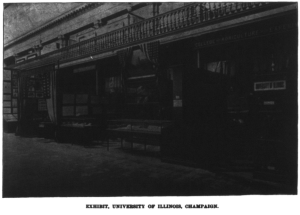
Photograph of the University of Illinois' exhibit in the Illinois Building at the Columbian Exposition, 1893, Chicago, Illinois
Photograph of the University of Illinois’ exhibit in the Illinois Building at the Columbian Exposition, 1893, Chicago, Illinois

The Columbian Exposition was also remarkable from a U.S.-Japan relationship perspective. While there had been other world’s fairs such as in London 1851, Philadelphia in 1876, Paris in 1889?, this 1893 was the first time that Japan as a nation decided to build their own pavilion. This was a building modeled after the Hooden or Phoenix temple in Kyoto, built by master workers, and was the largest of any country’s pavilions at the exposition. (Not incidentally, this was the first time Frank Lloyd Wright saw Japanese architecture and you could definitely say this was life changing for him and his body of work.) Shiga-san was connected to the exposition in 3 ways: first, as I mentioned, he spent several trips in regions across Illinois collecting insect specimens to be included in the exposition, in the Illinois building specifically for the state laboratory of Natural History. Second, he was actually employed as a clerk in the Japanese display (which is different from the pavilion) located in the Manufactures and Liberal Arts building, which a variety of countries showed examples of their specializations. Thirdly, he helped to secure Japanese art to be bought locally by Professor Frank Forrest Frederick who was one of two art professors at Illinois, which we have a newspaper article from the campus paper. We have evidence by way of a newspaper article in the campus daily news that art from the Japanese exhibition was on view for a week at the University.
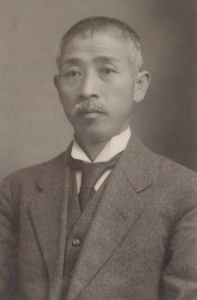
Shiga-san as a distinguished older gentleman

Shiga-san graduated in 1893 and returned to Japan. He became a professor of architecture at the Tokyo Institute of Technology, now called Tokyo Tech. He also designed a building for Tokyo Tech. I’m hoping to find more information about that topic someday, perhaps a future trip to Japan!

He was the Architect to the Education Department of the Imperial Government, 1900-1903 and 1908-1912. He was awarded the Fifth Order of the Sacred Treasure; according to one source I have he was Second grade of Fourth rank in the Imperial Court, another says “bearer of the first grade rank of the imperial government.” Also, I see he was editor for a “Journal of Architecture” in the 1910’s. I would love to be able to add copies to Ricker’s collections someday.
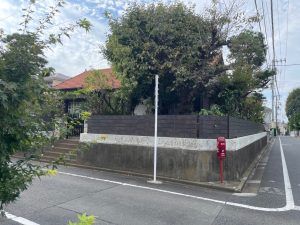
Shiga-san's only known extant building he designed - the family home, still occupied by his descendants.
Shiga-san’s only known extant building he designed – the family home, still occupied by his descendants.

Shiga-san looked back fondly on his time at Illinois, as he served as the President of the Japan alumni club for several decades and hosted Illinois visitors, including the Illinois Baseball team in 1928.


As I mentioned, I gave a presentation about Shiga-san to Japanese colleagues in October, 2024 in Tokyo while visiting. One colleague, KIKKAWA Hideki, was kind enough to point out to me that Shiga-san’s last known extant building he designed was recently added to the national historic register. As I had some free time I went ahead and visited the property, which is located near Iogi station in west Tokyo. It was a cute, very residential neighborhood with local schoolchildren planting a garden nearby. I was touched that Shiga-san’s master’s thesis was about domestic architecture, and his legacy is his family home he designed, which his family still lives in today. How wonderful is that!

Acknowledgments:

I’d like to acknowledge a number of people who helped me track down information on these topics: Sammi Merritt, Jameatris Rimkus, Bethany Anderson, Salvatore De Sando, Steve Witt, Tommy McElrath, and KIKKAWA Hideki.

Further Reading

There are several articles by and/or about Shiga-san in the Illini Everywhere article – I will just add below those that I consulted most heavily and/or were not covered in that article.

“CLUB HEARS TALK ABOUT JAPANESE TRIP.” Daily Illini, 23 October 1928.

“DISTINGUISHED JAPANESE GRADUATE OF THE STATE UNIVERSITY.” Daily Illini, 19 January 1900.

“旧滋賀家住宅主屋/Former Shiga Family Residence Main Building.” Suginamigaku, March, 2024.

“Illini Everywhere: Japanese Illini since 1872.” University Archives Student Life and Culture, September 2019.

JAPANESE ILLINOIS CLUB INVITATION TO TOURING ILLINI. Daily Illini, 21 April 1915.

The Illinois Building and Exhibits Therein at the World’s Columbian Exposition, 1893. Chicago: John Morris Company, 1893.

The semi-centennial alumni record of the University of Illinois, ed. by Franklin W. Scott. Urbana : University of Illinois; 1918.

Shiga, Shigetsura.Future development of Japanese dwelling houses. Master’s Thesis, 1905.
Walker, John Brisben, 1847-1931, and Ill.) World’s Columbian Exposition (1893: Chicago. A World’s Fair, 1893. [United States?: J.B. Walker, 1893.

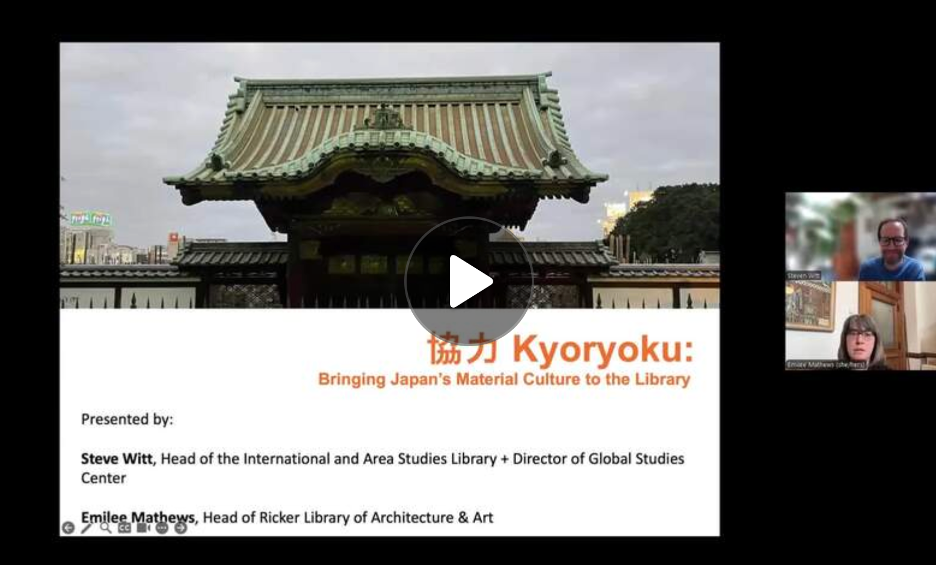
Library Friends Webinar: 協力 Kyoryoku: Bringing Japan’s Material Culture to the Library

In October 2024, Head librarian Emilee Mathews was fortunate enough to travel to Japan for professional development, research, and collection development. She collaborated with Steve Witt, Japanese Studies Librarian and head of the International and Area Studies Library, to give a presentation on international relationships and buying trips at the University Library.

Emilee also documented the experience on Ricker’s Instagram account  – you can find the posts associated with this event by searching #RickerinJapan.

The March, 2025 presentation is linked here. Thank you everyone who attended!

Image of Kyoroku video recording

Teaching and Learning Menu – new webpage and recording!

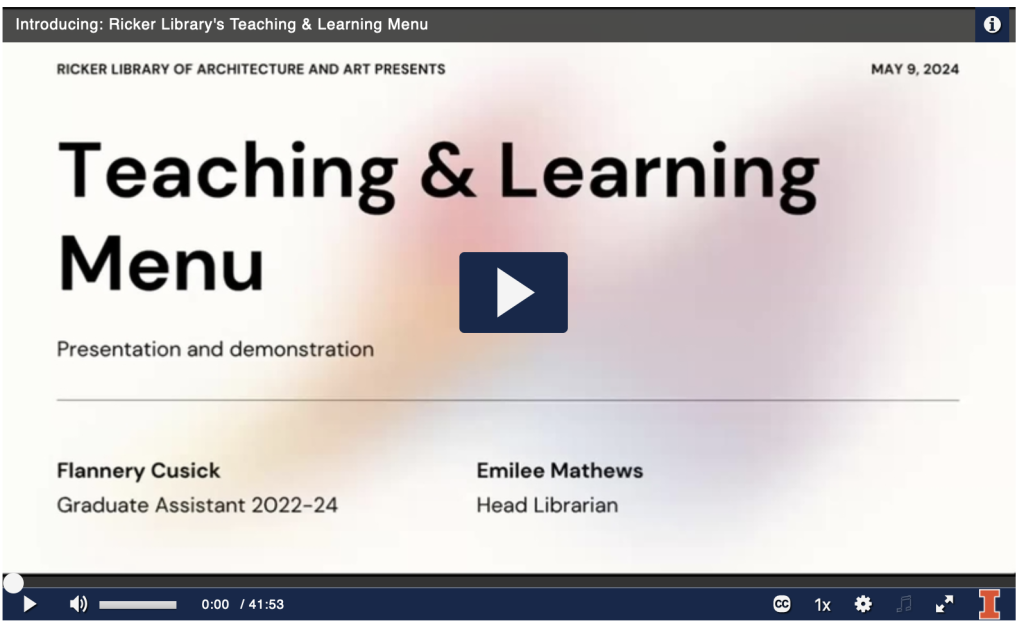
screenshot of the webinar recording for "Introducing Ricker's Teaching and Learning menu"The question is evergreen: How do we get campus partners in teaching and outreach engaged, excited, and informed about what we do, our impact, and how to work with us? Ricker Library has created a new Teaching & Learning Menu to try to solve this problem: We articulate the library’s pedagogy, policies, and offerings for instructional sessions, workshops, collaborations, and more. This menu not only publicizes the library’s teaching and learning services, but also simplifies the process of requesting sessions and expand outreach beyond existing relationships with faculty members, students, and the Champaign-Urbana community.

On May 9, 2024, Ricker Graduate Assistant and menu mastermind Flannery Cusick presented a virtual webinar, “Introducing:  Ricker Library’s Teaching & Learning Menu.We discussed the goals of the project, demostrated the website, and sparked discussion on this topic many of us grapple with. 

We had over 50 people join us for the webinar, and as of July 2024 approximately 30 plays on the Mediaspace video. We had a productive session discussing how we can better engage, excite, and inform our campus partners about our library’s teaching and outreach efforts. For those who attended, we appreciate your active participation and insightful contributions. We hope the demonstration of our Teaching & Learning Menu provided you with useful strategies and ideas to implement in your own work.

For those of you who were unable to attend, we have good news! A recording of the webinar with closed captioning is available for you to view at your convenience, and you can access it here. If you have any lingering thoughts, feedback on our session, or questions about the Teaching & Learning Menu, please feel free to fill out our Feedback Form or contact the Ricker Library team.

We look forward to hearing from you!

Teaching & Learning Menu

Webinar Recording

Feedback Form

View our Slides


Thanks, Emilee and Flannery

Anti-Racist Action Plan, Update #3

We created an Anti-Racist Action Plan in Summer 2020 to guide our objectives and hold ourselves accountable. As part of that, we are providing regular updates on our progress, and here’s the third update:


#1: Ensure that diversity, equity, and inclusion lie at the heart of all that we do.

  • All new hires, including faculty, academic professionals, graduate, and undergraduate employees have position requirements that outline a commitment to diversity, equity, and inclusion – DONE
  • We are working on incorporating this commitment into existing job descriptions – IN PROGRESS
  • We will work towards hiring BIPOC employees, particularly when full-time, permanent positions open – IN PROGRESS. We have a fulltime position for a Visiting Design and Materials Research Librarian opening soon. The search committee has been formulated, and we are working on identifying and implementing best practices in recruiting and hiring diverse individuals for the position.

Continue reading “Anti-Racist Action Plan, Update #3”

Aspen Magazine: Art in a Box Recording Available


A recording of the event, “Aspen Magazine: Art in a Box” is now available!

graphic for Aspen magazine event

Aspen Magazine:
Art in a Box

A Special Presentation by
Emilee Mathews
Art and Architecture Librarian

Aspen Magazine is a renowned publication that brought together leading artists across the United States and the United Kingdom, running from 1965 to 1971. The subject of recent museum exhibitions from Walker Art Gallery in Minneapolis, Minnesota, and Whitechapel Art Gallery in London, Aspen Magazine is one of the most iconic examples of the 1960’s artist magazine movement. Each issue was directed by artists and designers who determined all aspects of the issue’s intellectual and visual content. Editors included Andy Warhol (who edited the Pop Art issue in 1966) and Angus MacLise of the Velvet Underground (who edited the Psychedelic issue in 1970). Articles—often in pamphlet form, many times including Super 8 films, reel-to-reel tapes, and records—featured such luminaries as Marshall McLuhan, Lamonte Young, Roland Barthes, and Lou Reed. Topics across art, design, architecture, music, literature, media, and film were featured regularly.

Art and Architecture Librarian Emilee Mathews will go behind the scenes to delve into the magazine’s formation and context, and will show the Ricker Library of Architecture and Art’s recently donated copy to feature highlights from the magazine’s short but spectacular run.

Decentering the Canon Recording Available

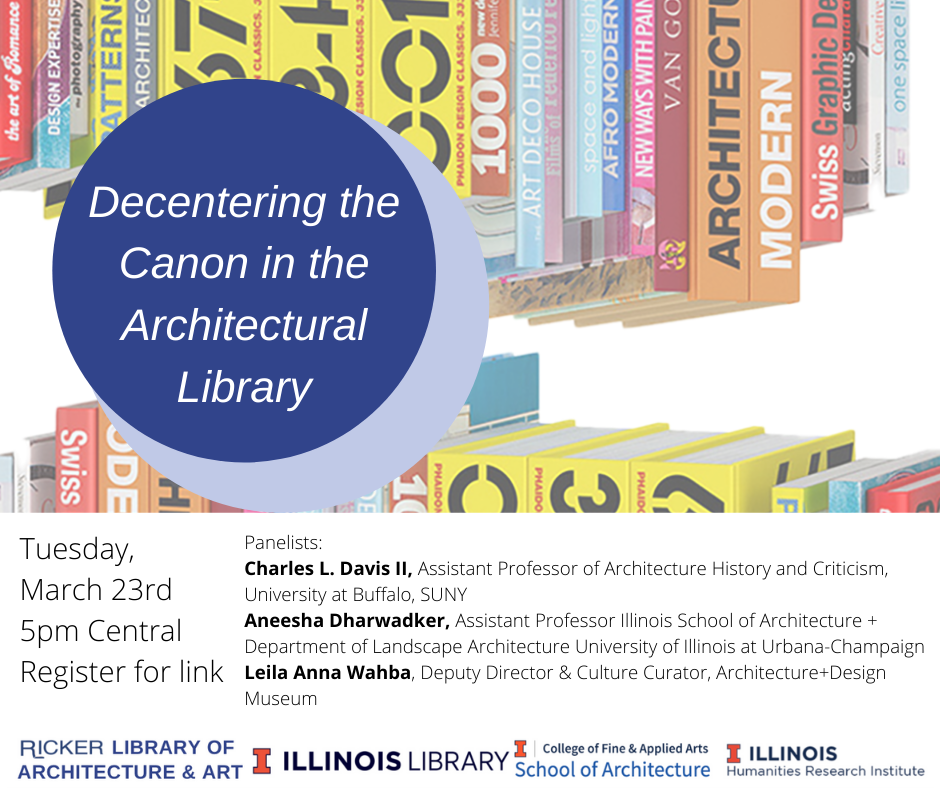
Decentering the Canon in the Architectural Library graphic

The recording is now available with some simple navigation so that you could go to the first topic, the second topic, the Q&A, or just start from the beginning.

Additionally, Ricker has put together a quick bibliography of resources brought up during the panel, by the discussants, audience members in the Q&A, and what have been submitted since in the survey. Please provide comments and suggestions! deliberately to ask for your comments and further suggestions in this at least somewhat collaborative format. Lastly, a post-event survey is available to collect feedback.

Decentering the Canon in the Architectural Library event

Decentering the Canon in the Architectural Library graphic

Please join us for a panel discussion on decentering the canon in the architectural library. The library collects materials that have filtered through such canonizing forces as higher education and the publishing ecosystem. Can the library broaden the canon, or does it merely reinforce it? What critical interventions might we make to resist our canonizing tendencies, for today and or tomorrow?

Our panelists include expertise from a broad range of disciplines within architecture, including architectural history, museums, and practice:

  • Charles L. Davis II, Assistant Professor of Architecture History and Criticism, University at Buffalo, SUNY
  • Aneesha Dharwadker, Assistant Professor Illinois School of Architecture + Department of Landscape Architecture University of Illinois at Urbana-Champaign
  • Leila Anna Wahba, Deputy Director & Culture Curator, Architecture + Design Museum, Los Angeles

The panel will be moderated by Soumya Dasgupta, PhD. candidate in Architecture (History and Theory) in the Illinois School of Architecture, and Emilee Mathews, Head of Ricker Library of Architecture and Art, at the University of Illinois at Urbana-Champaign.

This event is hosted by the Ricker Library of Architecture and Art in partnership with the Illinois School of Architecture; funding is provided by the University of Illinois Library Innovation Fund and co-sponsored by the Humanities Research Institute.

Register here for the event: https://bit.ly/37GmuQj

Anti-Racist Action Plan, Update #2

We’ve created an Anti-Racist Action Plan to guide our objectives and hold ourselves accountable. As part of that, we are providing regular updates on our progress, and here’s the second update:


#1: Ensure that diversity, equity, and inclusion lie at the heart of all that we do.

  • All new hires, including faculty, academic professionals, graduate, and undergraduate employees have position requirements that outline a commitment to diversity, equity, and inclusion – DONE
  • We are working on incorporating this commitment into existing job descriptions – IN PROGRESS
  • We will work towards hiring BIPOC employees, particularly when full-time, permanent positions open – IN PROGRESS. We have a fulltime position for a Visiting Design and Materials Research Librarian opening soon. The search committee has been formulated, and we are working on identifying and implementing best practices in recruiting and hiring diverse individuals for the position.

Continue reading “Anti-Racist Action Plan, Update #2”

Bridget R. Cooks Lecture


Modern Art Colloquium and Ricker Library present:


Xaviera Simmons, High Seasoned Brown, 2004

Contemporary Landscape Photography and the Black Female Figure

Wednesday, September 9 @ 5:30pm CT
Registration Link: https://forms.gle/kM5QUHnizfRWf4NX9

a lecture by

PROFESSOR BRIDGET COOKS

University of California, Irvine


More about Dr. Cooks:

Portrait of Bridget R. Cooks

Bridget R. Cooks is Associate Professor in the Department of Art History and the Department of African American Studies at the University of California, Irvine. Her research focuses on African American artists, Black visual culture, and museum criticism. Cooks has worked in museum education and has curated several exhibitions including, Grafton Tyler Brown: Exploring California, (2018) (Pasadena Museum of California Art); and Ernie Barnes: A Retrospective at the California African American Museum (2019), and the forthcoming exhibition The Black Index.

She is author of the book Some of her other publications can be found in Afterall, Afterimage, American Studies, Aperture, and American Quarterly. She is currently completing her next book titled, Norman Rockwell: The Civil Rights Paintings.

Continue reading “Bridget R. Cooks Lecture”