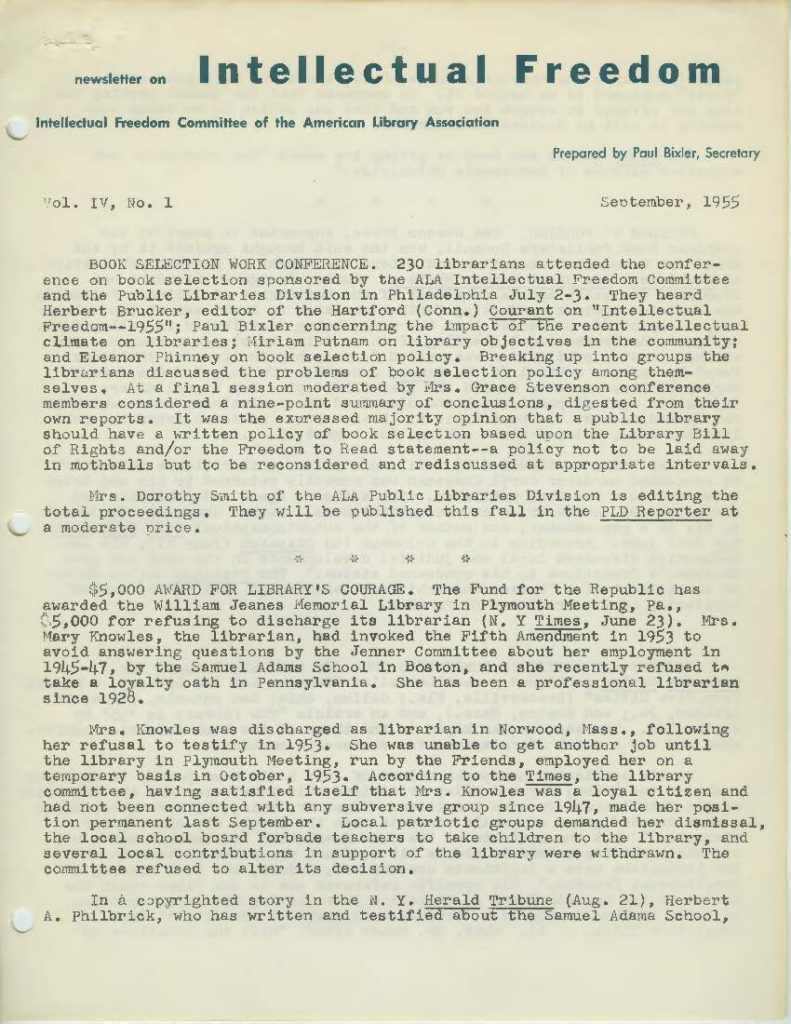
In the spring of 1953, Mary Knowles was fired from her position at the South Norwood Branch Library outside of Boston. Previously, Knowles had been called before the United States’ Senate Internal Security Subcommittee (SISS) and questioned about alleged communist activities during her 1945-1947 tenure at the Samuel Adams School for Social Studies, an institution on the US Attorney General’s list of subversive organizations.[1] Knowles invoked her fifth amendment right and refused to answer the subcommittee’s questions; although no action was taken against her by SISS, the South Norwood Branch Library terminated Knowles’ employment due to her refusal to testify.[2]
Later that year, Knowles was hired as a librarian on a temporary contract at the William Jeanes Memorial Library outside of Philadelphia while the permanent librarian was in recovery for an injury. When she was asked to take the Pennsylvania Loyalty Oath, Knowles refused and responded with a letter explaining her stance:
“On the Matter of loyalty to the United States, I believe it is one of the responsibilities of a mature citizen to be actively aware of and engaged in the demonstration of loyalty at all times. I think the imposition of a loyalty oath robs a citizen of such responsibility, and weakens the need for active participation on the part of the individual.”[3]
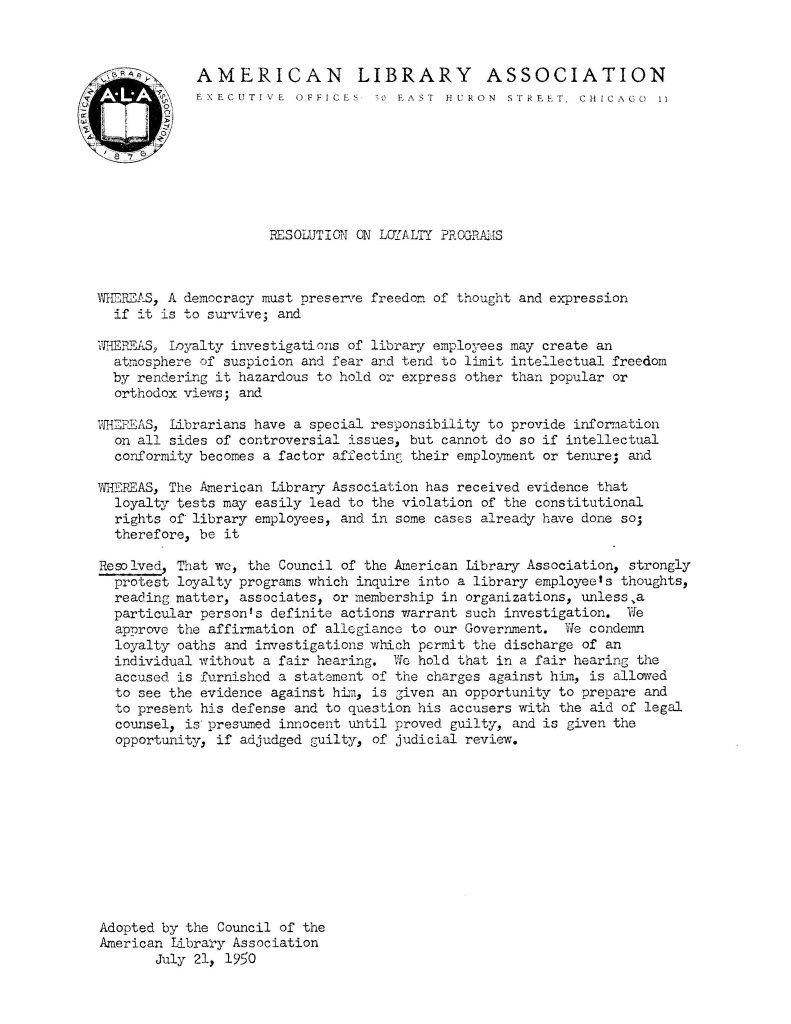
In 1954, after the injured librarian retired, Knowles accepted a permanent position at the library. Despite her refusal to take a loyalty oath and the strife her hiring caused in local government meetings and amongst local residents, the library’s governing committee chose to stand behind their decision to employ Mary Knowles based on her qualifications as a librarian.[4]
Soon after, an organization known as the Fund for the Republic awarded the library committee $5,000 for “courageous and effective defense of democratic principles.”[5] The Fund for the Republic was later under investigation by a subcommittee of the House Un-American Activities Committee (HUAC), where the award given to the library committee was specifically called into question. Chairman Francis E. Walter stated: “The committee wishes to know more about the factors which prompted the Fund for the Republic to consider the retention of a Communist a defense of ‘democratic principles’ worth $5,000 of its tax-exempt money.”[6]
Mary Knowles was once more called to Washington in 1955 to testify before the SISS, where she once again refused to answer questions about the Samuel Adams School for Social Studies. She did not invoke her fifth amendment right this time, however, stating that “since any association that I had with an organization on the Attorney General’s list was so far in the past, that I would no longer be privileged to claim the fifth amendment, I have not done so.”[7] Because she did not invoke her Fifth Amendment right when she declined to answer the subcommittee’s questions, she was cited with 58 counts of Contempt of Congress, each count representing a separate refusal to answer a question. She was convicted on 52 of these counts in 1957, with each count incurring a fine of $500 and 120 days in jail. The conviction was overturned by the US Court of Appeals in 1960 after much of the McCarthyism hysteria had subsided.[8]
The library committee stood behind Knowles throughout this entire ordeal, going so far as to publicize her conduct: “Even under the greatest stress she has gone quietly about her own affairs and has managed to do a highly credible job as a librarian. She has stood firmly by her stated principles; she has acted without recrimination.”[9] Her example of professional defiance during the Red Scare endures as a lesson in speaking truth to power when civil liberties are suppressed. Knowles served patrons as librarian and eventually as director of the William Jeanes Memorial Library until her retirement in 1979.[10]
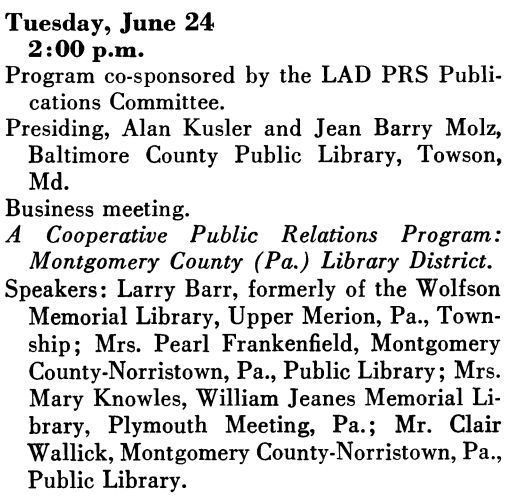
Mary Knowles is featured as part of a recently installed exhibit in concert with this year’s Gryphon Lecture where Wayne A. Wiegand, the F. William Summers Professor of Library and Information Studies Emeritus at Florida State University, spoke on missing stories in American library history. This exhibit utilizes materials from the research done by Professor Wiegand at the ALA Archives for his book In Silence or Indifference: Racism and Jim Crow Segregated Public School Libraries, and will be available for viewing at The Center for Children’s Books until the end of the Spring 2026 semester.
[1] “Plymouth Meeting Librarian Refuses to Testify,” Newsletter on Intellectual Freedom 4, no. 2, January 1956, 3.
[2] “$5,000 Award for Library’s Courage,” Newsletter on Intellectual Freedom 4, no. 1, September 1955, 1.
[3] Civil Liberties Committee of the Philadelphia Yearly Meeting of the Religious Society of Friends, The Plymouth Meeting Controversy, by George Willoughby, Emerson L. Darnell, Robert C. Folwell, Paul A. Lacey, Olcutt Sanders, Harry E. Sprogell (Philadelphia, 1957), 8. https://hdl.handle.net/2027/mdp.39015031054029
[4] Ibid., 9.
[5] Ibid., 15.
[6] Ibid., 18.
[7] Ibid., 23.
[8] Everett T. Moore, “The Plymouth Meeting Controversy,” ALA Bulletin 54, no. 8, September 1960, 648.
[9] Civil Liberties Committee of the Philadelphia Yearly Meeting of the Religious Society of Friends, The Plymouth Meeting Controversy, 3.
[10] “Retirements,” American Libraries 10, no. 11, December 1979, 674.