ACDC News – Issue 12-15

Remote rural Australians on the wrong side of the digital divide. And it’s not so much about distance.

Plans during 2008 for super-fast broadband services excluded two percent of Australia. A year later, the proportion had risen to 10 percent in “remote” and “very remote” regions. Communications researcher Lelia Green reported this challenge in a recent article in the journal, Culture Unbound .

Her historical analysis also examined perspectives of rural Western Australians when the telephone, broadcast radio, two-way radio, and satellite were introduced. Findings suggested that while these remote residents were keen to gain access through new communications technologies they did not imagine such services so much in terms of “dispelling of distance.” Instead, they imagined them in terms of equity and interconnections. Those challenges remain as the National Broadband Network takes shape, she concluded.

You can read the article, “Imagining rural audiences in remote Western Australia,” at: http://www.cultureunbound.ep.liu.se/v2/a09/cu10v2a09.pdf


New issue of JAC available online

Concerned about assuring the integrity of online public research reporting? Interested in website design, use of social media by farm organizations, sources of information about agroterrorism, or competencies needed by future agricultural communicators?

You can read four research reports, a commentary, and two book reviews in the new issue of the Journal of Applied Communications . This open-access journal is published by the Association for Communication Excellence in Agriculture, Natural Resources, and Life and Human Sciences (ACE).

Read Issue 2 of Volume 96 at: http://journalofappliedcommunications.org .


Promising ITs for use in agricultural and environmental sciences.

Writing in a 2012 issue of Agricultural Informatics/Agrárinformatika , Rȯbert Szilágyi suggested several information technologies he considers promising. Among them:

  • Cloud computing “provides equality in resources management and exploitability.”
  • Parallel computing “brings exponentially increased core processing to low-end computers facilitating the use of huge computer power by small agricultural research units.”
  • Mobile internet can implement e-government service “as a cost effective and technical interoperable solution, by providing open sources.”
  • On-farm sensor networks “provide remote, real-time monitoring of important farming operations.”
  • Mobile broadband “is among the areas where growing revenues are expected.”

You can read more about these and other possibilities at: http://journal.magisz.org/index.php/jai/article/view/77


Losing the language of Nature .

“What does it say about Western industrialized society when the latest edition of the Oxford Junior Dictionary has omitted words of historical significance pertaining to Nature and culture…?”

That question came from Chris Maser and Carol A. Pollio, authors of a new edition of Resolving Environmental Conflicts , which we are including in ACDC. They listed 107 nature-oriented words that were deleted from the latest edition, ranging from acorn, adder, almond, and apricot through turnip, vine, violet, walnut, weasel, willow, and wren. Yes, and deletions included animal words such as boar, colt, piglet, and poultry.

Authors observed that, “as a global society, we are slowly making ourselves blind to our relationships with one another, the universe, and ourselves—which is augmented by Nature deficit disorder in the children of today.”

You can read more about the book, including several reviews, at the lead author’s website: http://www.chrismaser.com/bk-conflict.htm

Please get in touch with us at docctr@library.illinois.edu for help in scouting for content that fits your interests.


Meet Olivia Harris, newest addition to the ACDC staff.

Olivia is a sophomore in agricultural communications here at the University of Illinois. Within the program, she has chosen to pursue a news-editorial concentration as she feels writing is one of her stronger skills. Her favorite topics to communicate are environmental issues, whether it is the link between agriculture and the environment or controversy about atmospheric science. She is passionate about being a good steward of the planet.

On campus, Olivia is an officer in Agricultural Communicators of Tomorrow (ACT) and copy editor for the Green Observer , a student-run publication about environmental issues. We welcome her as part-time student assistant in the Center, helping process materials and provide information services.

Picture of Olivia Harris


Announcing the new ACDC online search system

Your online searches for documents in the ACDC collection are now easier than ever, thanks to a new web-based search system developed by the University of Illinois Library. BibLeaves went online September 10, with ACDC as the pioneer collection it serves. You will find simpler, more robust service when you click on “Document Search” from the ACDC home page. Here are a few of the features we think you will find helpful:

  • Simply enter author, title, keyword(s), or year into the single entry box.
  • Search by which format you desire (e.g., books, journal articles).
  • Sort any search result (e.g., from “farm journals”) by relevance, year, author or title.
  • Identify named collections of interest to you (e.g., Harold Swanson Collection).
  • Forward citations by email or SMS

Want to get acquainted with BibLeaves now? Click here .


Find us on Twitter

ACDC team members are proud to announce our first foray into new social media endeavors: a twitter account ! Please feel free to tweet at us @ACDCUIUC (all caps) and make sure to follow us as we keep you posted on agricultural communications news and events, and happenings at the Center and in the agricultural communications community.

If you have any suggestions for whom we should follow, or if you would like us to follow your account, please feel free to tweet your suggestions, or email them to docctr@library.illinois.edu .


Communicator activities approaching

  • September 20-23, 2012
    Annual conference of the Canadian Farm Writers’ Federation (CFWF) in Winnipeg, Canada. A celebration of soil and water, the building blocks of agriculture. Information: http://cfwf2012.com
  • September 25-26, 2012
    “Fertile ground, forward thinking.” Fall conference of the National Agricultural Marketing Association (NAMA) in Minneapolis, Minnesota USA. Information: http://www.nama.org
  • September 27-28, 2012
    Human Choice and Computers International Conference in Amsterdam, the Netherlands. An initiative within the International Federation of Information Processing. Sustainable and responsible innovation, citizen rights and involvement, and implications of social media are among the topics to be covered. Information: http://ifiptc9.csir.co.za/conference.html
  • October 15, 2012
    Deadline for research and professional papers to be presented in the Agricultural Communications Section, Southern Association of Agricultural Scientists (SAAS) meeting, February 2-5, 2013, at Orlando, Florida USA. Information: Frankie Gould at FGould@agcenter.lus.edu or 225-578-5679.
  • October 17-21, 2012
    “Big land. Big sky. Big issues.” Annual conference of the Society of Environmental Journalists (SEJ) in Lubbock, Texas USA. Information: http://www.sej.org
  • October 23-24, 2012
    Food Integrity Summit in Chicago, Illinois USA. A forum on ethics, values and trust, giving food system stakeholders opportunity to address the fundamental challenge of building trust in today’s food. Strategic partners: International Food Information Council and National Restaurant Association. Information: http://www.foodintegrity.org/events/2012-summit
  • October 24, 2012
    Food and Agriculture Messaging Summit: Creating Movements and Taking Action. A supplemental seminar about putting food-related research into action, Chicago, Illinois USA. Hosts: U.S. Farmers and Ranchers Alliance, Center for Food Integrity, and International Food Information Council. Information: http://www.fooddialogues.com/usfra-research-summit
  • November 2, 2012
    Deadline for research posters and innovative-idea posters to be presented in the Agricultural Communications Section, Southern Association of Agricultural Scientists (SAAS) meeting, February 2-5, 2013, in Orlando, Florida USA. Information: Prof. Chris Morgan at acm@uga.edu or 706-542-7102.
  • November 7-9, 2012
    “Our rich heritage: A bridge to the future.” Annual meeting of the National Association of Farm Broadcasting (NAFB) in Kansas City, Missouri USA. Information: http://www.nafb.com
  • November 26, 2012
    Deadline for submitting papers for the 12 th International Conference on Social Implications of Computers in Developing Countries, Ocho Rios, Jamaica, May 19-22, 2-013. Organized by Working Group 9.4 of the International Federation of Information Processing (IFIP). Information: http://www.ifipwg94.org/ifip-conference-2013

Honored for concise writing.

We close this issue of ACDC News with impressive results of an entomology writing contest. The sponsoring newspaper offered a prize for the shortest poem that could be written on “The Antiquity of the Cootie.” The prize winner was:

Adam

Had ’em.


Best wishes and good searching.

Please pass along your reactions, suggestions and ideas. Feel free to invite our help as you search for information. And please suggest (or send) agricultural communications documents we might add to this unique collection. We welcome them in hard copy (sent to Ag Comm Documentation Center, 510 LIAC, 1101 S. Goodwin Avenue, Urbana, IL 61801) or in electronic format sent to docctr@library.illinois.edu

ACDC News – Issue 12-14

“Startling lack of food knowledge.”

Survey findings among 2,000 young adults (ages 16-23) in Britain led researchers to report “a startling lack of knowledge among young consumers about how our food ends up on the table.” Here are some of the findings of research carried out for the charity, Leaf (Linking Environment and Farming):

  • Four in ten failed to match milk with a picture of a dairy cow.
  • One-third did not know that eggs are laid by hens, and even more are unaware that bacon comes from pigs.
  • One-half did not correctly identify steak as coming from beef cattle.

You can read a summary of findings, as reported recently in the Daily Mail Online via AgriMarketing Weekly, at: http://www.agrimarketing.com/s/75810

Please alert us to other research findings or case examples of public need for greater understanding of food and agriculture. Send them to us at: docctr@library.illinois.edu


Communicators in agriculture colleges:  “Assert yourself into the decision process.”

That advice comes from Dr. J. Scott Angle, dean of the College of Agricultural and Environmental Sciences, University of Georgia. He offered it during June at the annual conference of the Association for Communication Excellence (ACE) in Annapolis, Maryland.

He emphasized that few administrators are in a position to think across the full scope of their organizations, and of the state-wide interests they serve. So communicators must advise deans and other administrators, serve as eyes for issues and happenings around the state, find new sources of shared interest, and provide strategic counsel about communicating.

You can read other noted remarks from his presentation here .


How pork producers decide whether to contract.

The decisions pork producers make involve their own characteristics and the nature of their operations, according to findings reported by agricultural economists Jason Franken, Joost Pennings, and Philip Garcia. However, relationships among behavior, risk attitude, and related characteristics are complex and can mask the effect of risk aversion. Here are some of the findings, based on interviews with a sample of pork producers in Illinois:

  • Age and experience make them more comfortable managing price risks without using long-term contracts.
  • Larger (and perhaps expanding) farms with more debt and less capacity to bear risk contract to ensure a stable cash flow.

Authors called for a more complete understanding of the structure of decision making, as a guide to helping producers transfer risk.

You can read their poster presentation via AgEconSearch at: http://purl.umn.edu/103610


“Three key areas that many ag communicators seem to forget.”

Thanks to Geoffrey Moss, veteran rural communicator of Wellington, New Zealand, for three reminders; they seem so basic and obvious, but somehow slip through the cracks in our day-to-day rush of moving agricultural information. Here are the three he identified:

  1. Define your target audience. The more specific you can be, the more effective you will be with your messages
  2. Next, find out where they get their information – neighbors, newspapers, radio, extension workers, etc.
  3. And most important, find out what they want to know. What you think they want to know may be of little interest to them.

What else gets forgotten? We welcome your thoughts and suggestions about key areas that somehow get forgotten in communicating about agriculture. Send them to us at: docctr@library.illinois.edu .


More than 6.8 million views of “I’m farming and I grow it.”

This parody music video promoting agriculture has attracted more than 6.8 million views on YouTube. It features a trio of Kansas farm brothers as they sing and show how they “gotta feed everybody,” echoing an LMFAO song, “I’m sexy and I know it.”

You can view it at: http://www.youtube.com/watch?v=48H7zOQrX3U


How communication serves social enterprises in the Philippines.

Thanks to Prof. Madeline Suva for alerting us to a new monograph, “Communication in the Social Enterprise: Selected Cases in the Philippines.” Published by the College of Development Communication at the University of the Philippines Los Baños, it features 10 social enterprises. Here are examples of those serving rural interests and needs:

  • Baba’s Foundation, Inc. It helps marginalized sectors of society, including the production and marketing needs of farmers.
  • Coastal Conservation and Education Foundation, Inc. It has developed social services (including seaweed farming) to address conservation issues and improve community life.
  • HINIMO, Inc. It works with farmers’ cooperatives to help women and young people earn income by making and selling handicrafts from recycled materials such as old newspapers.
  • KATAKUS Foundation, Inc. It empowers women through appropriate technology in harmony with the environment.

Results showed that communication is viewed as an essential tool and process in these social enterprises. It helps develop and strengthen relations with various stakeholders and helps promote initiatives to the public. Researchers found face-to-face interaction the most commonly used type of communication.

You can read the monograph here .


Communicator activities approaching.

  • September 20-23, 2012
    Annual conference of the Canadian Farm Writers’ Federation (CFWF) in Winnipeg, Canada. A celebration of soil and water, the building blocks of agriculture. Information: http://cfwf2012.com
  • September 25-26, 2012
    “Fertile ground, Forward thinking.” Fall conference of the National Agricultural Marketing Association (NAMA) in Minneapolis, Minnesota USA. Information: http://www.nama.org
  • September 27-28, 2012
    Human Choice and Computers International Conference in Amsterdam, The Netherlands. An initiative within the International Federation of Information Processing. Sustainable and responsible innovation, citizen rights and involvement, and implications of social media are among the topics to be covered. Information: http://ifiptc9.csir.co.za/conference.html
  • October 17-21, 2012
    “Big land. Big sky. Big issues.” Annual conference of the Society of Environmental Journalists (SEJ) in Lubbock, Texas USA. Information: http://www.sej.org
  • November 7-9, 2012
    “Our rich heritage: A bridge to the future.” Annual meeting of the National Association of Farm Broadcasting (NAFB) in Kansas City, Missouri USA. Information: http://www.nafb.com
  • November 26, 2012
    Deadline for submitting papers for the 12 th International Conference on Social Implications of Computers in Developing Countries, Ocho Rios, Jamaica, May 19-22, 2-013. Organized by Working Group 9.4 of the International Federation of Information Processing (IFIP). Information: http://www.ifipwg94.org/ifip-conference-2013

Sign language.

We close this issue of ACDC News with a piece of sign wisdom from John J. Davis who reported it in 1937:

When your nose itches, it’s a sign that company is coming,

But when your head itches, it’s a sign that the company has arrived.


Best wishes and good searching.

Please pass along your reactions, suggestions and ideas. Feel free to invite our help as you search for information. And please suggest (or send) agricultural communications documents we might add to this unique collection. We welcome them in hard copy (sent to Ag Comm Documentation Center, 510 LIAC, 1101 S. Goodwin Avenue, Urbana, IL 61801) or in electronic format sent to docctr@library.illinois.edu

ACDC News – Issue 12-13

Battling outbreaks and comparing websites in the new issue of JAC .

You can read research reports about these and other current agricultural communications topics in the first 2012 issue of the Journal of Applied Communications :

  • “Using visual pedagogy to tell our stories” by Chris LaBelle
  • “Salmonella and the media: a comparative analysis of coverage of the 2008 salmonella outbreak in jalapeños and the 2009 salmonella outbreak in peanut products” by Kori Barr, Erica Irlbeck, and Cindy Akers
  • “Preferred information channels and source trustworthiness: assessing communication methods used in Florida’s battle against citrus greening” by Ricky Telg, Tracy Irani, Paul Monaghan, Christy Chiarelli, Michael Scicchitano, and Tracy Johns
  • “From opposite corners: comparing persuasive message factors and frames in opposing organizations’ websites” by Katie Abrams and Courtney Meyers

JAC is an open-access journal published by the Association for Communication Excellence (ACE), so you can view these articles online at: http://journalofappliedcommunications.org/current-issue.html


How to address conflicts of interest in public-private partnerships.

  • Disclosing the possible conflicts,
  • Withdrawing from decision processes,
  • Public reporting,
  • Transparency,
  • Whistle blowing,
  • Independent monitoring.

These are among the dimensions covered in an article we have added from BMC International Health and Human Rights . Authors summarized procedures used by health organizations and international agricultural research centers to introduce a range of good practices in this increasingly-important arena.

You can read the article at: http://www.ncbi.nlm.nih.gov/pmc/articles/PMC2914055/


Projects sparked by 300 million wireless subscribers in rural India.

Mobile phone technology is attracting keen interest as a way to cut through language, literacy, and other barriers to provide services such as agriculture, education, healthcare, banking and microfinance, and entertainment. We are adding to the ACDC collection a case report about RuralVoice, one such project based on a Spoken Web technology. Several organizational partners are involved in this field study in villages around Dharwad.

You can learn more about RuralVoice at:

http://finnode.fi/files/251/Case_Bop_and_RuralVoice_CIRCMI.pdf

http://www.ifip.org/images/stories/ifip/public/Newsletter2011to2012/news_mar_2012.pdf


Consumer awareness and feelings about home-country poultry.

More than 80 percent of Ghana consumers who took part in a recent study about poultry choice had knowledge of the country of origin. That finding was reported early this year, based on a market survey among 500 consumers in the Accra-Tema Metro area. More than 70 percent of respondents said they were likely or very likely to choose poultry products from Ghana. However, more than 40 percent expressed desire for products from the European Union, Brazil, and United States. Researchers found country of origin to be important to about 41 percent of the respondents. Product packaging, meat quality, and expiry date anchored their decisions about buying poultry from the U.S.

You can read this 2012 conference paper via AgEconSearch at: http://purl.umn.edu/119745


Words to use (and lose) in communicating with consumers.

Those who attended the National Institute for Animal Agriculture conference in Denver, Colorado in March heard several tips for communicating with consumers. Speaker Jim Fraley, livestock program director of Illinois Farm Bureau, used results of recent consumer research in the Chicago area to offer several messaging tips for those who wish to communicate with consumers about agriculture. Among them:

Words to Lose Words to Use

Producer                                           Farmer

Produce                                            Grow/raise

Profit                                               Earn a living

Sustainable                                      Wise use of land/water

Affordable/abundant food                 Healthy/wholesome food

We feed the world                            I grow food for my family and yours

You can read his PowerPoint presentation at: https://animalagriculture.org/Solutions/Proceedings/Annual%20Conference/2012/Animal%20Care/Fraley,%20Jim.pdf


Neglected responsibilities for people?

During recent weeks, our thoughts turned to the 150 th anniversary of the Morrill Act in the USA. Signed by Abraham Lincoln on July 2, 1862, it created a “people’s” college in every state and quietly revolutionized higher education in America. The occasion prompts us to recall a comment that continues to challenge the agriculture-related mission of those land-grant institutions. Charles E Kellogg and David Knapp observed in 1966:

“Although called the ‘people’s colleges,’ the agricultural colleges’ direct focus has been primarily on thing—soil, water, plants, and animals—under the unstated assumption that if these were properly looked after and handled efficiently, human welfare on farms would be served. Yet the recent advances in science and technology have themselves caused problems for people, including people on farms, that are not solvable simply by more and better technology. Have colleges neglected their responsibilities for people?”

Hundreds of research reports that have come into the Agricultural Communications Documentation Center confirm the continuing challenge of that question. Check with us at docctr@library.illinois.edu if we can help you explore and address it.


Remembering a special associate and friend.

The recent passing of Dix Harper stirs special memories of appreciation here in the Agricultural Communications Documentation Center.

  • Dix worked closely with ACDC through his service as historian of the National Association of Farm Broadcasting. He helped establish a home in the University Archives for the historical records of NAFB.
  • He provided long-time service in the respected Oscars in Agriculture program, recognizing excellence in agricultural reporting through radio, television, newspapers, and magazines. With his cooperation, the national winning entries for nearly two decades are now housed in the Agricultural Communications Documentation Center for future reference.
  • His professional skills, creativity, generous spirit, versatility, dedication, and integrity provided inspiration for ACDC Associate Jim Evans, among many others. “I was fortunate to have Dix as an associate and mentor early in my career,” Jim reports. “That friendship spanned more than 55 years, and I’m most grateful.”

You can read about his career here .


Communicator activities approaching.

  • August 15-19, 2012
    “Solutions for a green future.” 2012 Congress of the International Federation of Agricultural Journalists (IFAJ) near Stockholm, Sweden. Information: http://www.ifaj.org/congress2012.html
  • September 5-7, 2012
    Annual conference of the Association of Food Journalists (AFJ) in Washington, D.C. USA. Information: http://www.afjonline.com/conference.cfm
  • September 20-23, 2012
    Annual conference of the Canadian Farm Writers’ Federation (CFWF) in Winnipeg, Canada. A celebration of soil and water, the building blocks of agriculture. Information: http://cfwf2012.com
  • September 25-26, 2012
    “Fertile Ground, Forward Thinking.” New fall conference of the National Agricultural Marketing Association (NAMA) in Minneapolis, Minnesota USA. Information: http://www.nama.org
  • September 27-28, 2012
    Human Choice and Computers International Conference in Amsterdam, The Netherlands. An initiative within the International Federation of Information Processing. Sustainable and responsible innovation, citizen rights and involvement, and implications of social media are among the topics to be covered. Information: http://ifiptc9.csir.co.za/conference.html
  • October 17-21, 2012
    “Big land. Big sky. Big issues.” Annual conference of the Society of Environmental Journalists (SEJ) in Lubbock, Texas USA. Information: http://www.sej.org
  • November 7-9, 2012
    “Our rich heritage: A bridge to the future.” Annual meeting of the National Association of Farm Broadcasting in Kansas City, Missouri USA. Information: http://www.nafb.com
  • November 26, 2012
    Deadline for submitting papers for the 12 th International Conference on Social Implications of Computers in Developing Countries, Ocho Rios, Jamaica, May 19-22, 2013. Organized by Working Group 9.4 of the International Federation for Information Processing (IFIP). Information: http://www.ifipwg94.org/ifip-conference-2013

Plenty of artistic creativity on the land.

Creative murals by rice farmers in Japan came to our attention recently. You can view some of them at sites such as:

http://webecoist.com/2010/05/20/amazing-living-art-18-giant-rice-murals-pics

http://www.desire-z.us/2012/01/creative-mural-by-japan-rice-farmer.html

http://www.weirdasianews.com/2009/10/05/japanese-rice-farmers-create-giant-paddy-art


Best wishes and good searching.

Please pass along your reactions, suggestions and ideas. Feel free to invite our help as you search for information. And please suggest (or send) agricultural communications documents we might add to this unique collection. We welcome them in hard copy (sent to Ag Comm Documentation Center, 510 LIAC, 1101 S. Goodwin Avenue, Urbana, IL 61801) or in electronic format sent to docctr@library.illinois.edu

ACDC News – Issue 12-12

Impacts of media coverage on sale of organic milk.

Media coverage of organic food production and the National Organic Program significantly affected consumer purchase of organic milk at 257 grocery stores in a northern California market. Reporting in a 2012 issue of the Journal of Agricultural and Resource Economics, Kristin Kiesel found that:

  • Increased intensity of national and local newspaper coverage (measured in number of news articles) was associated with a 5 percent increase in organic milk sales during the weeks of 2002 in which she observed relevant news coverage.
  • Media effects on sales of organic milk dissipated quickly in weeks following news coverage.
  • Critical coverage of organic food production and the National Organic Program did not result in significant changes in organic milk sales prior to implementation of the program.

You can read this article via AgEconSearch at: http://purl.umn.edu/122316

This is a subject area in which we are actively collecting resources. Please alert us to other research findings or case studies you have seen about impacts of media coverage on purchases of food and other agricultural products. Send them to us at: docctr@library.illinois.edu .


Concerns about market transparency in U.S. agriculture.

  • More difficulty getting timely, accurate information about current market prices.
  • A dairy pricing system that is “convoluted, unduly complicated, and antique.”
  • Hog and cattle producers finding fewer local cash spot markets.

These were among the concerns identified in a recent report from the U.S. Department of Justice: “Competition and agriculture: Voices from the Workshops in Agriculture and Antitrust Enforcement in our 21 st Century Economy and Thoughts on the Way Forward.”

Findings were based on five workshops throughout the nation involving a wide spectrum of interested parties, plus more than 18,000 public comments from farmers, consumers, trade associations, and academics, among others. Lack of market transparency was among 10 themes that recurred throughout the workshops.

You can read the May 2012 report at: http://www.justice.gov/atr/public/reports/283291.pdf


Communicating with consumers about antibiotic issues and food animal production.

Recently we added to the ACDC collection a conference presentation about this hot-button subject. Dr. Mike Lormore, director of Dairy Cattle Technical Services, Pfizer Animal Health, delivered it at the March 2012 conference of the National Institute for Animal Agriculture. Citing findings of consumer research sponsored by Pfizer Animal Health, he reported that:

  • Consumers mostly support farm antibiotic use for treatment of sick animals.
  • However, they are not sure treated animals should go into the food supply.
  • They also hold the view that antibiotics are used indiscriminately on the farm, with minimal oversight of either veterinarians or the Food and Drug Administration.
  • Also, they believe that using antibiotics on the farm contributes to the creation of resistant pathogens that threaten health – and using antibiotics to promote growth is unacceptable.

You can review the PowerPoint presentation, including his conclusions and recommendations, at: http://animalagriculture.org/Solutions/Proceedings/Symposia/2011%20Antibiotics/Lormore,%20Mike-Connecting%20with%20Consumers.pdf


Agricultural journalism—more than reporting news of the day.

We noted with special interest a recent column, “The ability to look back,” by Greg Horstmeier, president of the American Agricultural Editors’ Association. He emphasized that reporting on the here and now is only part of the agricultural journalist’s job. It is also important to remember our jobs are also about recording things for history, he suggested.

“Is it worth all that effort?” he asked. “Absolutely. History typically only has a rare chance to be recorded, and is too many times not.” Without such effort, he said, the potential for perspective is lost.

His message resonates here in the Agricultural Communications Documentation Center. It encourages us as we work each day to capture insights and lessons learned about this important field, give them an enduring home, and make them available today and during the decades ahead. We believe the long trail of human experience suggests that not all valuable knowledge is new knowledge. Insights from past experience can have lasting value.

You can read his column in the AAEA ByLine newsletter at: http://www.ageditors.com/byline/index.php/from-the-presidents-desk-33


Beautiful fruit art.

Thanks to an ACDC associate, Steve Shenton, for alerting us to photos of beautiful watermelon carvings from a festival in Italy. They reveal some uniquely creative ways in which to communicate using the fruits of nature. You can see these photos on sites such as the following blog: http://yougottobekidding.wordpress.com/2012/03/14/watermelon-festival-in-italy


Educational and community radio in the new media mix.

Countries in Asia, Africa, and elsewhere have much to teach others about using radio effectively, according to Sally Berman of the Food and Agriculture Organisation (FAO) of the United Nations. Writing in the International Review of Research in Open and Distance Learning , she suggested that the medium deserves greater attention as a means of giving educational opportunity to rural people everywhere.

She cited examples in Asia and Africa, including successful and innovative uses of community and educational radio teamed with Internet, phones, information centers, and other partners. A rich diversity of various solutions is necessary to meet the different [distance education] challenges of the international community, she said, “and radio should not be overlooked in the mix of emerging approaches.”

Please let us know at docctr@library.illinois.edu when you see other examples of rural broadcast radio used innovatively in combination with other media.

You can read this journal article at: http://www.irrodl.org/index.php/irrodl/article/view/563/1038


Thanks for videos provided.

Several VHS videos came into the ACDC collection recently as contributions from Amy McDonald of McDonald Marketing Communications, Dublin, Texas. They featured programs and samples that ranged from a feature about the Agricultural Communicators of Tomorrow (ACT) organization to 30-second commercials promoting consumption of dairy products.

We appreciate these audio-video resources and welcome others. If you have such materials about communications aspects of agriculture and wish to have them considered for a home in the ACDC collection please check with us at docctr@library.illinois.edu . They may provide continuing value for students, teachers, researchers, practitioners, and others.


Welcome to a student assistant in the Center this summer .

It is a pleasure to welcome Thomas O’Malley as part-time student assistant in the Center this summer. A recent graduate in Earth Systems, Environment, and Society, Thomas has special interest in agricultural history. He is helping process the John Harvey collection of Volume 1 Number 1 farm periodicals into the ACDC collection.

Picture of Thomas O'Malley


Communicator activities approaching.

  • August 4-8, 2012
    “AMS/ABQ.” Agricultural Media Summit in Albuquerque, New Mexico USA. A joint meeting of the Livestock Publications Council (LPC), American Agricultural Editors’ Association (AAEA), and Agri Council of American Business Media. Also the annual meeting site of Agricultural Communicators of Tomorrow (ACT). Information: http://www.agmediasummit.com
  • August 15-19, 2012
    “Solutions for a green future.” 2012 Congress of the International Federation of Agricultural Journalists (IFAJ) near Stockholm, Sweden. Information: http://www.ifaj.org/congress2012.html
  • September 5-7, 2012
    Annual conference of the Association of Food Journalists (AFJ) in Washington, D.C., USA. Information: http://www.afjonline.com/events .cfm
  • September 20-23, 2012
    Annual conference of the Canadian Farm Writers’ Federation (CFWF) in Winnipeg, Canada. A celebration of soil and water, the building blocks of agriculture. Information: http://cfwf2012.com
  • September 25-26, 2012
    “Fertile Ground, Forward Thinking.” New fall conference of the National Agricultural Marketing Association (NAMA) in Minneapolis, Minnesota USA. Information: http://www.nama.org
  • October 17-21, 2012
    “Big land. Big Sky. Big issues.” Annual conference of the Society of Environmental Journalists (SEJ) in Lubbock, Texas, USA. Information: http://www.sej.org
  • November 26, 2012
    Deadline for submitting papers for the 12 th International Conference on Social Implications of Computers in Developing Countries, Ocho Rios, Jamaica, May 19-22, 2013. Organized by Working Group 9.4 of the International Federation for Information Processing (IFIP). Information: http://www.ifipwg94.org/ifip-conference-2013

G(r)azing at the weather .

With weather in the news around the world, we close this issue of ACDC News with a livestock insight from Weather Proverbs by George Freier:

“Goats graze down the mountain before a rain

And up the mountain for fair weather.”


Best wishes and good searching.

Please pass along your reactions, suggestions and ideas. Feel free to invite our help as you search for information. And please suggest (or send) agricultural communications documents we might add to this unique collection. We welcome them in hard copy (sent to Ag Comm Documentation Center, 510 LIAC, 1101 S. Goodwin Avenue, Urbana, IL 61801) or in electronic format sent to docctr@library.illinois.edu

ACDC News – Issue 12-11

Seven new reports of agricultural communications research.

Use of new media, organizational branding and ways in which consumers gather information during a food safety incident got major attention during a recent communicator conference.

We are pleased to call attention to seven research reports that were presented on June 11 at the annual conference of the Association for Communication Excellence (ACE) in Annapolis, Maryland. The Research Special Interest Group of ACE organized this session. You can click on titles to gain access to the abstracts, as well as names of the researchers and email addresses you can use to reach them.


Information flow (and gaps) in European pork supply networks.

A recent research report provides an aggregated overview of the kinds of information flowing through stages of feed production, pig production, slaughter and processing, and retail. Researchers Richard Lehmann, Melanie Fritz, and Gerhard Schiefer especially focused on information needs and gaps in three domains:

  • Food safety (representing the social dimensions of sustainability)
  • Quality (representing the economical dimensions)
  • Global warming potential (representing the environmental dimensions)

Their analysis prompted them to suggest specific kinds of information that needs to be provided in all four sectors of these pork supply networks in Europe.

You can read this conference paper from the 2011 International European Forum via AgEconSearch at: http://purl.umn.edu/122014


On a daily basis, farm radio and Internet are agri-media channels used most.

That finding came through in a recent national survey of U.S. farmers and ranchers. Ag Media Research developed the survey that was administered during late 2011 within a representative national sample of 1,504 farmers and ranchers with gross farm incomes of at least $100,000.

A news release we are adding to the ACDC collection indicated:

  • On a daily basis, farm radio and the Internet (accessed from home/office) were the two most-used agri-media channels.
  • For those choosing either radio or the Internet as their first choice, farm television was the preferred second daily information source.
  • Among information sources used at all (not specific to daily or any time frame), farm-title publications – newspapers and magazines – garnered the highest numbers.
  • Use of mobile Internet access – via hand-held devices including smart phones – engaged less than 25 percent of all surveyed producers.
  • Respondents expressed high levels of trust in their primary information providers. More than 60 percent reported tuning in to a specific radio station or stations for their farm information.

You can read the release at: https://www.library.illinois.edu/cms/funkaces/acdc/news/National_Association_of_Farm_Broadcasting.docx


Honored for communicating about food – by music.

We have added to the ACDC collection an announcement in AgriMarketing Weekly. It features an honored food specialist who uses music to communicate the importance of food and agricultural science to the public, policy makers, and the news media. Dr. Carl Winter, an extension specialist at the University of California-Davis, will receive the 2012 Borlaug CAST Communication Award during October at the World Food Prize Symposium.

He is cited for knowing how to use humor and music to communicate important messages about agriculture. Known as the “Elvis of E. coli,” he has given nearly 200 live performances of his food safety music parodies. He has also distributed more than 30,000 audio CDs and animated music DVDs. His food safety music website and YouTube page have attracted nearly one million visitors.

You can read the award announcement at: http://www.agrimarketing.com/s/75039

You can watch him explain his adventure in using music to help teach about food at: http://www.viddler.com/v/89e5bf06

You can visit his website and watch some of his food safety music at: http://foodsafe.ucdavis.edu


Needed: More focus on the culture of hunting.

A recent article in Human Dimensions of Wildlife emphasized that hunter education programs need to focus on more than hunting skills. A review of existing literature led authors Elizabeth Ryan and Bret Shaw to suggest greater emphasis on the unique values and benefits of hunting. The mentor/mentee relationship is particularly important in passing on the beliefs and qualities associated with hunting culture, they observed.

They cited literature suggesting that community-based mentoring programs can be especially effective. “Supporters of hunting who best understand the culture and the contributions that hunters make to their communities are poised to be the most effective proponents of hunting.”

You can review the abstract of this journal article at: http://www.tandfonline.com/doi/abs/10.1080/10871209.2011.559530#preview

Check with us at docctr@library.illinois.edu for help in scouting it for information that fits your interests.


Communicator activities approaching.

  • August 4-8, 2012
    “AMS/ABQ.” Agricultural Media Summit in Albuquerque, New Mexico USA. A joint meeting of the Livestock Publications Council (LPC), American Agricultural Editors’ Association (AAEA) and Agri Council of American Business Media. Also the annual meeting site of Agricultural Communicators of Tomorrow (ACT). Information: http://www.agmediasummit.com
  • August 15-19, 2012
    “Solutions for a green future.” 2012 Congress of the International Federation of Agricultural Journalists (IFAJ) near Stockholm, Sweden. Information: http://www.ifaj.org/congress2012.html
  • September 5-7, 2012
    Annual conference of the Association of Food Journalists (AFJ) in Washington, D.C., USA. Information: http://www.afjonline.com/conference.cfm
  • September 20-23, 2012
    Annual conference of the Canadian Farm Writers’ Federation (CFWF) in Winnipeg, Canada. A celebration of soil and water, the building blocks of agriculture. Information: http://cfwf2012.com
  • October 17-21, 2012
    “Big land. Big Sky. Big issues.” Annual conference of the Society of Environmental Journalists (SEJ) in Lubbock, Texas, USA. Information: http://www.sej.org/initiatives/sej-annual-conferences/AC2012-main

Perspective on getting educated.

We close this issue with a story from Tom Powell in Curing the cross-eyed mule: Appalachian mountain humor , a collection by Loyal Jones and Billy Edd Wheeler.

A young lawyer once asked Dr. Hector Barnett, our veterinarian, how much education he had. The old man stroked his chin and weighed his answer carefully before he replied. “Well, son, that depends on whether you’re talkin’ schoolin’ or learnin’.”


Best wishes and good searching.

Please pass along your reactions, suggestions and ideas. Feel free to invite our help as you search for information. And please suggest (or send) agricultural communications documents we might add to this unique collection. We welcome them in hard copy (sent to Ag Comm Documentation Center, 510 LIAC, 1101 S. Goodwin Avenue, Urbana, IL 61801) or in electronic format sent to docctr@library.illinois.edu

ACDC News – Issue 12-10

New 2012 Media Channel Study.

Farm and ranch owners, operators, and managers in the U.S. continue to find a special place for printed information, according to the 2012 Media Channel Study. This survey, conducted by Readex Research for the Agri Council of American Business Media, involved a sample of 1,062 farmers and ranchers.

  • More than 80 percent said they read agricultural magazines or newspapers (98 percent), general daily newspapers (80 percent), and printed agricultural newsletters (81 percent) at least monthly.
  • More than half of the respondents said they use agricultural radio programs (53 percent) or agricultural television programs (57 percent) at least monthly.
  • About half of the respondents said they use digital resources at least monthly, most commonly agricultural websites (54 percent) and agricultural e-newsletters (45 percent).
  • Most continue to use both traditional and digital agricultural media to help them run their farms and ranches.
  • Respondents said they rely most on agricultural dealers and retailers (about 70 percent) for validating and informing the purchasing decisions they make for agricultural products, equipment, services, or supplies.

This research will be presented in August at the Agricultural Media Summit. A public version of the results is available in a free download as a PowerPoint presentation at: www.abmassociation.com/Document.asp?DocID=16


How Philippine print media covered agricultural biotechnology.

Content analysis provided a 10-year view (2000-2009) of media coverage of agricultural biotechnology in the Philippines, the first Asian country to approve the planting of Bt corn. Authors of a recent article in the Journal of Science Communication examined patterns of coverage by three national English-language newspapers. They found during the decade:

  • A trend toward positive to neutral stories
  • Preference for institutional sources of information
  • A shift from sensational to balanced coverage

You can review this article (Volume 10, September 2011) through open access at : http://jcom.sissa.it/archive/10/03/Jcom1003%282011%29A01/


Redefining the ways farmers manage risks.

Traditional risk management practices involve helping the farmer calculate the probability and consequences of risk. That approach may not provide satisfactory results, according to a report presented at the 2011 Congress of the European Association of Agricultural Economists.

A team of researchers suggested that risk attitude is wrongly seen as a stable personality trait on which optimal behavior should be based. They argued that risk attitude is, instead, context specific and can be manageable. They presented a comprehensive theoretical basic model and used a case example (high-risk-high-value strawberries) to illustrate it.

You can read this research report via AgEconSearch at: http://purl.umn.edu/115749


Student taking the New York Times to task.

A commentary, “Why the New York Times’ essay contest is phony,” caught our eye recently on the Drovers Cattle Network. We always are interested in items about how general media cover food and agriculture. In this case, author Lisa Henderson took the Times to task for bias in handling an essay contest about why it is ethical to eat meat. She took special issue with the panel of five “anti-meat” judges. “Does anyone really think this collection of judges could pick a winning essay that says anything positive about the eating of meat?” she asked. “Not likely.”

Later, we learned that Lisa is a sophomore at Kansas State University majoring in agricultural economics and agricultural communications. She is the daughter of Greg Henderson, editor and associate publisher of Drovers Cattle Network. In a follow-up commentary he reported that the contest attracted about 3,000 entries and stirred a fuss about every conceivable side of the issue. Almost 17,000 people voted online for their favorite essay among six finalists. The winner proved to be a meat-eating school teacher from North Carolina.

You can read Lisa’s commentary at: http://www.cattlenetwork.com/Commentary-why-The-New-York-Times-essay-contest-is-phony-149176065.html

You can read her father’s follow-up commentary at: http://www.cattlenetwork.com/cattle-news/latest/Update-A-meat-eater-wins-The-NY-Times-contest-150677855.html


Wendell Berry – on rebranding the concepts of “education” and “economy.”

Essayist, novelist, and poet Wendell Berry used the Jefferson Lecture in the Humanities during April to call for a rethinking of human connections with community and the land. The Jefferson Lecture, sponsored by the National Endowment for the Humanities, is described as the most prestigious honor the federal government bestows for distinguished intellectual achievement in the humanities. Berry has long been known for his advocacy for family farming, community relationships, and sustainability.

He prescribed two antidotes for what he sees as an increasingly abstract and distanced relationship of humans to the land and to community.

  1. Broaden the definition of education—to study and appreciate practical skills like the arts of land use, life support, healing, housekeeping, and homemaking.
  2. Appreciate the word “economy” for its original meaning of “household management.” “So I am nominating economy for an equal standing among the arts and sciences. I mean, not economics, but economy, the making of the human household upon the earth: the arts of adapting kindly the many human households to the earth’s many ecosystems and human neighborhoods. This is the economy that the most public and influential economists never talk about, the economy that is the primary vocation and responsibility of every one of us.”

You can read more about his remarks in a news report by Scott Carlson in the Chronicle of Higher Education at: http://chronicle.com/article/In-Jefferson-Lecture-Wendell/131648/?sid=aty-utm_medium=en


Six barriers to sustainable consumer food choice.

In a recent journal article, Klaus Grunert argued that consumers face barriers even if food is eco-labeled and they are motivated to support sustainability of their food chain. His 2011 report in the International Journal on Food System Dynamics describes six possible barriers:

  1. Exposure does not lead to perception. Do consumers perceive eco-labels?
  2. Perception leads only to peripheral processing. Consumers may see the label, but not care to make an effort to understand what it means.
  3. Consumers may make “wrong” inferences. They may see the label, try to understand what it means, but draw the wrong inferences.
  4. Eco-information is traded off against other criteria. The price may be higher, the taste is not good, and the family prefers something else.
  5. Lack of awareness and/or credibility. Consumers who want to make sustainable choices may find it hard to carry them out in practice.
  6. Lack of motivation at time of choice. Consumers may forget about their positive attitude when making food choices.

“Manufacturers, retailers, and public bodies should work together in developing eco-labels that are clearly defined, are placed prominently on food products, and are supported by communication explaining their role and meaning.

You can read this journal article (“Sustainability in the food sector” Volume 2(3), 2011, pages 207-218) at: http://www.fooddynamics.org


Communicator activities approaching

  • August 4-6, 2012
    Agricultural Media Summit in Albuquerque, New Mexico USA. Organized by the Livestock Publications Council (LPC), American Agricultural Editors’ Association (AAEA) and Agri Council of American Business Media. Also the annual meeting site of Agricultural Communicators of Tomorrow (ACT). Information: http://www.agmediasummit.com
  • September 20-23, 2012
    Annual conference of the Canadian Farm Writers’ Federation in Winnipeg, Canada. A celebration of soil and water, the building blocks of agriculture. Information: http://cfwf2012.com

Watching the weather.

We close this issue of ACDC News with a bouncy piece of wisdom from George Freier’s book, Weather Proverbs :

“The winds of the daytime wrestle and fight,

Longer and stronger than those of the night.”


Best wishes and good searching.

Please pass along your reactions, suggestions, and ideas. Feel free to invite our help as you search for information. And please suggest (or send) agricultural communications documents we might add to this unique collection. We welcome them in hard copy (sent to Ag Comm Documentation Center, 510 LIAC, 1101 S. Goodwin Avenue, Urbana, IL 61801) or in electronic format sent to docctr@library.illinois.edu

ACDC News – Issue 12-09

Extraordinary collection from John Harvey .

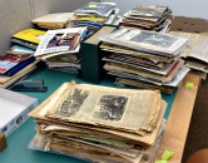
The Center has been buzzing during recent weeks with a new and special collection from a widely-respected U.S. agricultural journalist, John Harvey of Wilmington, Delaware. ACDC associate Stephanie Pitts-Noggle has been working on nine boxes of agricultural periodicals that he has contributed. They range in age from the 1800s to recent years. And what makes them extraordinary is that they include 477 Volume 1 Number 1 issues of agricultural periodicals. Yes, they offer 477 examples of innovation in agricultural publishing in the U.S. across a century and a half.

They will be joined by a yet-uncounted number of V1N1 issues that ACDC staff associate Jim Evans is contributing to the Center. John and Jim have been sharing this unusual hobby for decades. They believe the collection—in whatever size it emerges—can be a useful resource during the years ahead.

ACDC staff members have some promising ideas in mind for featuring and using the collection. What ideas might you suggest? Please pass them along because we will welcome them.

Picture of V1N1 Collection Picture of Stephanie Pitts-Noggle with the Farm Journal


Reactions of consumers when they hear about use of nanotechnology in foods. A research team in Ireland used an innovative technique to learn how consumers respond to added information they receive, step by step, about food-related applications of nanotechnology. A small sample of Irish consumers took part in one-to-one conversation with an expert in food-related nanotechnology research. Among the findings:

  • Additional information of both risks and benefits appeared to influence their attitudes positively toward food applications of nanotechnology.
  • The majority said they were confident in their assessments of nanotechnology after taking part in the conversation.
  • A questionnaire after the conversation confirmed that participants were more likely to purchase nano foods after taking part in it.
  • However, acceptance was conditional on potential risks being adequately addressed before nano food products reach the market and the stated health claims being validated.

You can read this paper from the 2011 International European Forum via AgEconSearch at http://purl.umn.edu/122006


More courageous rural reporting . Recently we added to the ACDC collection several reports about honors for courageous rural reporting. They included this award-winning effort:

Stanley Nelson, editor of the weekly Concordia Sentinel , Ferriday, Louisiana, received the 2011 Tom and Pat Gish Award for courage, integrity, and tenacity in rural journalism. This award was presented by the Institute for Rural Journalism and Community Issues, University of Kentucky. Nelson and the Sentinel investigated an unsolved murder from the era of conflict over civil rights. Detailed reporting in more than 150 stories over a four-year period resulted in threats, office burglary, and some cancelled subscriptions. It also resulted in identification of a living suspect and grand jury investigation. You can learn more about his reporting efforts at http://www.uky.edu/CommInfoStudies/IRJCI/Gish2011.html


How Philippine print media covered agricultural biotechnology. Content analysis provided a 10-year view (2000-2009) of media coverage of agricultural biotechnology in the Philippines, first Asian country to approve the planting of Bt corn. Authors of a recent article in the Journal of Science Communication examined patterns of coverage by three national English-language newspapers. They found during the decade:

  • A trend toward positive to neutral stories
  • Preference for institutional sources of information
  • A shift from sensational to balanced coverage

You can review this article (Volume 10, September 2011) through open access at http://jcom.sissa.it/archive/10/03/Jcom1003%282011%29A01/


Social media and agri-food issues in Germany. Recently we added to the ACDC collection a 2010 article about this subject in the International Journal of Food System Dynamics . Using framing theory, researchers analyzed agri-food content of web-based blogs (2009) and discussion groups (2007-2009) in Germany. Postings from the whole German-speaking social media community on the internet were scanned. Findings revealed trends in numbers of postings during that period, ranging from fewer than 200 to more than 1,000 per week. The top five agri-food issues accounted for almost two-thirds of all 62,803 hits:

  • Renewable resources
  • Agricultural structure in Germany
  • Genetic engineering for agriculture
  • Industrial agriculture
  • Farm animal welfare

All contentious issues were found mainly framed in a two-sided way.

You can read this journal article (“Two sides of the same coin?” Volume 1(3), 2010, pages 264-278) online at http://www.fooddynamics.org .


“There’s a ton of opportunity for you in agricultural journalism.” University of Illinois members of Agricultural Communicators of Tomorrow (ACT) heard that message during early May from three respected agricultural journalists. Guest speakers included Jeanne Bernick, editor of Top Producer ; Holly Spangler, associate editor of Prairie Farmer ; and Mike Wilson, executive editor of Farm Futures . Here are some of the points they emphasized in encouraging students to consider journalism and editorial careers related to agriculture:

  • Farmers need to know what’s going on around the world.
  • Appetites are growing, globally, for information about food and agriculture. “Agricultural journalists must have a role…Don’t be afraid to step forward.”
  • Agricultural journalism is an exciting calling. “Everything I wanted to do I can do through agricultural journalism.”
  • New information technologies permit agricultural journalists to work from home and operate across media platforms.
  • In this multi-media environment, “content providers” may be a new name for this work. As gatekeepers, agricultural journalists follow a special mission of finding and presenting appropriate, credible content.

The ACDC collection includes a wide selection of resources about careers in agricultural journalism. Check with us at docctr@library.illinois.edu for help in reviewing them to fit your interests.


Communicator activities approaching.

  • June 2-5, 2012
    “Adventures in Communications.” Annual institute of the Cooperative Communicators Association (CCA) in Tucson, Arizona USA. Information: http://www.communicators.coop
  • June 11-14, 2012
    “Charting a New Course.” Annual conference of the Association for Communication Excellence in Agriculture, Natural Resources, and Life and Human Sciences (ACE) in Annapolis, Maryland USA. Information: http://www.aceweb.org
  • August 4-6, 2012
    Agricultural Media Summit in Albuquerque, New Mexico USA. Organized by the Livestock Publications Council (LPC), American Agricultural Editors’ Association (AAEA) and Agri Council of American Business Media. Also the annual meeting site of Agricultural Communicators of Tomorrow (ACT). Information: http://www.agmediasummit.com

Let’s banish the word “amazing.” So far, that is the top-ranked advice of those submitting entries for the 2012 List of Banished Words. The project at Lake Superior State University highlights nominations for Words Banished from the Queen’s English for Mis-use, Over-use and General Uselessness.

“Banish it for blatant overuse and incorrect use – to stop my head from exploding,” one nominator urged.

Another possible candidate? Nominations continue throughout the year. We wonder how many might nominate “pink slime” as an expression to be banished.

You can read the 2012 list-to-date at http://www.lssu.edu/banished/current.php


Best wishes and good searching.

Please pass along your reactions, suggestions, and ideas. Feel free to invite our help as you search for information. And please suggest (or send) agricultural communications documents we might add to this unique collection. We welcome them in hard copy (sent to Ag Comm Documentation Center, 510 LIAC, 1101 S. Goodwin Avenue, Urbana, IL 61801) or in electronic format sent to docctr@library.illinois.edu .

ACDC News – Issue 12-08

Metaphors that farm magazines use about climate change . Researcher Therese Asplund recently identified three metaphors used by the two largest Swedish farm magazines during 2000-2009:

  • Greenhouse metaphor. Highlights temperature and radiation in the atmosphere. Neglects other meteorological aspects (such as precipitation, clouds, snow) and impacts of climate change on natural and social systems.
  • Game metaphor. Highlights positive impacts such as higher yields and increased income) and as winning through mitigation. Neglects negative impacts such as more insect outbreaks, warmer and drier conditions, shorter growing season.
  • War metaphor. Highlights negative impacts (such as crop damage, higher taxes and negative image) and combat/battling for mitigation.

These findings prompted the author to observe that the inconsistent and confusing messages may result in conflicts and disputes. At the same time, she noted, multiple metaphors may “open up new perspectives on the issue of climate change” and allow readers to talk about it from several angles.

You can review this Journal of Science Communication article (Volume 10, December 2011) through open access at http://jcom.sissa.it/archive/10/04/Jcom1004%282011%29A01/


Rural community coverage earns Pulitzer recognition. Editorial staff members of a weekly newspaper serving a small rural community in Maine were named finalists recently in the 2012 Pulitzer Prize program. Editor A. M. Sheehan and Assistant Editor Matt Hongoltz-Hetling of the Advertiser Democrat (Norway, Maine) earned finalist honors in the local reporting category. They were recognized for their “tenacious exposure of disgraceful conditions in federally-supported housing in a small rural community.” Within hours, the coverage sparked state investigation.

The Advertiser Democrat has a history of covering burglaries, poverty, homelessness, internet access, scarcity of doctors, fire services, and other rural issues. You can learn more at www.advertiserdemocrat.com/featured/story/02-16-news-2012pulitzerfinalist-16


Nine best practices for boosting media coverage . Recently we added to the ACDC collection a report about Maisha Yetu, a project that is changing media coverage of health in rural and other areas of Africa. Maisha Yetu (“Our Lives” in Swahili) has been carried out for about a decade by the International Women’s Media Foundation. One unusual idea features several ways to gain buy-in from top editors and top management of media organizations—even memorandums of agreement. Another successful practice features use of in-house journalist/trainers.

You can read this report, “Writing for our lives,” at http://iwmf.org/docs/9464_WFOLforweb2.pdf


So where are we finding information these days? You may be interested in some of the out-of-mainstream journals from which we have recently identified agricultural communications literature for the ACDC collection:

Annals of Internal Medicine

Journal of Foodservice Business Research

Adotas

Journal of Hospitality and Tourism Research

Field Methods

Cultural Studies Critical Methodologies

ETC: A Review of General Semantics

South African Journal of Agricultural Extension

Science Technology and Society

Journal of Community Informatics

Please let us know at docctr@library.illinois.edu when—in unusual or usual places—you, too, come across information about the communications aspects of agriculture. We welcome additions you may suggest.


An unusual perspective on how information affects food buying . Studies of the impact of information on food demand often center on foodborne illness or food safety events. Many studies focus on effects of advertising. Less often do they analyze the impact of scientific nutrition information, delivered by multiple media. Using U.S. consumer panel data and content analysis of information in popular media sources, Sakiko Shiratori and Jean Kinsey studied the impact of information on the purchase of omega-3 fortified eggs.

Results showed significant positive impact of nutrition information from the popular media on consumers’ food choices. Authors noted that although mega-3 fortified eggs usually sell at a premium price, “growing knowledge of the health benefits of omega-3 propels their consumption.” They concluded that “publishing in popular media can be said to be an effective communication approach.”

You can read this 2011 conference research paper via AgEconSearch at http://purl.umn.edu/103850


Thanks and best wishes to Michelle Fluty as she leaves the Center after two school years as ACDC student assistant. We congratulate Michelle for completing her undergraduate degree in agricultural communications this month. She also parts with a remarkable record of having checked the entire ACDC collection to be sure documents are filed as intended and in good condition. Perhaps it is surprising Michelle has not gone blind! This sharp-eyed dairy judge inventoried some 37,000 documents about agricultural communicating around the globe. And the inventory project was only part of what she contributed. She will be missed here as an associate and friend.

Picture of Michelle Fluty


Communicator activities approaching.

  • May 21-24, 2012
    “East Meets West for Sustainable Development.” 2012 conference of the Association for International Agricultural and Extension Education (AEAEE) in Nakhon Pathom Province, Thailand. Information: http://www.aiaee.org/images/stories/AIAEE/2012Conference/flyer.pdf
  • May 28-June 1, 2012
    26th annual National Extension Technology Conference (NETC) in New Orleans, Louisiana USA. Information: http://www.netc2012.org
  • June 2-5, 2012
    “Adventures in Communications.” Annual institute of the Cooperative Communicators Association (CCA) in Tucson, Arizona USA. Information: http://www.communicators.coop
  • June 11-14, 2012
    “Charting a New Course.” Annual conference of the Association for Communication Excellence in Agriculture, Natural Resources, and Life and Human Sciences (ACE) in Annapolis, Maryland USA. Information: http://www.aceweb.org
  • August 4-6, 2012
    Agricultural Media Summit in Albuquerque, New Mexico USA. Organized by the Livestock Publications Council (LPC), American Agricultural Editors’ Association (AAEA) and Agri Council of American Business Media. Also the annual meeting site of Agricultural Communicators of Tomorrow (ACT). Information: http://www.agmediasummit.com

Colorful climate reporting. We close this issue of ACDC News with a 2011 winning entry in the Bulwer-Lytton Fiction Contest sponsored by the English Department, San Jose State University. This annual competition challenges entrants to compose the opening sentence to the worst of all possible novels. Here is the winning entry by Mike Pedersen of North Berwick, Maine, in the Purple Prose category:

“As his small boat scudded before a brisk breeze under a sapphire sky dappled with cerulean clouds with indigo bases, through cobalt seas that deepened to navy nearer the boat and faded to azure at the horizon, Ian was at a loss as to why he felt blue.”

You can read other mind-stretching entries at http://www.bulwer-lytton.com/2011win.html


Best wishes and good searching.

Please pass along your reactions, suggestions and ideas. Feel free to invite our help as you search for information. And please suggest (or send) agricultural communications documents we might add to this unique collection. We welcome them in hard copy (sent to Ag Comm Documentation Center, 510 LIAC, 1101 S. Goodwin Avenue, Urbana, IL 61801) or in electronic format sent to docctr@library.illinois.edu

ACDC News – Issue 12-07

What “digital divide” means. And so what? One of the most thorough analyses we have seen about the digital divide appeared in the September 2011 issue of the journal Telecommunications Policy . Martin Hilbert used network analysis to view the main approaches researchers have taken to conceptualize the digital divide. He found many diverse actors with dissimilar goals are involved in confronting it.

Beyond that, will efforts toward a single definition, coherent national strategy, and common outlook on digital development do better than others? Not really, he said. Instead, he suggested shifting focus to identifying desired impacts, which then determine ways to solve a particular problem and reach a desired goal. “The ends should determine the means, not the other way around.”

You can review a permitted scholarly posting of this article, “The end justifies the definition,” online at: http://www.martinhilbert.net/ManifoldDigitalDivide_Hilbert_AAM.pdf


How U.S. agri-businesses address the triple bottom line. A recent article in the International Food and Agribusiness Management Review examined sustainability strategies that U.S. agribusinesses use to integrate environmental and social responsibilities with economic goals. Researchers gathered responses from a sample of 165 agribusiness professionals representing U.S. firms participating in management seminars.

Results indicated that “although U.S. agribusiness companies tend to adopt broad sustainability views which are driven by management pressures, they primarily develop actions at the lower sustainability levels which are driven by external pressures such as customers, suppliers and the media.”

You can read this journal article at http://purl.umn.edu/117601


More courageous rural reporting . Recently we added to the ACDC collection several reports about honors for courageous rural reporting. Here is a sobering example:

Reporter Vicky Ntetema received the 2010 Courage in Journalism Award from the International Women’s Media Foundation for bravery in covering an issue in rural Tanzania. Her investigation shed light on brutal killings of albinos, as arranged by witchdoctors for use in traditional “remedies.” Her life was threatened, she was forced twice to leave Tanzania for her safety, and at the time of the honor she was operating under cover. According to the BBC, for which she reports, some 170 witchdoctors have been arrested for albino killings.

You can learn more about Vicky Ntetema’s reporting efforts at: http://iwmf.org/archive/articletype/articleview/articleid/1217/vicky-ntetema-tanzania.aspx


Contributing valued historic documents . Thanks to Eldon Fredericks, emeritus faculty member at Purdue University, for contributing 75 historic documents to the ACDC collection. Most of them include reports, newsletters and training materials from the National Project in Agricultural Communications during the latter 1950s. NPAC is one of the most effective professional development programs so far for extension and research communicators in land-grant universities and the U.S. Department of Agriculture. It was funded by the Kellogg Foundation.

Contributions such as this are helping ACDC assemble a complete set of NPAC resources for future reference. You can learn more about the project and the materials by visiting the ACDC search page: http://web.library.uiuc.edu/asp/agx/acdc/search.html . Conduct a Subject search on “npac”


Food issues in the minds of UK residents: a 2011 update. We added recently to the ACDC collection a 2011 report, “Biannual Public Attitudes Tracker,” from the UK Food Standards Agency. Based on a probability sampling of more than 2,000 adults, the survey identified these top six total concerns about food:

Food prices                           61 percent

Amount of salt in food           50

Amount of fat in food            44

Date labels                            27

Foods aimed at children,        26

including school meals

BSE                                      18

All six concerns had increased significantly since November 2010.

You can read the full report at: http://www.food.gov.uk/multimedia/pdfs/biannualpublicattitudestrack.pdf


A challenge for land-grant universities. We appreciate a heads-up from ACDC Associate Steve Shenton about a case study that argues for stronger public engagement in land-grant universities. This report in the Journal of Higher Education Outreach and Engagement suggests that scholars increasingly need to embrace and pursue a view of scholarship as a public rather than a private craft. It tells of a natural resources faculty member who built up a large research and extension education program at Cornell University addressing the human dimensions of wildlife management.

“Dan and his colleagues…have demonstrated that it is possible for academic professionals to pursue their scholarship through a stance of deep engagement, leading to products of both public and academic value. Crucially, they have shown that deep public engagement does not require the sacrifice of academic values. … these forms of value can feed and build upon each other.”

You can read “The craft of public scholarship in land-grant education” at http://openjournals.libs.uga.edu/index.php/jheoe/article/view/493

We welcome your thoughts and experiences. Reach us at docctr@library.illinois.edu .


Communications – key to new EC action plan for welfare of animals. Early this year the European Commission posted a 2012-2015 action plan in this arena. Livestock farming in the EU represents an annual value of 149 billion euros. The Commission cited communications is a major factor in this strategy because:

  • Consumers and many other stakeholders lack appropriate information on important aspects of animal welfare.
  • Principles of animal welfare need to be simplified

According to the report, strategic actions for communications will begin with research. It will map out the current animal welfare education and information activities directed at the general public and consumers.

You can read the report at: http://ec.europa.eu/food/animal/welfare/actionplan/docs/aw_strategy_19012012_en.pdf


Communicator activities approaching.

  • May 21-24, 2012
    “East Meets West for Sustainable Development.” 2012 conference of the Association for International Agricultural and Extension Education (AEAEE) in Nakhon Pathom Province, Thailand. Information: http://www.aiaee.org/images/stories/AIAEE/2012Conference/flyer.pdf
  • May 28-June 1, 2012
    26th annual National Extension Technology Conference (NETC) in New Orleans, Louisiana USA. Information: http://www.netc2012.org
  • June 2-5, 2012
    “Adventures in Communications.” Annual institute of the Cooperative Communicators Association (CCA) in Tucson, Arizona USA. Information: http://www.communicators.coop
  • June 11-14, 2012
    “Charting a New Course.” Annual conference of the Association for Communication Excellence in Agriculture, Natural Resources, and Life and Human Sciences (ACE) in Annapolis, Maryland USA.

Eye-opening testimonials in agricultural advertising. We close this issue of ACDC News with an eye-opening claim by a company wanting to buy advertising space in farm papers during 1922. The marketer of Ditto Egg Tablets claimed that more than 100,000 poultry raisers testified to the value of this egg tonic.

In reporting the claim to member publications, the Agricultural Publishers Association urged them to scrutinize advertising copy carefully. APA energetically fought fraudulent advertising across the decades.


Best wishes and good searching.

Please pass along your reactions, suggestions and ideas. Feel free to invite our help as you search for information. And please suggest (or send) agricultural communications documents we might add to this unique collection. We welcome them in hard copy (sent to Ag Comm Documentation Center, 510 LIAC, 1101 S. Goodwin Avenue, Urbana, IL 61801) or in electronic format sent to docctr@library.illinois.edu

ACDC News – Issue 12-06

First fashion brand from rural women. February 15 proved a significant day in the fashion industry of Pakistan as an impressive fashion show launched the nation’s first brand for rural women. It’s called Sughar (translated in English as “skilled and confident woman”) and it involves the work of 500 rural women in two provinces of the nation. Featured products include stylish hand clutches, hand bags, and traditional-cum-modern dresses. Each product depicts a folk story or a tradition that is followed in diverse communities of Pakistan.

A national nonprofit organization, Participatory Development Initiatives, facilitates this social enterprise program. “The fashionable and fabulously designed products were the source of attraction to many who were amazed at the talent and skills of rural women.”

You can learn more about Sughar at http://sugharwomen.blogspot.com/2012/02/sughar-pakistans-first-ever-rural-women.html


On the changing definition of “agricultural journalism.” William Allen, University of Missouri, usefully traces the roots and growth of agricultural journalism in the new Encyclopedia of Science and Technology Communication . He describes the uniqueness and importance of agricultural journalism, extending beyond “just good journalism.” the “farm story” has evolved to target urban as well rural areas, and deals with concepts like food, science, or trade.

Check with us at docctr@library.illinois.edu if you lack access to this article.


Careers, commodity websites, social media, “Food, Inc.” featured in JAC . You can read research reports about these and other dimensions of agricultural communications in the third 2011 issue of the Journal of Applied Communications :

  • Tamra Watson and J. Tanner Robertson, “Perceptions of agricultural communications freshmen regarding curriculum expectations and career aspirations”
  • Joy N. Goodwin, Christy Chiarelli and Tracy Irani, “Is perception reality? Improving agricultural messages by discovering how consumers perceive messages”
  • Christy Witt, David Doerfert, Tracy Rutherford, Theresa Murphrey, and Leslie Edgar, “The contribution of selected instructional methods toward graduate student understanding of crisis communication.”
  • Mica Graybill-Leonard, Courtney Meyers, David Doerfert, and Erica Irlbeck, “Using Facebook as a communication tool in agricultural-related social movements.”
  • Kori Barr, Erica Irlbeck, Courtney Meyers, and Todd Chambers, “Television journalists’ perceptions of agricultural stories and sources in Texas”
  • Courtney Meyers, Erica Irlbeck, Mica Graybill-Leonard, and David Doerfert, “Advocacy in agricultural social movements: exploring Facebook as a public relations communication tool”
  • Courtney Meyers, Erica Irlbeck, and Kelsey Fletcher, “Postsecondary students’ reactions to agricultural documentaries: a qualitative analysis”

View them online at http://journalofappliedcommunications.org/current-issue.html


How to research, monitor, and evaluate communication for development . Special thanks to Dr. June Lennie of the Queensland University of Technology (Brisbane, Australia) for alerting us to a comprehensive new resource:

“Researching, monitoring, and evaluating communications for development:trends, challenges and approaches.”

Dr. Lennie and Prof. Jo Tacchi of RMIT University (Melbourne, Australia) wrote this 153-page report for the United Nations Inter-agency Group on Communication for Development.

The report highlights principles and approaches for effective, appropriate and sustainable research, monitoring, and evaluation of communication efforts in support of development. You can read it at:

http://www.unicef.org/cbsc/files/RME-RP-Evaluating_C4D_Trends_Challenges__Approaches_Final-2011.pdf


Tell kids to do journalism in high school to boost grades and scores. Students in the U.S. who work on high school newspapers and yearbooks get better grades in high school, earn higher scores on college entry exams, and get better grades as college freshmen. Those findings come from research commissioned by the Newspaper Association of America. The study involved more than 31,000 randomly selected students who took the ACT college entrance exams across a five-year period. The findings do not assure causation, but do show what the report describes as strong positive relationship.

High school journalism faces many obstacles, according to the report, due mainly to budget cuts and legal pressures (related to free speech). Rural schools were cited as being among those most likely to cut back on journalism offerings.

You can read the full report at:

http://www.naafoundation.org/Research/Foundation/Student-Journalism/High-School-Journalism-Matters.aspx


Communicator activities approaching.

  • April 16-18, 2012
    “Sustainable Human Development.” The World Information Technology Forum (WITFOR) in New Delhi, India. Organized by the International Federation for Information Processing. Will focus on four key areas: agriculture, education, health and e-governance. Information: http://www.witfor.org
  • April 18-20, 2012
    “Acres of Innovation.” 2012 conference of the National Agri-Marketing Association in Kansas City, Missouri USA. Information: http://nama.org/amc
  • May 21-24, 2012
    “East Meets West for Sustainable Development.” 2012 conference of the Association for International Agricultural and Extension Education (AEAEE) in Nakhon Pathom Province, Thailand. Information: http://www.aiaee.org/images/stories/AIAEE/2012Conference/flyer.pdf
  • May 28-June 1, 2012
    “That Voodo You Do.” 26th annual National Extension Technology Conference (NETC) in New Orleans, Louisiana USA. Information: http://www.netc2012.org
  • June 2-5, 2012
    “Adventures in Communications.” Annual institute of the Cooperative Communicators Association (CCA) in Tucson, Arizona USA. Information: http://www.communicators.coop
  • June 11-14, 2012
    “Charting a New Course.” Annual conference of the Association for Communication Excellence in Agriculture, Natural Resources, and Life and Human Sciences (ACE) in Annapolis, Maryland USA.

To dream the impossible dream. We close this issue of ACDC News with a “hen” story told in 1935 by Victor Hayden, executive secretary of the Agricultural Publishers Association. He offered it in response to a tale circulating in newspaper trade circles. A newspaper was claiming to have issued its first annual farm edition in tabloid form. According to the paper, members of the regular staff produced this 24-page edition in 10 days, along with their regular editorial duties.

Hayden responded with a tale of his own. It involved a farmer’s hens and may speak to motivational appeals we all have heard and endured:

The farmer exhibited an ostrich egg to his hens and told them that, while he wasn’t scolding them for their efforts, they might take this as an example and try to do better.


Best wishes and good searching.

Please pass along your reactions, suggestions and ideas. Feel free to invite our help as you search for information. And please suggest (or send) agricultural communications documents we might add to this unique collection. We welcome them in hard copy (sent to Ag Comm Documentation Center, 510 LIAC, 1101 S. Goodwin Avenue, Urbana, IL 61801) or in electronic format sent to docctr@library.illinois.edu