About the Piano and Rolls
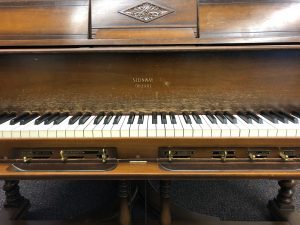
MPAL’s Steinway Model M walnut piano was made in New York on October 4, 1927, and then shipped to the Aeolian Company of New York City raw (with no lacquer), for installation of the player mechanism. Steinway made relatively few models over the years, and the M was the most common size for a home piano. To make them “player ready” the Steinway company lengthened the case by six inches, allowing the installation of the reproducing mechanics, but the rest of the piano remained the Model M scale design. School of Music inventory records indicate that the piano was purchased from Mrs. Lee Drendel in Springfield, IL in the 1950s or 1960s.
In 2017, a generous grant from the University’s Office of the Vice Chancellor for Institutional Advancement and additional funding from the Dean of Libraries and University Librarian John Wilkin, enabled renovation of the piano and creation of a secure room for it. The piano and its case were renovated by The Piano People of Champaign, IL and the player mechanism was restored by Mel Septon of Player Pianos Plus in Northbrook, IL. On September 22, 2018, an event was held featuring the renovated player piano and speakers Dr. Catherine Hennessy and Mel Septon.
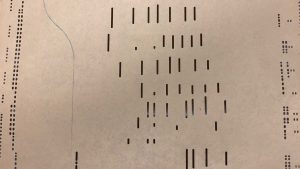
MPAL holds approximately 270 Duo-Art original and reprinted rolls as well as compatible rolls from companies such as Connorized, Imperial, and QRS. An inventory of the rolls is available on request.
Piano and Rolls Use Policy
Use of the piano and rolls is mediated by MPAL personnel. Interested individuals, groups, or classes should request an appointment via email. For extensive use of the collection/piano beyond a one-time visit, it is best to schedule with us at least a month in advance. The piano rolls do not currently circulate outside of the library.
Select Titles in MPAL About Player and Reproducing Pianos
History and Reference Works
- The art of the player-piano: a text-book for student and teacher; Grew, Sydney; 1922
- Inventing entertainment: the player piano and the origins of an American musical industry; Dolan, Brian; 2009
- Pianola: the history of the self-playing piano; Ord-Hume, Arthur; 1984
- Player piano treasury; the scrapbook history of the mechanical piano in America as told in story, pictures, trade journal articles and advertising; Roehl, Harvey; 1973
- Reproducing pianos past and present; Holliday, Kent; 1989
- Sound conversations: print media, player pianos, and early radio in the United States (U of I dissertation); Wolter, Catherine Hennessy; 2016
- The Classical reproducing piano roll: a catalogue-index; Sitsky, Larry; 1990
- Duo-Art Piano Music: a classified catalog of the world’s best music recorded by more than two hundred and fifty pianists for the Duo-Art reproducing piano; Aeolian Company; 1927
- Music for the Aeolian grand; Aeolian Company; 1901
Composers Writing for or Performing on Player Piano
The player piano generated intense interest for many composers when it was first manufactured. Composers such as George Gershwin, Igor Stravinsky, and Sergei Prokofiev were all enthusiastic about the artistic potential and enterprising record companies such as Duo-Art had composers record their own pieces.
The player piano was by no means universally popular or respected by composers or musicians. In 1906 John Philip Sousa wrote of the “menace of mechanical music” because “The new technologies of player pianos were so dangerous that [he] felt compelled to spur his public to action before music was reduced to a mere ‘mathematical system of megaphones, wheels, cogs, discs, cylinders, and all manner of revolving things.’” [Warfield, Patrick. 2009. “John Philip Sousa and “the Menace of Mechanical Music”.” Journal of the Society for American Music 3 (4) (11): 431-463.]
Later into the twentieth century, composers began experimenting with writing music specifically for the player piano, featuring instructions in the sheet music that would be nearly impossible for a human to do, but perfectly doable for the mechanics of the player piano.
Select examples of composers writing for or performing on player piano in MPAL’s collection:
- Zez Confrey
- Ruth Garland
- George Gershwin
- Percy Grainger
- Lejaren Hiller
- Conlon Nancarrow
- Igor Stravinsky
Note that not all piano rolls have been entered in the Library’s catalog, so there are more examples not listed here.
Images and Audio
Digital exhibit with images and audiovisual clips of MPAL’s DuoArt.
Images from the restoration process of the piano can be viewed on U of I Box.
Upcoming Events
Check our Events Calendar for upcoming player piano demonstrations.