What is a scholarly source?
Scholarly sources (also referred to as academic, peer-reviewed, or refereed sources) are written by experts in a particular field and serve to keep others interested in that field up to date on the most recent research, findings, and news. These resources will provide the most substantial information for your research and papers.
What is peer-review?
When a source has been peer-reviewed, it has undergone the review and scrutiny of a review board of colleagues in the author’s field. They evaluate this source as part of the body of research for a particular discipline and make recommendations regarding its publication in a journal, revisions prior to publication, or, in some cases, reject its publication.
Why use scholarly sources?
Scholarly sources’ authority and credibility improve the quality of your own paper or research project.
How can I tell if a source is scholarly?
The following characteristics can help you differentiate scholarly sources from those that are not. Be sure to look at the criteria in each category when making your determination, rather than basing your decision on only one piece of information.
Authors
- Are author names provided?
- Are the authors’ credentials provided?
- Are the credentials relevant to the information provided?
Publishers
- Who is the publisher of the information?
- Is the publisher an academic institution, scholarly, or professional organization?
- Is their purpose for publishing this information evident?
Audience
- Who is the intended audience of this source?
- Is the language geared toward those with knowledge of a specific discipline rather than the general public?
Content
- Why is the information being provided?
- Are sources cited?
- Are there charts, graphs, tables, and bibliographies included?
- Are research claims documented?
- Are conclusions based on evidence provided?
- How long is the source?
Currency/Timeliness
- Is the date of publication evident?
Additional Tips for Specific Scholarly Source Types
Each resource type below will also have unique criteria that can be applied to it to determine if it is scholarly.
Books
- Publishers
- Books published by a University Press are likely to be scholarly.
- Professional organizations and the U.S. Government Printing Office can also be indicators that a book is scholarly.
- Book Reviews
- Book reviews can provide clues as to if a source is scholarly and highlight the intended audience. See our Find Reviews guide to locate reviews on titles of interest.
Articles
- Are the author’s professional affiliations provided?
- Who is the publisher?
- How frequently is the periodical published?
- How many and what kinds of advertisements are present? For example, is the advertising clearly geared towards readers in a specific discipline or occupation?
- For more information about different periodical types, see our Selecting Sources guide.
Web Pages
- What is the domain of the page (for example: .gov, .edu, etc.)?
- Who is publishing or sponsoring the page?
- Is contact information for the author/publisher provided?
- How recently was the page updated?
- Is the information biased? Scholarly materials published online should not have any evidence of bias.
Is My Source Scholarly?
Use the flowchart below to determine if your source is scholarly.
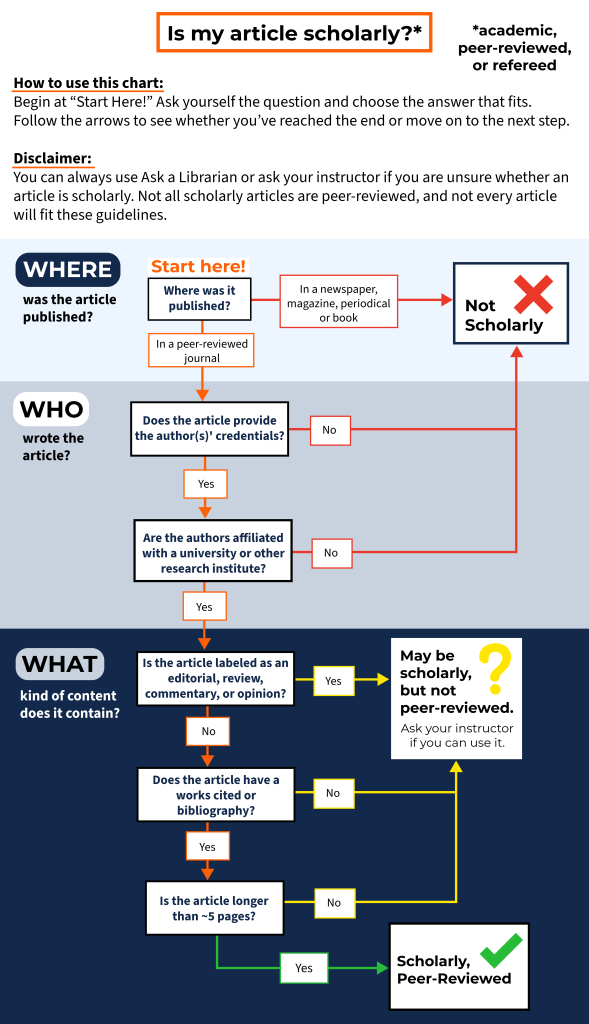
Is My Source Scholarly?
Disclaimer: You can always use Ask a Librarian or ask your instructor if you are unsure whether an article is scholarly. Not all scholarly articles are peer-reviewed, and not every article will fit these guidelines.
Step 1: Where was the article published?
Begin by asking yourself where the article was published. If it was published in a newspaper, magazine, periodical, or book, it is not scholarly. If the article was published in a peer-reviewed journal, move on to Step 2.
Step 2: Who wrote the article?
Ask yourself whether the article provides the author(s)’ credentials. If the answer is no, the article is not scholarly. If the answer is yes, proceed to the next question.
Are the authors affiliated with a university or other research institute? If the answer is no, the article is not scholarly. If the answer is yes, move on to Step 3.
Step 3: What kind of content does it contain?
Ask yourself whether the article is labeled as an editorial, review, commentary, or opinion? If the answer is yes, the article may be scholarly, but not peer-reviewed. Ask your instructor if you can use it. If the answer is no, proceed to the next question.
Does the article have a works cited or bibliography? If the answer is no, the article may be scholarly, but not peer-reviewed. Ask your instructor if you can use it. If the answer is yes, proceed to the next question.
Is the article longer than approximately five pages? If the answer is no, the article may be scholarly, but not peer-reviewed. Ask your instructor if you can use it. If the answer is yes, the article is scholarly and peer-reviewed. You have reached the end of the flowchart.
If you have any questions, please Ask a Librarian.