By Molly Banwart and Caroline Szylowicz
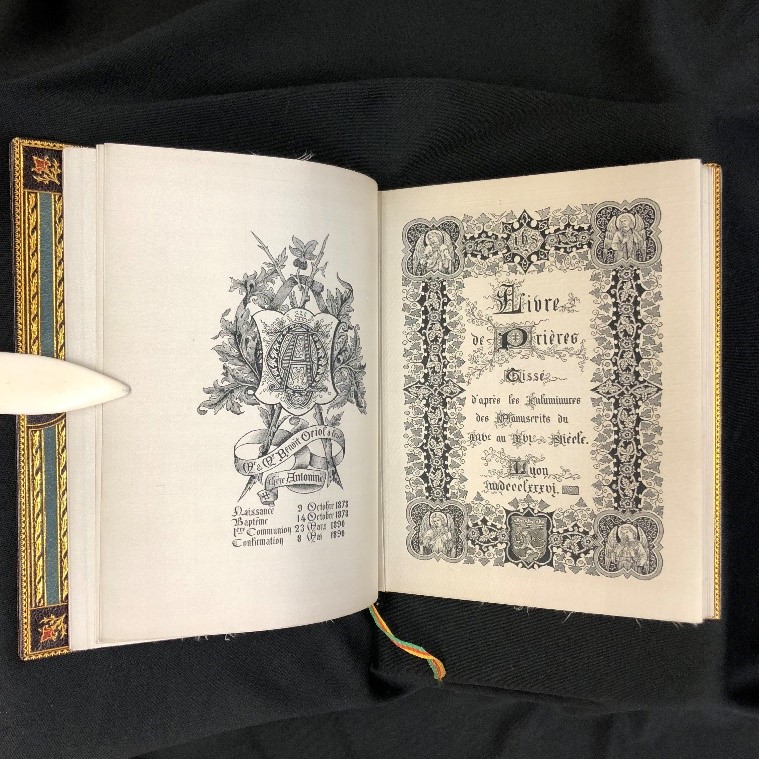
Have you ever seen a book made entirely of silk? One item getting a lot of reading room attention recently is this French Livre de Prières: Tissé d’après les enluminures des manuscrits du XIVe au XVIe siècle (242.802 H446l). This book was manufactured with the Jacquard process, which relied on a complex set of perforated punch cards to operate a silk loom, and is considered a precursor to early programming.
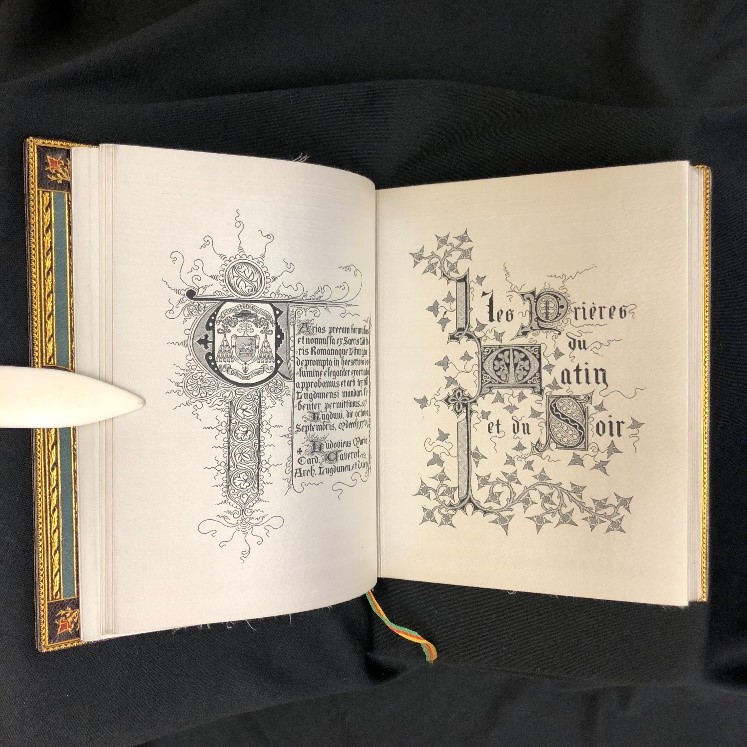
Lyon had been a center of silk production and weaving since the seventeenth century and was the birthplace of Joseph-Marie Jacquard (1752–1834), inventor of the programmable loom. Jacquard was inspired by Vaucanson’s punched-card loom to invent the Jacquard attachment, which let a single operator of any loom using the Jacquard attachment to precisely control which warp threads were raised or lowered during weaving, allowing for the creation of complex patterns. The Livre de Prières: Tissé d’après les enluminures des manuscrits du XIVe au XVIe siècle was produced in Lyon in the 1880s and conceived to be a technical marvel; this extraordinarily complex application used 106,000 cards to create a single leaf, and used four hundred threads per inch in the process.
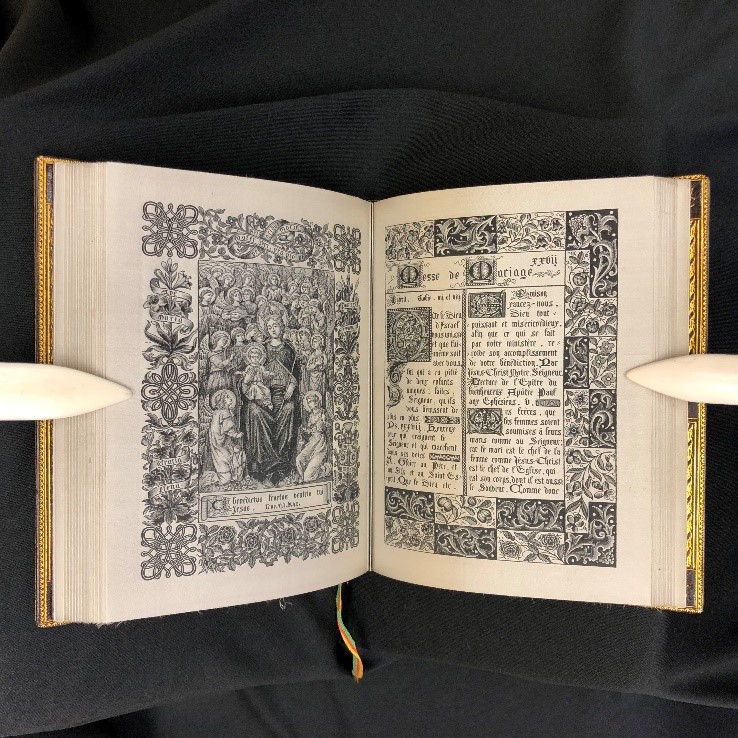
Its contents and aesthetics harken back to lavishly illuminated Gothic books of hours which contained calendars of Christian holidays and prayers meant to be recited at prescribed hours of the day, at a time of renewed interest for all things Medieval manifested in the neo-Gothic style. Medieval books of hours were hand inscribed on vellum, and those made for wealthy patrons included fine illustrations and gold leaf to enhance the item: an incredible expensive and labor intensive process.
By the end of the 15th century, the advent of printing made books more affordable and the emerging middle-class could begin to afford printed books of hours, but new books of hours in manuscript form continued to be commissioned by the very wealthy. With its shimmering silk, the Livre de Prières sought to capture its own luxury with its highly ornate decoration and illustrations created through intricately detailed weave while remaining a product of modern industry.
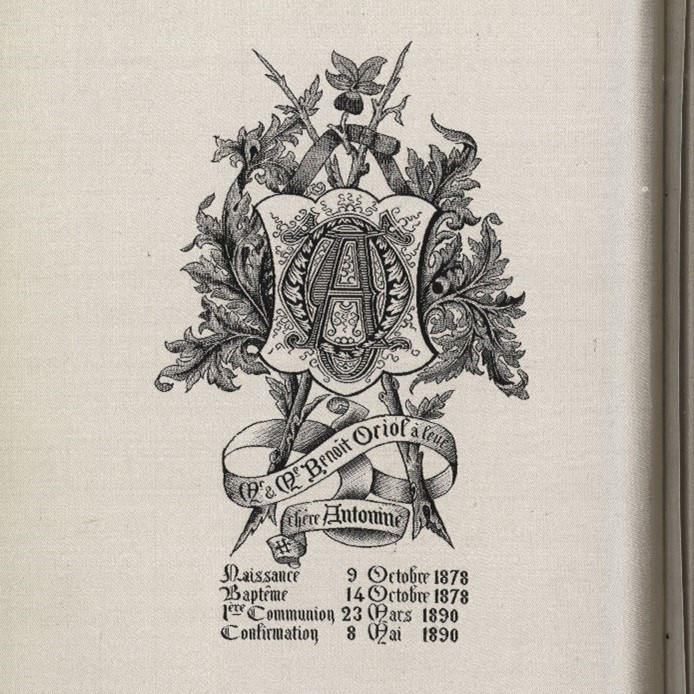
RBML’s copy includes a customized page featuring an ornate initial in an escutcheon. The banner reads “Mr. and Mrs. Benoît Oriol to their dear Antonine” and the dates of Antonine’s birth, baptism, and communions. This book would have been presented to young Antonine Oriol on the occasion of her Confirmation, on May 8, 1890.
Her father, Benoît Oriol (1840-1926), was a textile industrialist from Saint-Chamond, near Lyon. Oriol developed new machines to manufacture braids and ribbons, and chemical methods to improve the dyeing process. He held various political offices at the regional and national levels and was a member of the award jury at the 1889 Exposition Universelle, or World Fair, where the silk prayer book was exhibited for the first time and won a grand prize.
Shelfmark: 242.802 H446l