By Elissa B.G. Mullins
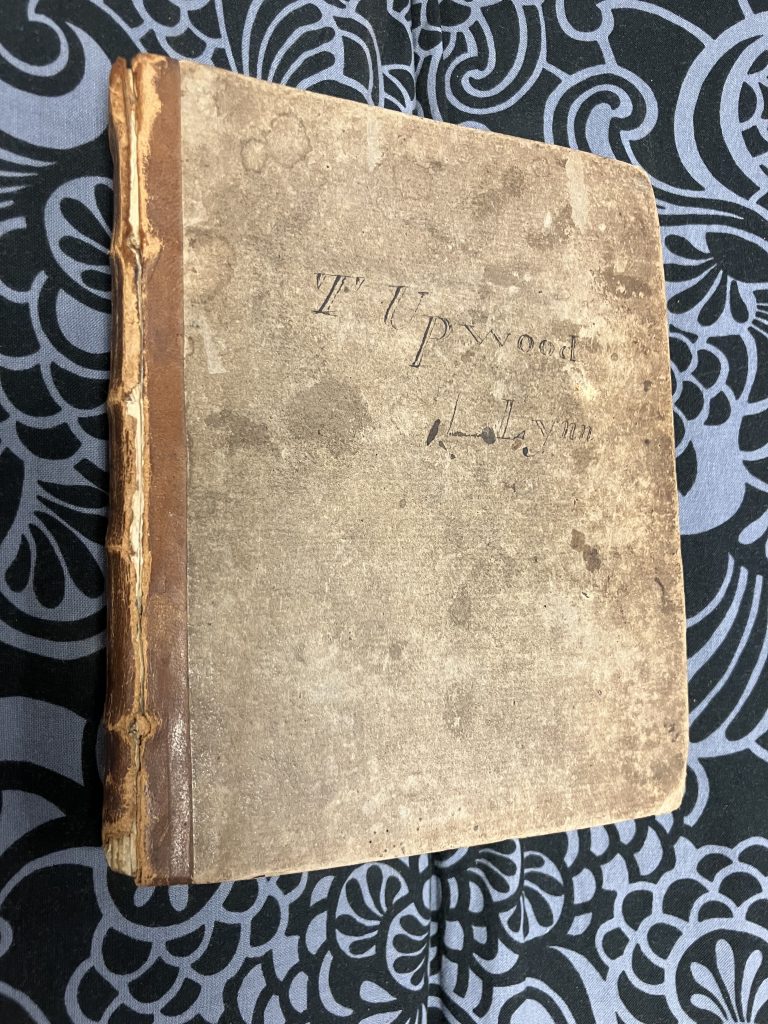
Shabbily clad in contemporary quarter calfskin, this newly cataloged “tortoise of varied voice” (Post-1650 MS 0608) contains a trove of unpublished occasional and epistolary verse, translations from (and into) Latin, Greek, and French, and Biblical paraphrases in the elegant hand of William Massey of Norwich (1691*-1764?), English Quaker and scholar.
The volume opens with a third-person biography in Latin (*in which Massey indicates that he “first inhaled the vital air” in January 1690, not 1691): He had five brothers, all of whom progressed to maturity, and a sister who died in infancy. He lost his mother before adolescence, and after devoting himself to “rural affairs” for several years, he went to Nottingham, where, under the auspices of William Thompson, he spent nearly two years learning Latin and Greek and “cultivating his intellect” (at last, his father was “totally satisfied with his genius”). When he was around the age of twenty-one, his father died in a vehicular accident, after which, for a time, Massey served as a private tutor in the homes of Samuel Everat in Willoughby and Samuel Howet in Holbeach, teaching children arithmetic and “the art of painting letters.”
In 1712, he moved to Wandsworth, a small town in the Surrey countryside, where he taught at a boarding school under Richard Scoryer and his successor Edward Powell; there, he was stricken with smallpox and confined to bed, but at length recovered his former health. Three years later, he moved to Norwich, opened a school of his own, and lived as a bachelor in various boarding houses for nearly seven years until, in 1722, he married Margery Molleson, daughter of Gilbert Molleson of London. The couple had three children, two sons and a daughter, who died at the age of 10 months; one of the boys was stillborn, and the other, six years old as of 1729, is described as a “sweet consolation” to his father and mother.
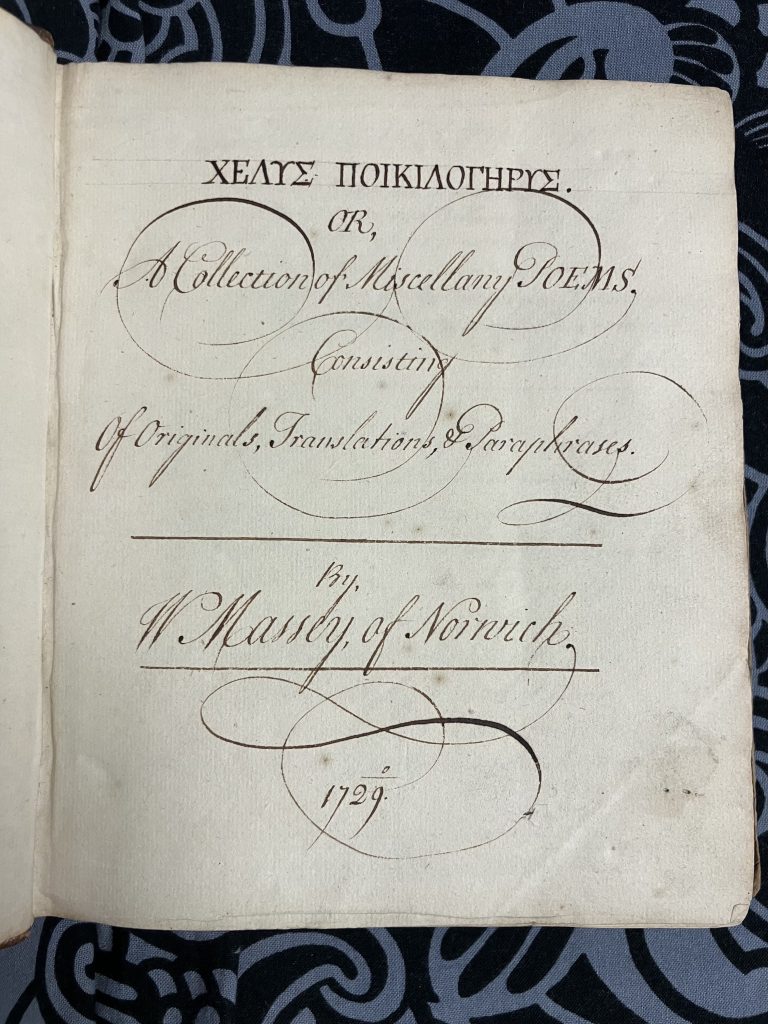
Massey published works on religion, ancient philosophy, and commentaries on contemporary works, including remarks on Milton’s Paradise lost and translations of Cicero’s Cato Major and Ovid’s Fasti; his best-known work, The origin and progress of letters, an essay (1763) concerns the history of writing materials, printing, alphabets, and calligraphy. The works collected in the present handwritten volume, which Massey titles “Chelus poikilogērus” (the “tortoise of varied voice,” or “many-toned tortoise”), appear to be almost entirely unpublished, with the exception of a poem entitled “The weaver” (pages 74-79), which is noted as having been “publish’d about ye time ye wearing of callicos was prohibited by Act of Parliament, 1720.”
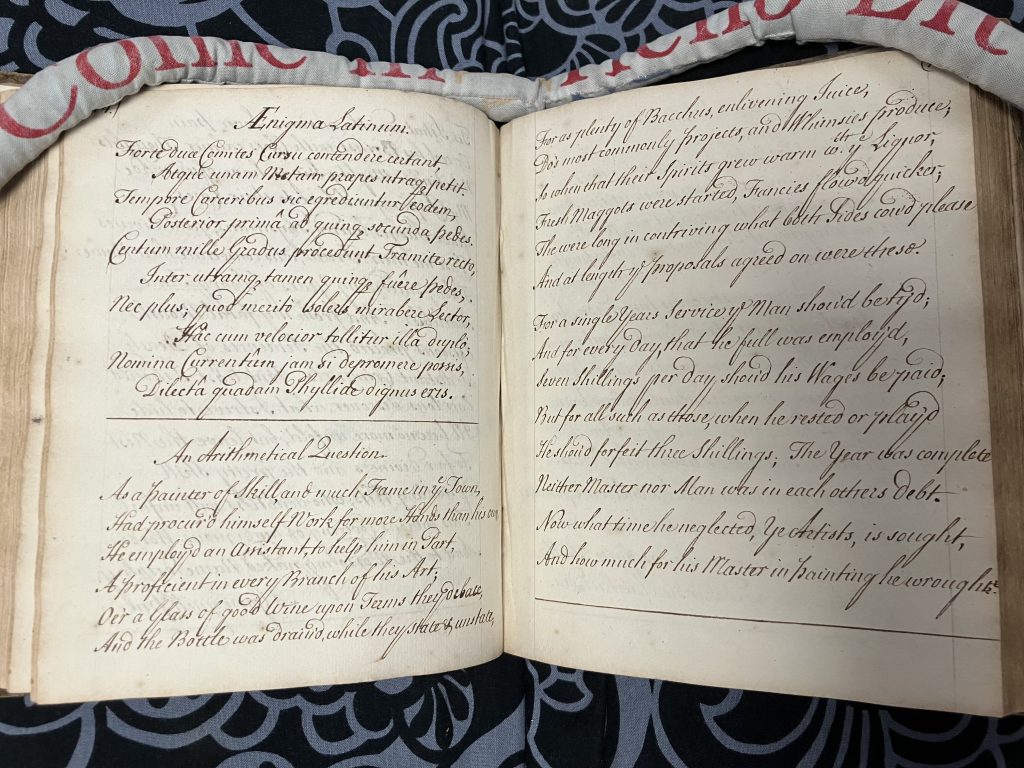
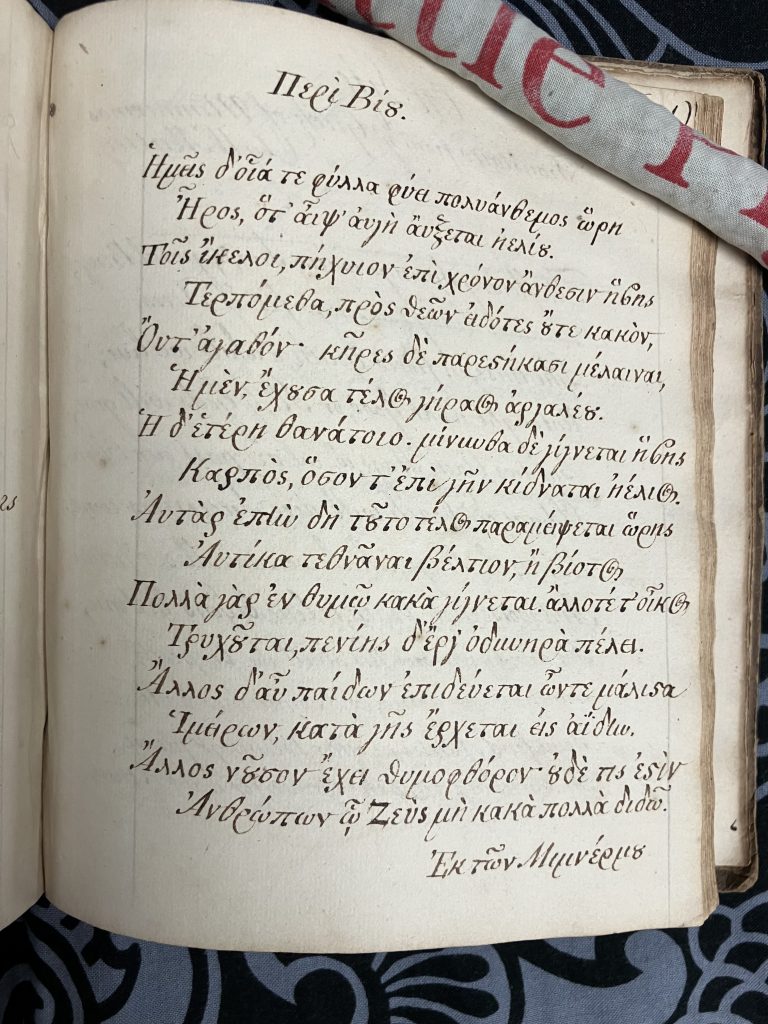
Ranging from drinking songs and whimsical riddles (see “An arithmetical question,” pages 124-25), to epithalamia and elegies on the deaths of King George I and the Duke of Marlborough, epistolary exchanges between friends (“‘Tis a long time ago since you did me the Favour to write me a Letter in Latin …,” pages 140-41), parallel translations of Callimachus, Eubulus, Posidippus, Metrodorus, and Mimnermus, and Biblical paraphrases from Job, Samuel, Deuteronomy, Exodus, and Habakkuk (similar of those published in his Synopsis sacerrima: or, an Epitomy of the Holy Scripture, in English verse, 1719), Massey’s “tortoise” is indeed of “varied voice.”