Written by Luisa Matzner, Graduate Assistant (Preservation Services Unit)
Introduction
Lavender Prairie News was a DIY periodical made by lesbians for lesbians, circulating in Champaign-Urbana from the late 1970s to the 1990s. The first of its kind in the area, the newsletter focused on issues facing the local lesbian community, both close to home and on the national level. Beyond a tool for political mobilization, it served as important communication for the feminist local music scene, including the organization of early iterations of the National Women’s Music Festival and regular advertisements from Olivia Records. As it gained traction in the 1980s, it also highlighted publications from Naiad Press and other independent feminist publishers that eventually became known as the women in print movement. With a staunchly separatist guiding ideology, the content focused almost exclusively on the experiences of cisgender lesbians completely decentering men. It serves as a vital primary source for second-wave feminism, an example of the women in print movement, and a testament to the queer community in Champaign-Urbana.
The original plans and concepts for a newsletter came after a group meeting at one of the organizer’s homes. A small existing group of lesbians and feminist organizers in the Champaign-Urbana area identified the need to create spaces for local queer women to gather and a way to spread information. The newsletter emerged as a solution to keep the community updated on events and happenings, originally formed as a three-person staff for writing, typing, and mailing the periodical. Additionally, this meeting also marked the beginning of the weekly Lesbian Coffeehouse at the Wesley Foundation, which became a mainstay event for the local lesbian community. The discussions and plans from this initial meeting were published as an open letter to lesbians in the area in late November 1975, an unofficial introduction for the newsletter. The first proper issue was published a few months later in March 1976 under the title Lesbian News, using a format common to other underground circulars of the time. The layout was very simple, utilizing the capabilities of a personal typewriter for the body text and featuring a hand-drawn masthead. The first issue only consisted of two pages, but the sparse content of the early issues proved to be a good example for issues to come. It provided information about local events, including the Lesbian Coffeehouse, details about conventions, and upcoming live music performances.
Origins and Publication
The newsletter continued to find its footing in the next few months. It made an immediate impact in the local lesbian community, with over 45 subscriptions by the second issue’s release, a notable number considering its circulation. It was not widely advertised in the general community; word of mouth and attendance at Gay Illini or coffeehouse events became the primary way to gain new subscribers. The newsletter continued to be published monthly under the Lesbian News title until December 1976, when the name was changed to Lavender Prairie News. This came after the formation of the Lavender Prairie Collective, the primary body responsible for the publication of the newsletter as well as the organization of most lesbian-oriented events in the area. At this point, the editorial staff that would support the newsletter for the next few years was formally established, with two people writing the content, one person handling the layout and subscriptions, two typists responsible for the reproduction, and three people working to distribute issues. Their work was entirely voluntary and unpaid. The 1977 subscription rate was $3 for a whole year, which covered printing and mailing expenses only. With a set staff and a more consolidated organizational system, the newsletter got underway in earnest.
Coverage
The content followed a fairly similar format and list of topics from month to month. Regularly occurring gatherings, music performances, classified ads, political organizing, and resource-sharing formed the bulk of the content published throughout its run. As it gained more subscribers, letters were submitted to the editors and printed in the next month’s issue, leading to back-and-forth discussion between subscribers over a couple months. Recurring segments would appear for a few months at a time. Notable examples include “Letters to Lezzie,” an anonymous advice column, and “Merry Meet,” a segment on practicing witchcraft. The newsletter also frequently advertised events beyond the Champaign-Urbana area, providing information on conferences and gatherings in the wider Midwest. On occasion, the newsletter published requests for mutual aid or financial support, often as the result of an ongoing court case determining early legal decisions around gay rights.
Many faculty members teaching at both the University of Illinois and Parkland College were part of the Lavender Prairie Collective. Additionally, the newsletter welcomed many college students who were exploring their sexuality for the first time. As a result, there was often a focus on academic events and organizations. Gay Illini, an early student-led organization at UIUC, ran a switchboard to serve as a support and advice hotline for queer people in the area. Staffed by volunteers, opportunities to work the switchboard were advertised in the newsletter regularly.
Local Lesbian Community
The newsletter also allowed for the local lesbian community to advertise a wide variety of events and gatherings. Beginning in the early 1980s, a group of women began meeting to read lesbian literature together over drinks and baked treats. Later dubbed “The Worms,” one member was selected to publish a book review from the previous month’s selection in the newsletter. With a strong interest in sporting and outdoors activities in the local community, groups gathered to attend UIUC women’s sports events, and a softball league was organized in the mid-1980s. Camping and biking trips occurred regularly as well. Around November and December, there were often invitations to gather for Thanksgiving and Christmas, an impactful example of chosen community stepping in after being ostracized from families. Over the years, some events became highly anticipated yearly occurrences that drew in large crowds, such as the popular annual variety show.

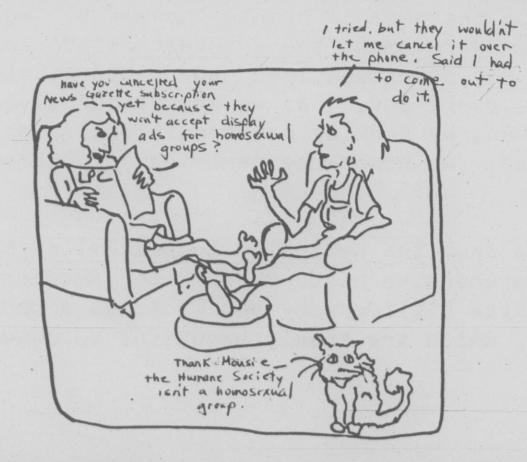
The newsletter also serves as an important record of local queer history in Champaign-Urbana. The 1980s were a tumultuous time for gay rights, both nationally and locally in east central Illinois. 1985 saw a boycott against the Champaign-Urbana News-Gazette when they refused to print advertisements submitted by gay and lesbian groups. After an advertisement submitted by the Gay Community AIDS Project was blocked, involvement from the Champaign-Urbana Human Rights Commission and the LAMBDA Legal Defense and Education Fund led to a change in policy. Additionally, movements in the late 1980s to codify policies to protect queer UIUC students were covered closely, with calls for demonstrations and support published in the newsletter throughout 1987. The resolution was eventually adopted by the Board of Trustees in September 1987. With the local governmental support of the Human Rights Ordinance, ratified by the City of Champaign and the City of Urbana in the late 1970s, the newsletter detailed further efforts to destigmatize and raise consciousness around the increasingly visible queer community in the area.
Separatist and Second-Wave Feminism
Lavender Prairie News emerged in the midst of second-wave feminism, offering a glimpse into the political organization and beliefs of feminists at the time. The Lavender Prairie Collective took a specific separatist approach in their ideology and organization. Separatist feminism, a branch of second-wave feminism that argued that women’s liberation could only come with complete segregation from men, sought to create separate systems, economies, and even vocabularies that removed men from the picture. This can be seen throughout the newsletter in multiple ways. The most common example is the use of alternate spellings of women that avoid using the word “men”: womon, womyn, or wimmin. There are also multiple references throughout its run to a women-only paradise, a concept most famously used by Sally Miller Gearhart in her 1978 book The Wanderground and further expanded by other separatist feminist literature. Separatist ideology was particularly prevalent among lesbians because of the radical decentering of men and the need to create their own spaces outside of heteronormative society.
As a quintessential product of second-wave feminism, the newsletter also illustrates some of the major pitfalls of the movement, especially its tendency to strongly skew towards the experiences of white middle-class cisgender women. The lack of representation in the movement, namely a lack of queer women of color and the intentional exclusion of trans women, is just as notable as their overt political messaging. There are frequent uses of the terms “womyn-identified womyn” and “womyn-born womyn,” terms criticized as being transmisogynist as they restrict womanhood only to those who are assigned female at birth.
Women in Print
Lavender Prairie News also serves as an excellent example of a publication in the women in print movement. Influenced by separatist ideology, the movement emerged as a response to the traditional publishing industry. Leaders of the movement argued that the publishing industry was inherently patriarchal and indicated the need to build a completely autonomous industry for women-led publication. Guided by DIY aesthetics and publication methods, as well as Marxist labor ideology, the movement emphasized the need to have women lead the production and circulation process independently of any traditional printing and publishing avenues. This led to the creation and circulation of DIY publications such as the Lavender Prairie News: circulars printed on home typewriters, photocopied surreptitiously in offices, and spread by an army of volunteers. Beyond smaller publications, the women in print movement also saw the beginning of independent publishers that specialized in lesbian literature. The most renowned of these was Naiad Press, founded by Barbara Grier and Donna McBride in 1973 to provide an avenue for more access to lesbian written works. Lavender Prairie News and other smaller periodicals served as vital advertisers for these independent publishers, regularly updating their readers with new releases. Another avenue to access both the smaller periodicals and independently published novels were feminist bookstores, also positioned within the larger women in print movement. In Champaign-Urbana, the Jane Addams Bookstore became known as the primary location to acquire women in print publications. Book club participants were directed to purchase their copies there, and new releases from publishing companies such as Naiad Press could be specially ordered and shipped there.
Conclusion
Overall, Lavender Prairie News is a testament to the early lesbian community in Champaign-Urbana, a reminder of where the community began and a historical record of the spaces and events where they gathered. It provides abundant material to research local queer history in east central Illinois, as well as publications within the women in print and broader separatist feminist movements. While some of the businesses and organizations no longer exist, some are still in operation, including Jane Addams Bookstore, Courage Connection (formerly A Woman’s Place), and the Etc. Coffeehouse. The newsletter itself has been revived by the local queer community under the name The Lavender Newsletter, with publication beginning in the early 2020s.
Lavender Prairie News, and its preceding title, Lesbian News, has recently been digitized and is now available to view publicly on the Illinois Digital Newspaper Collections [arranged under Lesbian News (November 1975-November 1976) and the Lavender Prairie News (December 1976-July 1992)] as the first LGBTQ+ title on the platform. The original circulation of the newsletter, an underground word-of-mouth effort, raised questions about its public accessibility; as such, last names, addresses, and phone numbers are redacted to protect the privacy of the people appearing in its pages. Unredacted digital copies are available to researchers by request.
Bibliography and Further Reading
Flannery, Kathryn T. Feminist Literacies, 1968-1975. University of Illinois Press, 2005.
Harker, Jaime. The Lesbian South: Southern Feminists, the Women in Print Movement, and the Queer Literary Canon. University of North Carolina Press, 2018.
Travis, Trysh. “The Women in Print Movement: History and Implications.” Book History 11 (2008), p. 275-300.