This summer a museum in Chicago donated a box of miscellaneous newspapers to the History, Philosophy, and Newspaper Library. One interesting discovery in the donation was a paper called Can Worker, a union newspaper for workers at Continental Can Company, Plant Number 5, located at 5401 West 65th Street in Chicago, in a neighborhood known as Clearing.
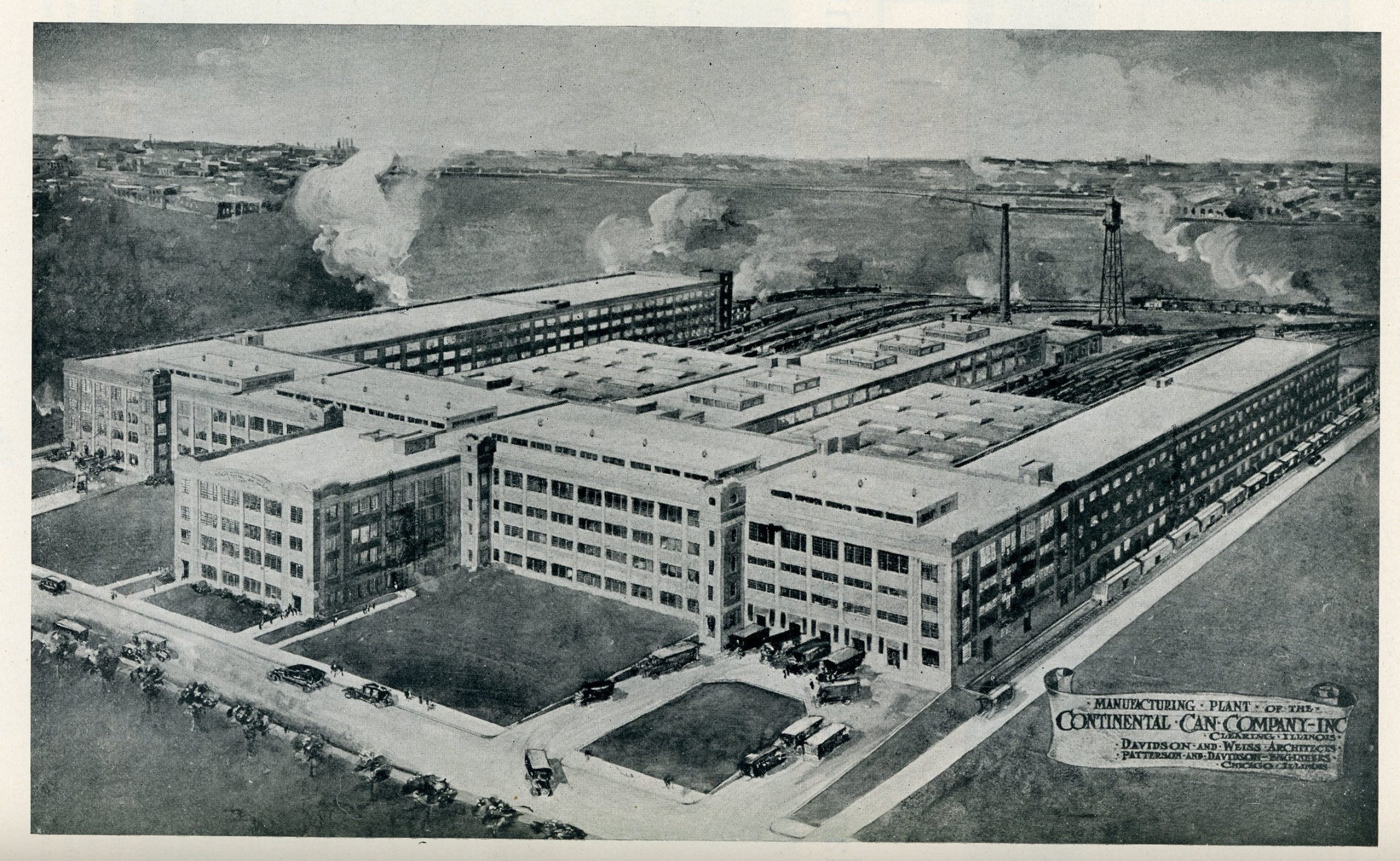
This factory was built in 1918. According to The American Architect, construction moved quickly, thanks in part to the fact that “the work was not under the local jurisdiction of any building department requiring permits, and was only amenable to a few regulations of the State Factory Inspection Department,”1 conditions that cannot have promoted the safety of the people who would eventually work there. Those workers unionized in 1941,2 and were represented by United Steelworkers of America Local 2374. They manufactured tin cans for food products like fruits and vegetables. You can get an idea of what they made from the drawing on their newspaper’s nameplate:
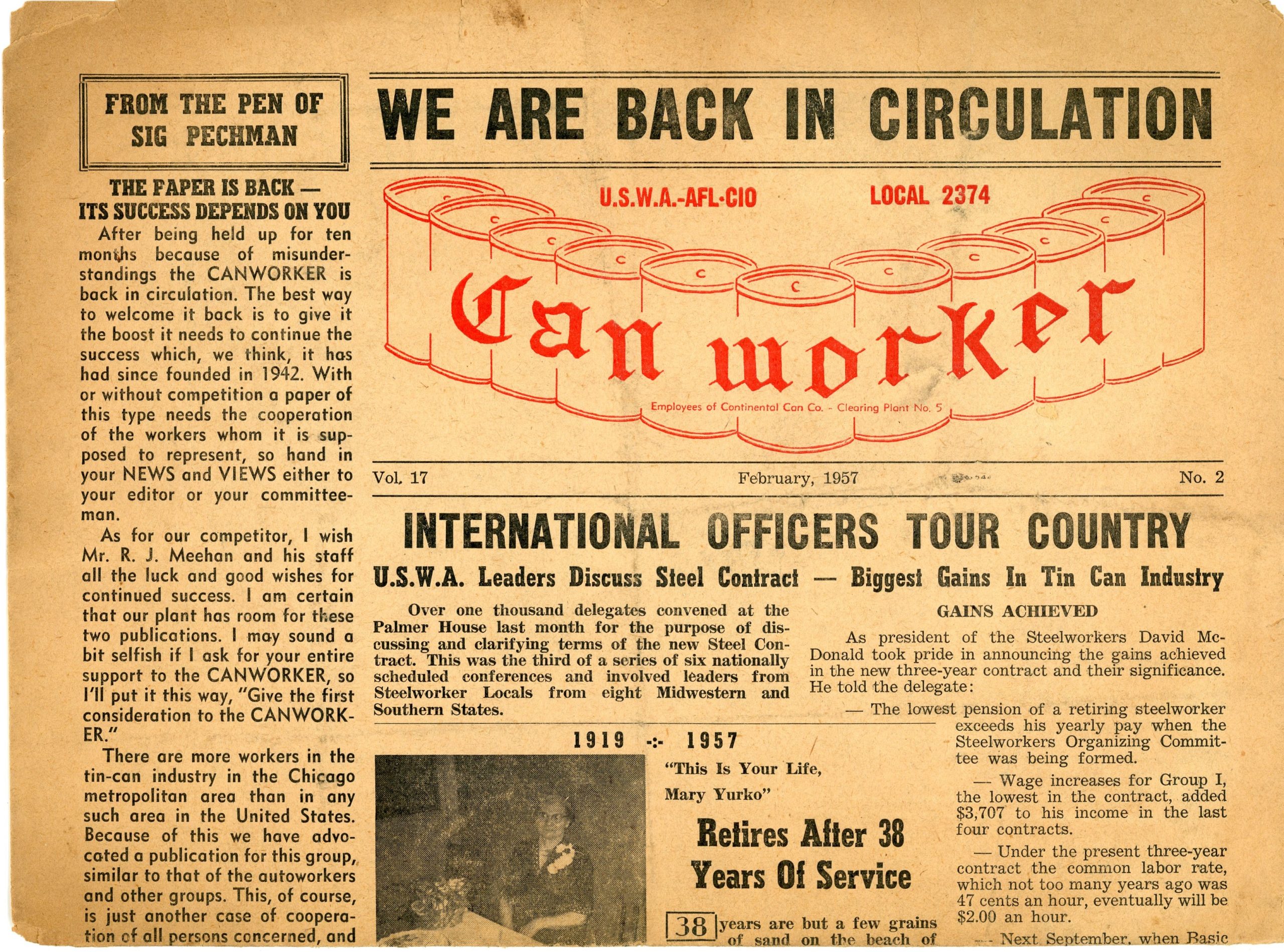
Can Worker began publication a year after unionization, in 1942. The issues we received all came from 1957. A good portion of the articles were about the workers who were also the paper’s intended readers, and these articles made me think of the supposedly recent phenomenon, “bringing your whole self to work.”3 Does the belief that this practice is recent perhaps disclose a class privilege, specifically the privilege not to have your whole self brought to work? Can Worker reported in considerable detail on the private lives of Plant Number 5 workers, reports encompassing the entire human life cycle from births through deaths and events in between: graduations, marriage engagements, weddings, anniversaries, birthdays, vacations, injuries, illnesses, hobbies, retirements, and more. Its editor had no use for privacy, and in this respect Can Worker was, perhaps, typical of American newspapers: when Henry James was planning a novel that would be “as American as possible,” he wrote that “there must, indispensably, be a type of newspaper man—the man whose ideal is the energetic reporter. I should like to bafouer the vulgarity and hideousness of this—the impudent invasion of privacy—the extinction of all conception of privacy.”4 That characterization might well apply to Sig Pechman, Can Worker’s doughty editor in chief and “energetic reporter.”
Continental Can Company was a massive, multi-national corporation that operated over 150 factories (with sales surpassing $1 billion).5 Continental published its own slick house magazines that projected the corporate message.6 Can Worker, on the other hand, focused on a single class of workers at a single factory, putting a tight frame on the lives of the men and women who worked there, which gave the paper a close-cropping effect. For example, in the pages of Can Worker you could read that Mrs. Josephine Grasso, of the Can Assembly Department, flew to Rome for her son’s ordination. On the same page, Can Worker reported that Chester Culver, Edward Bohanek, Mickey Lennen, Frank Musalbar, and Charles Petersen were all recovering from illnesses or accidents, with relevant details included—stories unlikely to be featured in Continental’s own house magazines.
The articles about illness and injury especially struck me: the “whole self” being brought to work was physical as well as social. Like many factories, Plant Number 5 had a hospital,7 suggesting a high incidence of on-the-job injury. Unsurprisingly, therefore, injury and illness were common topics in Can Worker. Two long articles on worker’s compensation legislation reveal how extensively workers’ bodies were subject to multiple, overlapping policy regimes. For example, one change in proposed legislation would “Increase the area of the human body compensable for disfigurement,”8 while another article noted the countervailing claims of employers: “Workman’s Compensation is a very intricate subject to understand because of the many gimmicks in the law, of which both employer and insurance company naturally take advantage.”9 An article on the benefits of the employee credit union ends by reminding the reader that a “member who becomes crippled for life or dies before a loan is paid off will have his debt cancelled and no money will be taken from his family or savings.”10 When your whole self must daily confront the risk of death or disfigurement, and when some of these deaths and disfigurements count while others do not, there was perhaps little privacy remaining to protect: the workers really were bringing their whole selves to work, and the amount of personal information revealed in the paper suggests an acquired level of comfort with that lack of privacy: the articles have a persistently cheerful tone, even those articles reporting illness and injury, which makes you feel the workers were, perhaps, just making the best of a bad deal.
Notes
1. Davidson and Weiss, “Manufacturing Plant of the Continental Can Company, Inc., Clearing, Ill.,” The American Architect 113, no. 2201 (1918): 259.
2. “CIO Brings Change at Continental Can Plant,” Daily Worker (New York, N.Y.), June 26, 1941.
3. See for example, Douglas Murray, “Work Is No Place for Your ‘Whole Self,’” Spectator, February 19, 2022; Letitia Silas, “Employers’ Whole-Self Conundrum: A Closer Look at the Practical and Legal Realities of Inviting Employees to Bring Their ‘Whole Self’ to Work.,” Employee Relations Law Journal 51, no. 4 (2026): 4–8.
4. Henry James, The Complete Notebooks of Henry James, ed. Leon Edel and Lyall H. Powers (Oxford University Press, 1987), 19.
5. Robert Halasz, “Continental Can Co., Inc,” in International Directory of Company Histories, vol. 15, ed. Tina Grant (St. James Press, 1996), 128.
6. Gebbie House Magazine Directory (Gebbie Press; House Magazine Pub. Co., 1954), ii.
7. Davidson and Weiss, “Manufacturing Plant of the Continental Can Company, Inc., Clearing, Ill.,” 253.
8. Mac Stricker, “Union Members Visit State Legislators: Give Opinions on Labor-Sponsored Bills: Workmen’s Compensation Discussed,” Can Worker (Chicago, Ill.), April 1957, 3.
9. Louis Addeo, “Workmen’s Compensation Laws Present Many Problems,” Can Worker (Chicago, Ill.), April 1957, 1.
10. Stricker, “Union Members Visit State Legislators: Give Opinions on Labor-Sponsored Bills: Workmen’s Compensation Discussed.”