For Illinois music educators whose professional music training is tied to the University of Illinois Urbana-Champaign, the university’s first band director, A. Austin Harding, is readily recognized as the founder of America’s collegiate band movement beginning in 1907. He was also one of the founders of the country’s school band movement in 1920 with Joseph Maddy and John Philip Sousa.
Harding (1880-1958) grew up in Paris, Illinois. As a high school student, he played cornet and directed the local municipal band. He later entered the University of Illinois as a civil engineering student. He was asked to direct the University of Illinois Band by the head of the School of Music in the spring of 1905 while he was still a senior in the College of Engineering. Harding accepted and was officially a member of the faculty in the fall of 1905. To Harding, the position was only a temporary arrangement, since his goal was to become a municipal and sanitary engineer. After two years of conducting the band, Harding was officially appointed the first Director of Bands in 1907, a position he held until his retirement in 1948.
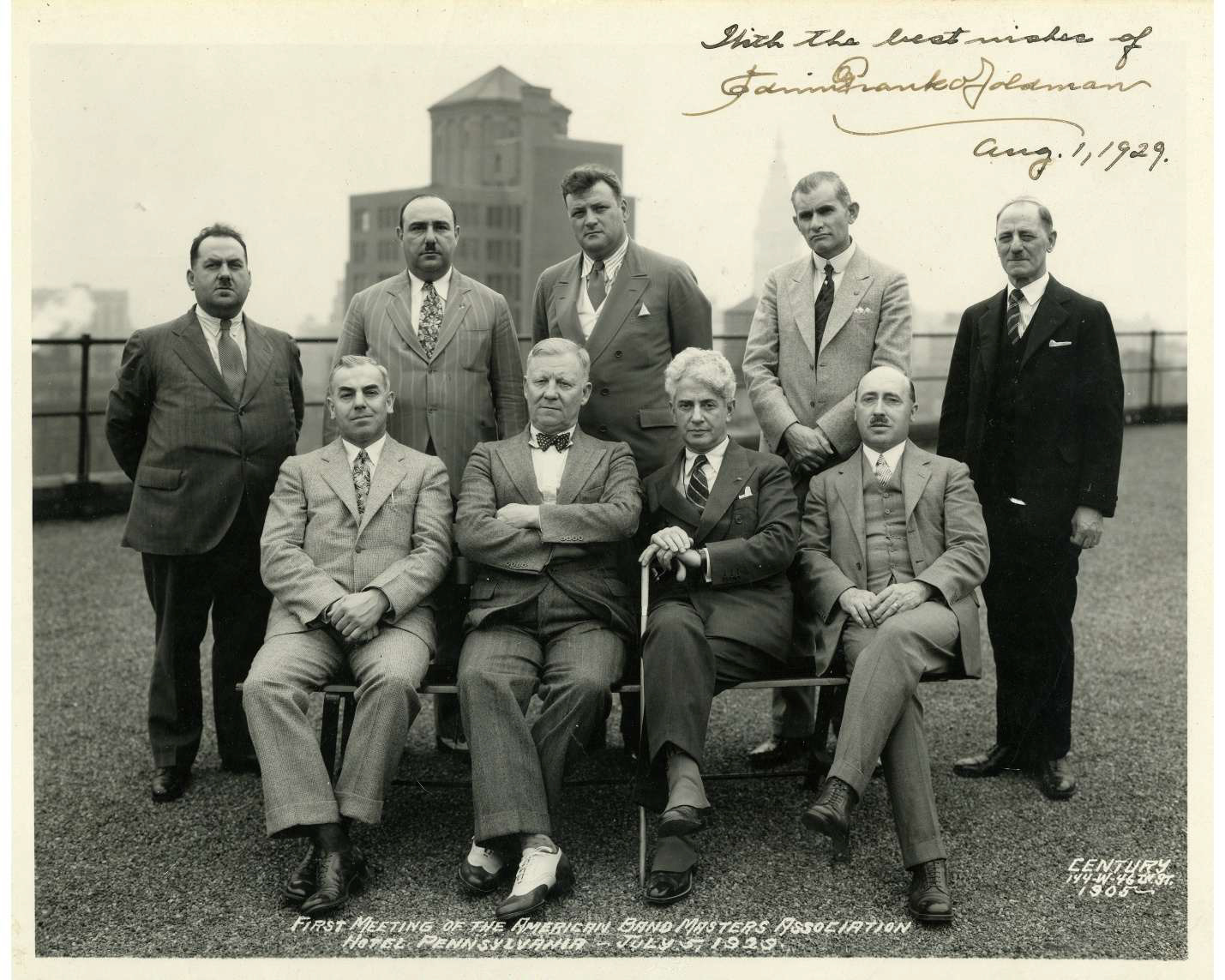
Many articles and dissertations have been written about Harding’s influence on today’s collegiate and public school band movements. However, much less is written about Harding’s work in 1929 forming the American Bandmasters Association (ABA) with Edwin Frank Goldman and John Philip Sousa. The other founding members were professional and military band directors that included Jean-Josaphat Gangier, Captain Charles O’Neill, Victor J. Grabel, Captain R. B. Hayward, Frank Simon, Lieutenant Charles Benter, Captain W.J. Stannard, Captain Taylor Branson, and Herbert L. Clarke. Harding was ABA’s only collegiate band director.
The ABA’s first official meeting in New York City on July 5, 1929, designated Edwin Franko Goldman President and John Philip Sousa was appointed as the organization’s Honorary President. Charles O’Neill was elected Vice President, Victor Grabel as Secretary, and Harding as Treasurer. During this meeting, members discussed the need for international standards for composers to write new music for wind bands. They also advocated for the commissioning of new music works to elevate wind band performance in America.
During the 1930 ABA conference in Middletown, Ohio with Frank Simon’s Armco Band as its host, Sousa recommended the modernization of the instrumentation of symphonic bands by discontinuing the use of E-flat clarinets and cornets. He considered these instruments fitting for only “street bands” and no longer viable for modern concert band performance. Karl King, Herbert L. Clarke and Sousa also advocated the development of state-government lobbying initiatives to support municipal bands throughout the country.
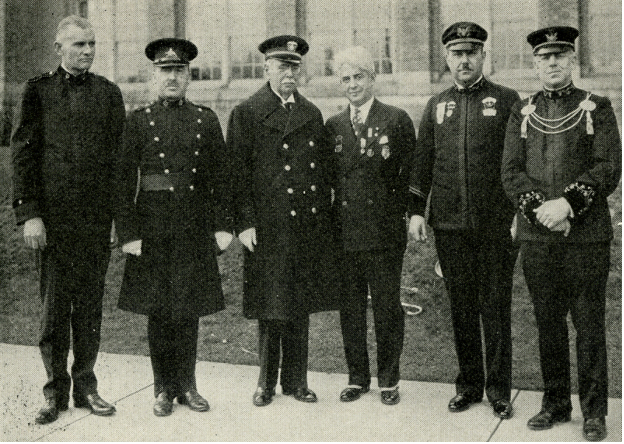
As the ABA’s work on refining band performance practices in America continued to blossom during their 1931 and 1932 conferences in Boston and Washington, the country’s banking system began to implode with 744 banks failing in 1930, and by 1933 over 4,000 had closed in a single year. This does not include the National Bank Holiday that took place March 1-13, 1933.
According to the Federal Deposit Insurance Corporation, depositors lost over 1.3 billion dollars between 1929 and 1933. This would be the equivalent of 28.5 billion dollars in today’s economy. Unlike the rest of the country, the ABA remained relatively flush with their cash reserves and were able to cover the expenditures for their 1931 conference. However, things became much bumpier starting in 1932.
As ABA’s treasurer, Harding kept their financial assets in Champaign’s First National Bank, which was the bank that the University of Illinois used to manage its institutional expenditures. However, on Tuesday, January 19, 1932, the first run on the Champaign Bank occurred. The bank managed to stay open until 3pm, but over 1 million dollars had been withdrawn in a single day. Three days later the bank reopened to finish out the week but remained closed for the next seven months.
On January 28th Harding wrote to Mr. Goldman to tell him that ABA’s assets had been frozen and expressed his serious concern about their situation.
I am very much disturbed about the whole matter, as I was putting the funds in the safest possible place; but there seems to be no real safe place now days. I not only had my personal account there with a fortunately, or rather unfortunately, substantial balance; the Vice-President of the bank is the University Treasurer, and all our band funds are deposited there. So, you can see that there was universal confidence in the bank and its officers. The sentiment in the community is entirely friendly to the bank, a big mass meeting of about 5,000 depositors met a few nights ago and they are inaugurating a movement with the cooperation of the Rotary and other service clubs, Chamber of Commerce and numerous committees to cooperate in re-opening the bank, if possible, without going through a receivership.
Goldman responded to Harding on February 1 that his New York bank had closed the previous year, and matter-of-factly wrote, “these things happen.” Goldman then asked Harding if he should find another bank, possibly one in Chicago, to help manage ABA’s funds.
One can only imagine what must have gone through Harding’s head after receiving Goldman’s letter. While much of Harding’s time as ABA’s treasurer was spent keeping the organization’s financial books on the positive side of the ledger, Goldman was much more cavalier with ABA’s conference expenditures which frustrated Harding during this challenging time.
On February 20, Harding wrote again to Goldman, explaining how the bank planned to reopen. For a short period of time only a portion of each depositor’s money would be made available for withdrawal. The bank would keep each depositor’s remaining balances until the bank stabilized its finances. For this financial inconvenience, the bank would provide each depositor a modest interest payment for these unused balances. However, to be able to do this the bank needed all its depositors to agree to this arrangement to ensure no one would lose their savings.
On August 12 Champaign’s First National Bank reopened for business and after eight months the ABA was able to start paying the bills for its 1932 conference. That same day Harding wrote to Goldman to say the organization’s account was overdrawn. The final costs for the printing of the conference program were nearly double what Goldman and Harding had planned for the April 1932 conference in Washington, DC.
The bank has just notified me that the check I wrote for the first payment on the cost of printing the Annual [conference program] overdrew our account some sixty odd dollars. So I am trying to get in what is due from the advertisers in the Annual as well as some dues to take us out of the red. The prospects for the re-opening of the other bank here [Commercial State Bank] on September 1 seem rather favorable now.
Throughout this financial crisis the correspondence between Harding and Goldman was less focused on ABA’s precarious financial situation and more centered on Sousa’s looming posthumous presence during the April conference after his sudden death on March 6th. However, Harding maintained a firm hand in ABA’s finances, which Goldman readily recognized as paramount for the organization’s continuing success.
In December 1933 as the country’s banking situation stabilized after its “bank holiday,” Goldman asked Harding if he would continue to serve as ABA’s treasurer for another year. Harding graciously declined Goldman’s invitation, and suggested others in the organization deserved to serve ABA as he had done. Harding never again served as the ABA’s treasurer, but he was eventually elected as its President between 1937 and 1938 because of his steadfast leadership during the worst years of the Great Depression. He was later recognized as ABA’s Honorary Life President from 1956 until his passing in 1958.