America’s Banjo Legacy with Dom Flemons
Music and Performing Arts Library
October 7, 2026
5:00-6:30
 The five-string banjo is an American invention, but its inventor was not, as some have asserted, Joel Walker Sweeney (1810-1860). Sweeney became America’s first major “banjo artist” during the 1830s and 40s, but the instrument that became the standardized five-string banjo sprang from the resourcefulness of West African musicians brought here as slaves. Using materials close at hand, these individuals led the development of this new music instrument whose roots drew heavily from the plucked string instruments were made from gourds and called bandora, banza, banjah, and akonting.
The origin of America’s banjo is essentially built on an eighteenth-century African instrument that was grounded in black music traditions. While most of the banjo playing styles associated with these traditions can be traced with some reasonable accuracy, the dating and location of the earliest five-string banjo remain elusive, lost in a maze of folklore.
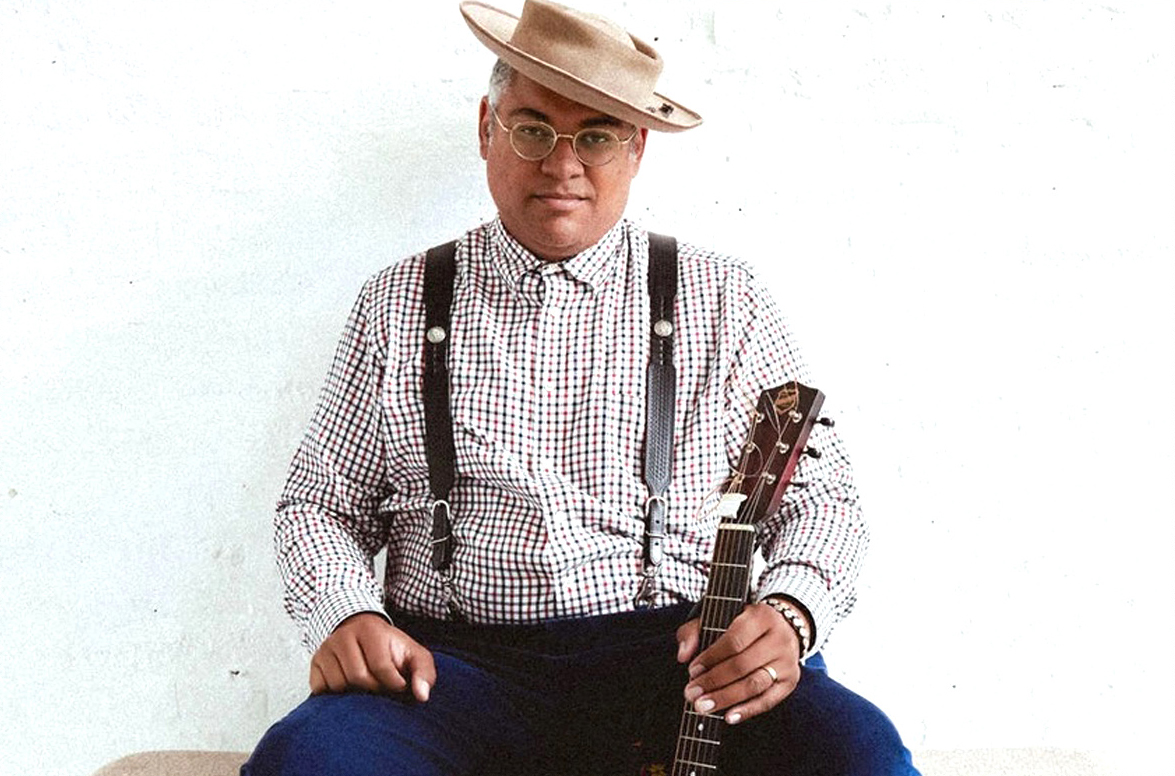
Dom Flemons, one of the country’s leading banjo scholars and performing artists, will provide a spell-binding performance discussion about America’s rich black banjo legacies to help kick off this year’s Folk and Roots Festival. He is a musician based in the Chicago area and famously known as “The American Songster®” because his repertoire covers over one hundred years of American roots music – everything from country, folk, and bluegrass to Americana and the blues.
This program is sponsored by the University of Illinois Library’s Sousa Archives and Center for American Music and the Music and Performing Arts Library. For further information contact Scott Schwartz at schwrtzs@illinois.edu or Kate Lambaria at lambari1@illinois.edu.