Summer Vacation with the IDHH

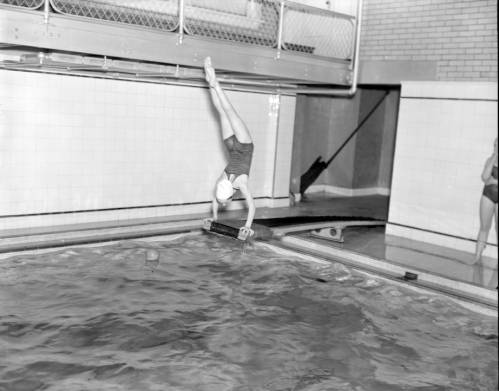
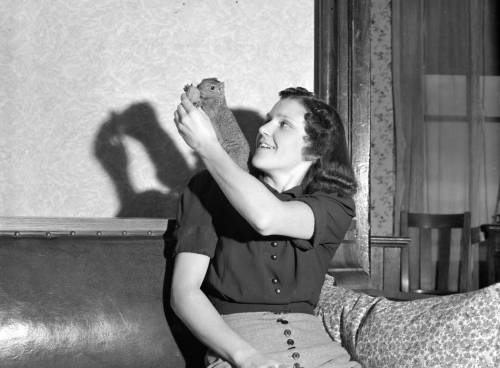
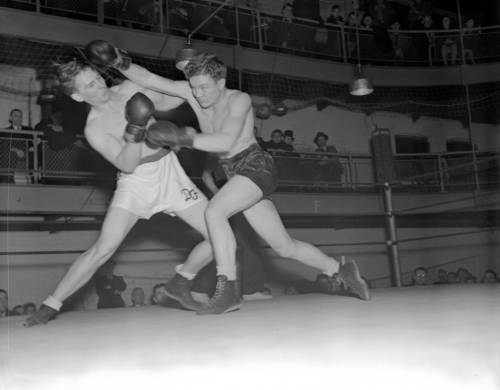
As the weather starts to warm up and the school semester ends, we here at the IDHH are ready to celebrate summer and summer vacations! Whether you’re headed outside for some fun in the sun and sport, off to the beach for the sand and waves, or just remaining at home for a staycation, we hope you can take some time to rest and relax before the “Sirius-ly Scorching Dog Days of Summer” arrive.

Here are a few of our favorite items related to summer vacations:

sepia-tone image of people picnicking and playing in the water at a lake beach.
Vacation Days, Lake Bluff, Ill. m86.1.1481. August 7, 1913. Bess Bower Dunn Museum of Lake County. Lake County History in Postcards. Courtesy of Bess Bower Dunn Museum of Lake County.
black and white image of two teenage girls sunbathing on a lawn
High School kids on vacation, Bloomington-Normal, IL 1949. July 7, 1949. Created by Stanley Lantz. McLean County Museum of History. Pantagraph Negative Collection, 1946 – 1949. Courtesy of McLean County Museum of History.
Color postcard frontside of people fishing on a pier.
Vacation days, Chicago [front]. July 19, 1909. Imprint by V.O. Hammon (Chicago, Ill.). Eastern Illinois University. Booth Library Postcard Collection. Courtesy of Eastern Illinois University.
black and white image of teenage boy swinging a baseball bat
High School kids on vacation, Bloomington-Normal, IL 1949. July 7, 1949. Created by Stanley Lantz. McLean County Museum of History. Pantagraph Negative Collection, 1946 – 1949. Courtesy of McLean County Museum of History.
world war 2 illustrated poster of a man relaxing in an armchair with a dog resting at his feet
Me travel? …not this summer. Vacation at home. 1945. Created by Albert Dorne (1904-1965). Illinois State University. World War II-Era Posters and Propaganda. Courtesy of Illinois State University.
black and white image of man reading a book while sitting in an armchair in front of an unlit fireplace
Sublimating vacation; Pantagraph photostory; vacations during wartime, Bloomington, IL, 1944. July 19, 1944. Created by Gladys Mittelbrusher. McLean County Museum of History. Pantagraph Negative Collection, 1940-1944. Courtesy of McLean County Museum of History.


Want to see more?

Visit the IDHH to view more items related to vacations and summer, or to view more collections and items from Illinois State University, McLean County Museum of History, Bess Bower Dunn Museum of Lake County, and Eastern Illinois University.

GOAL! Soccer from Illinois to the World Stage

The fairly simple sport of soccer, known internationally as football, is the world’s most popular ball game in numbers of participants and spectators. With the 2022 Men’s FIFA World Cup currently in play, the IDHH would like to highlight the sport of soccer and its rise in popularity in the United States. Soccer was brought to North America by European immigrants in the 1860s, with informal matches being contested by Canadian and American teams by the mid-1880s. Already a pastime with a devoted audience and professional associations in Britain, soccer was not immediately popular in Canada or the United States, as ice hockey and gridiron football (American football) were becoming more prominent respectively. 

However, American cities with large immigrant populations, such as Philadelphia, Chicago, and New York City, saw the sport played widely, and led to the official formation of the United States Soccer Federation in 1913. Over the first half of the 20th century, soccer’s popularity in the United States would steadily rise without ever truly finding a regular fan base. The sport’s fortunes would shift in the 1960s and ‘70s, though, as American teams began signing international players, such as the Brazilian athlete Pelé, and the passage of Title IX in 1972 further encouraged the participation of female players. Viewed as less violent and more socially inclusive than American football, soccer benefited from an influx of younger soccer players in the 1980s and ‘90s. The United States would host the 1999 FIFA Women’s World Cup, setting an all-time attendance record as the U.S. women’s team led by Mia Hamm clinched the Cup. In the last two decades, soccer has solidified itself as a significant sport in the United States, with the creation of various national soccer associations and leagues, and a devoted following of American teams on the international stage. 

Here are a few of our favorite soccer items:
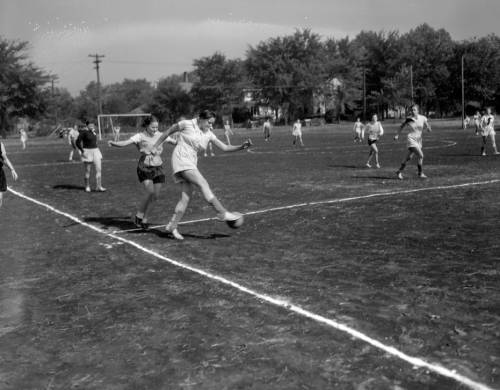
black and white photo of college women playing soccer, with one woman kicking a ball in the foreground
Illinois State Normal University Women’s Sports Day, Normal, IL, 1935. October 12, 1935. Photographed by Frank Bill. McLean County Museum of History. Pantagraph Negatives Collection, 1930 – 1939. Courtesy of the McLean County Museum of History.
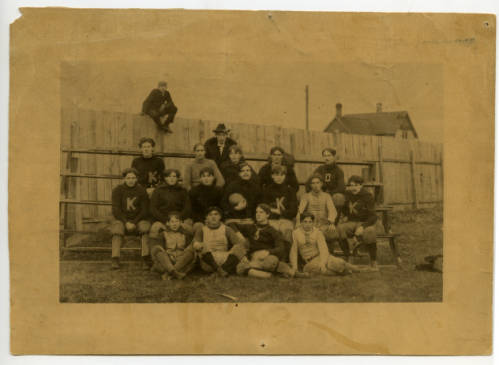
sepia-toned photo of women college football team
Soccer football 1906-1907. 1906. Photographed by Allen Ayrault Green. Knox College. Allen Ayrault Green Photograph Collection. Courtesy of Knox College.
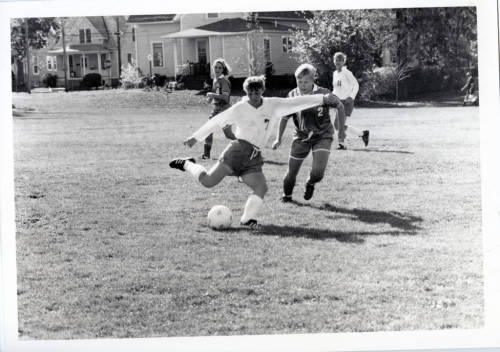
black and white image of college women playing soccer, with one woman in front about to kick the soccer ball
Women’s soccer. 1992. Knox College. The Way to Knox. Courtesy of Knox College.
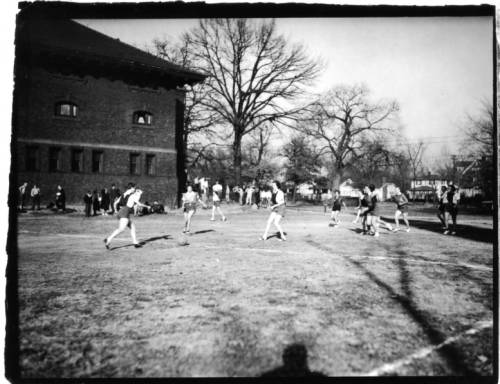
black and white photo of college women playing soccer on a field
Women’s Athletic Association – Soccer. 1937. Millikin University. Big Blue Photograph Collection. Courtesy of Millikin University.
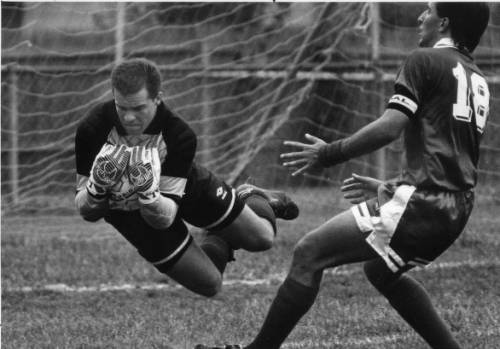
black and white photo of male goalkeeper holding a soccer ball to save a goal
Soccer – Men’s – Players – Kroening. [n.d.] Millikin University. Big Blue Photograph Collection. Courtesy of Millikin University.
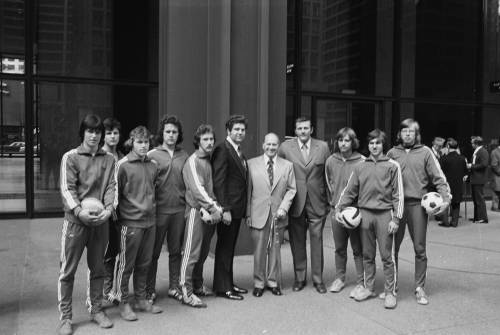
black and white photo of Congressman Frank Annunzio and a few members of the 1976 Polish soccer team
Congressman Frank Annunzio and the Polish soccer team. 1976. Photographed by Copelin Commercial Photographers. University of Illinois Chicago. Congressman Frank Annunzio Photo Collection. Courtesy of the University of Illinois Chicago.

Want to see more? 

Visit the IDHH to browse even more items related to the sport of soccer.
Look at the Unbe-leaf-able Fall Foliage

Cooler weather. Baking spices. Warm cider. These things might conjure up a variety of associations and feelings, but for those of us living in the northern United States, they herald the beginning of the autumn or fall season. With the start of November, the IDHH would like to highlight that time of year when the daylight hours wane and sweater weather is in vogue. In the Northern Hemisphere, autumn is usually recognized as the time between the autumnal equinox toward the end of September and the winter solstice toward the end of December. This time of the year has held various significance across cultures and periods, but early associations in the Northern Hemisphere centered around the passing of the year and the importance of the harvest season in areas across medieval Europe. 
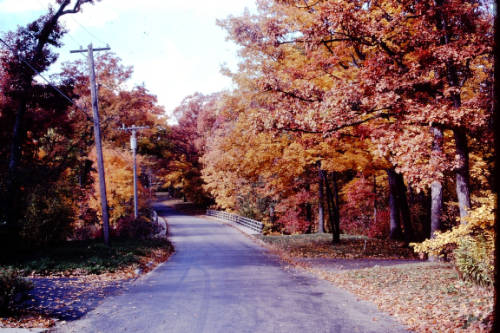
While this connection to harvesting continues to be paramount for those working in agriculture, the environmental changes during the fall season have also become a key aspect of tourism for certain areas of the world. In the United States, portions of northern New England, Appalachia, and the upper Midwest offer prime views of leaves changing from their usual green color to vivid hues of orange, red, and yellow in the autumn months. Millions of visitors pour into these areas of the country to witness this stunning natural display – an act referred to as ‘leaf peeping’ in some circles. A phrase used colloquially in the United States since only the 1960s, leaf peeping is an autumn activity enjoyed internationally in the provinces of Ontario and Quebec in Canada, as well as in various parts of Japan.  

Here are a few of our favorite items featuring vibrant fall foliage:

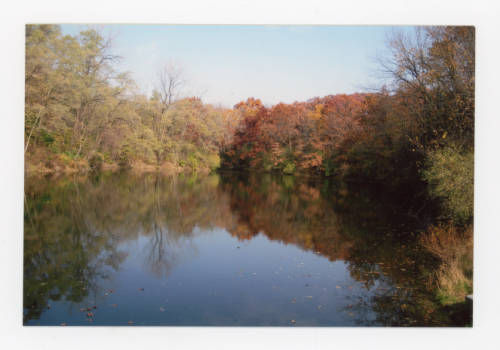
color photo of autumn-colored leaves along a river
Fall color. Circa 1990s. Knox College. Green Oaks Biological Field Station. Courtesy of Knox College.
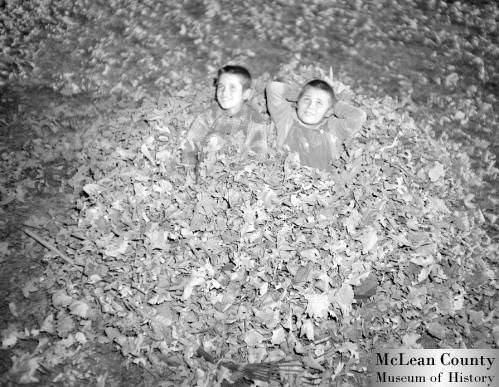
black and white photo of two young boys posing in a pile of leaves
Brothers Walter and Edward Mann raking fall leaves, Bloomington, IL 1947. October 9, 1947. Photographed by Wilma Tolley. McLean County Museum of History. Pantagraph Negative Collection, 1946 – 1949. Courtesy of the McLean County Museum of History.
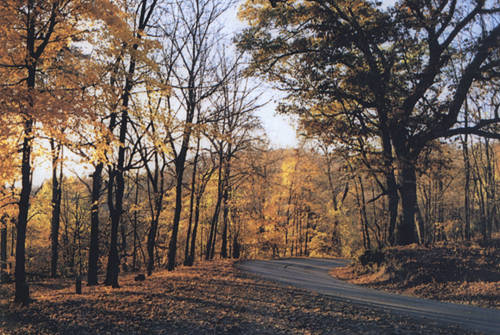
a color image of yellow-leaved trees along an empty street around sunset near the Illinois River
Pere Marquette Park and Lodge, on the Great River Road (IL 100) facing the Illinois River. [n.d.] Photographed by Art Grossmann. Eastern Illinois University. Booth Library Postcard Collection. Courtesy of Eastern Illinois University.
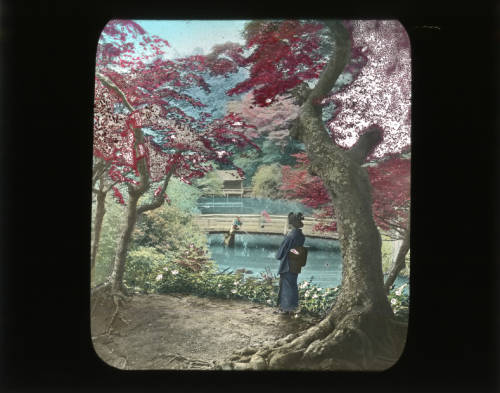
a color lantern slide of maples in autumn in Tokyo with a person in a kimono standing near a bridge over water
Autumn view of maples, Oji, Tokyo. Circa 1880s. Created by Kinbē Kusakabe. Dominican University. Japanese Lantern Slides. Courtesy of Dominican University.
color image of orange, yellow, and red leaves in trees along an empty street in Highland Park, IL
Autumn street. October 1978. Photographed by Henry X. Arenberg. Highland Park Historical Society. Highland Park History. Courtesy of the Highland Park Historical Society.

Want to see more? 

Visit the IDHH to browse even more items related to the fall season.

Memorial to the Remembered: Tombstones and Headstones

October marks that time of the year when we dress up as ghouls and goblins, decorate our homes with spiderwebs and skeletons, and indulge in all manner of frightening things. As a nod to these spine-chilling 31 days, the IDHH is featuring the fascinating use and art of tombstones and other grave markers. As diverse as the great variety of funerary traditions around the world, grave markers serve not only the utilitarian purpose of demarcating the physical space where an individual might lie, but also reflect the social values and traditions of a specific period or people. Cemeteries and other burial places held great significance from the earliest days, as providing a place for the dead was thought to be an important family obligation. This significance would eventually extend to larger communal graveyards and burial places as inclusion in these spaces became exclusive to community members, often excluding foreigners, criminals, and other unwanted groups. 

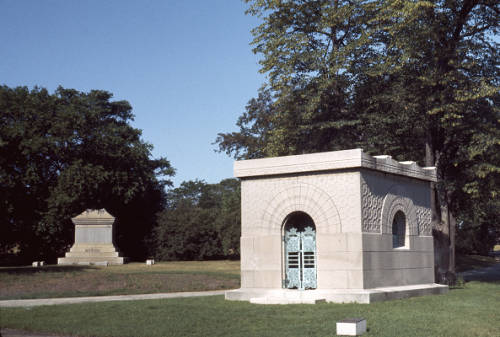
The tombstones and grave markers within these communal spaces have communicated a number of ideas to visitors over time. As a work of art, the craftsmanship and skill in the construction of the tombstones can be an aesthetic pleasure in its own right. Such artistry leads people to create gravestone rubbings with charcoal and to capture graveyard scenes through painting and photography. The construction and grandiosity of these markers may also impart a sense of prestige or wealth, such as in the image below of Carrie Eliza Getty’s large tomb in Chicago. Of course, tombstones also act as a memorial to previous generations, prompting us to seek out the histories of those buried there, like of the Mabie family and their influential 1840s circus show in Wisconsin. Whether viewed as art, icon, or historical marker, tombstones offer a (spooky) glimpse into the values and customs of those who are no longer with us. 

Here are a few of our favorite items featuring tombstones from across the Midwest:

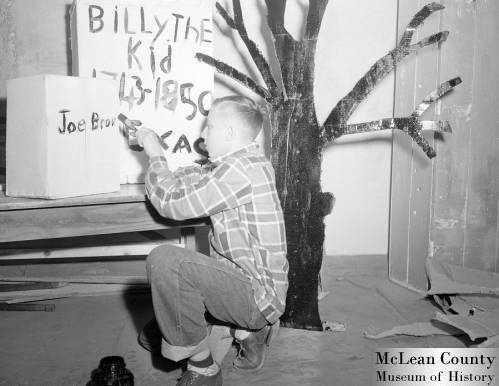
black and white photo of young boy painting tombstone decoration including one for Billy the Kid with a cardboard tree in the background
Boy painting tombstone decorations, unspecified location, Central Illinois, 1951 Halloween picture layout. October 29, 1951. Photographed by Gene Smedley. McLean County Museum of History. Pantagraph Negative Collection 1950 – 1959. Courtesy of the McLean County Museum of History.
color image of mausoleum building with another tombstone in the background
Carrie Eliza Getty Tomb and Joseph Medill tombstone, Graceland Cemetery. 1976. Photographed by Charles William Brubaker. University of Illinois Chicago. C. William Brubaker Collection. Courtesy of the University of Illinois Chicago.
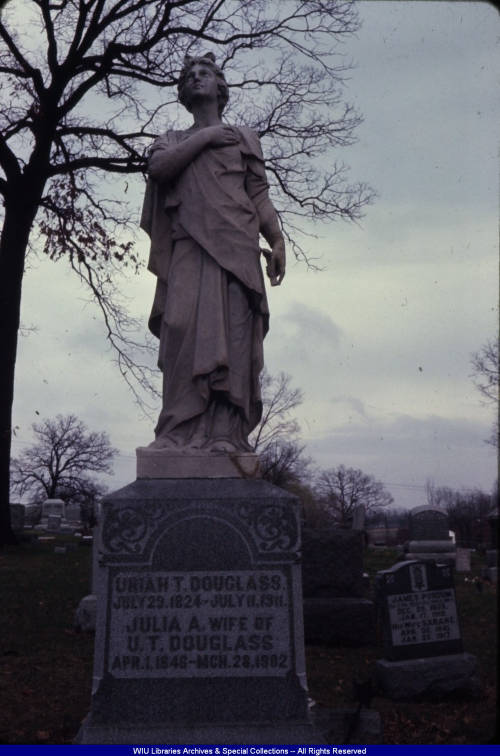
color image of tombstone with human statue carved on top
Tombstone of Uriah T. Douglass and Julia A. Douglass in Oakwood Cemetery. [n.d] Western Illinois University. Digital Image Collection. Courtesy of Western Illinois University.
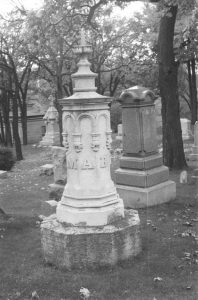
black and white photo of tombstone carved as pillar with the letters M A B visible
Tombstone. [n.d.] Photographed by Sverre O. Braathen. Illinois State University. Sverre O. Braathen Circus Photo Collection. Courtesy of Illinois State University.
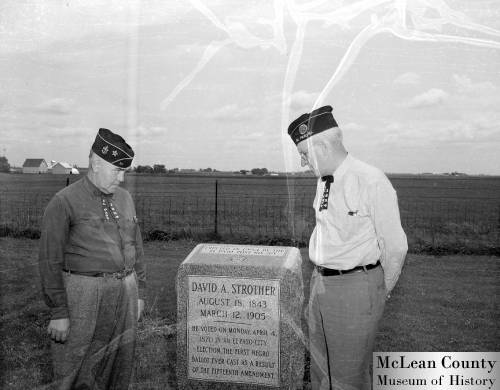
black and white photo of two veterans looking at a tombstone of David A Strother
Two veterans looking at tombstone of David A. Strother, first African American to cast a vote in the United States, El Paso, IL, 1954. May 28, 1954. Photographed by Ann Broder. McLean County Museum of History. Pantagraph Negative Collection 1950 – 1959. Courtesy of the McLean County Museum of History.
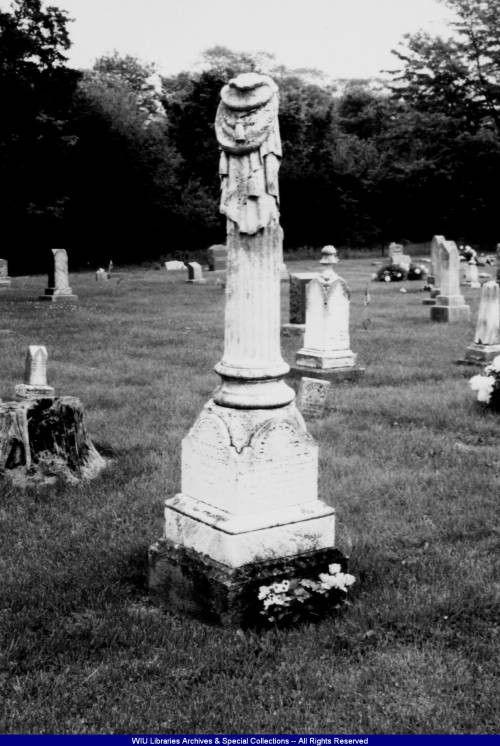
black and white photo of tombstone carved as pillar with cloth on top
Scott tombstone Scott’s Cemetery 2002. 2002. Photographed by John Hallwas. Western Illinois University. Digital Image Collection. Courtesy of Western Illinois University.

Want to see more? 

Visit the IDHH to browse even more items related to tombstones and grave markers.

Bees and Butterflies and Bats, Oh My!

As temperatures warm and days get ever longer, the sounds of bees buzzing past and birds chirping in the trees indicate not only the arrival of summer, but also the height of the plant pollination period. June 1st marked the beginning of National Pollinators Month, recognizing these creatures and the crucial role they play in the larger system of plant reproduction and proliferation. Pollinators come in all shapes and sizes, encompassing such diverse animals as insects, birds, and even some mammals. These animals travel from one flower or plant to another, carrying pollen as they go, and fertilizing flora with each new plant they visit. The symbiotic dynamic between these plants and pollinators is vital to both groups, as pollinators eat the pollen or nectar for its nutritional content, while the plants rely on the pollinators to spread their pollen, aiding in reproduction.  

The importance of this intricate process and the players within it has captivated human populations for centuries as butterflies, hummingbirds, and other pollinators have been ascribed cultural significance and symbolism in various communities around the world. Such cultural significance persists today as we create entertainment like The Bee Movie that foregrounds pollinators, hold events such as the Aurora Pollinator Festival that highlight the role of pollinators, and design outdoor environments that offer ideal conditions for these animals. Indeed, as our climate changes there is a greater need than ever to create pollinator-friendly landscapes using pollinator-friendly practices. By providing habitats conducive to pollinator animals, we can simultaneously safeguard this essential process and beautify the natural world around us. 

Below are a few of our favorite items featuring one of the most popular pollinators – the honey bee:

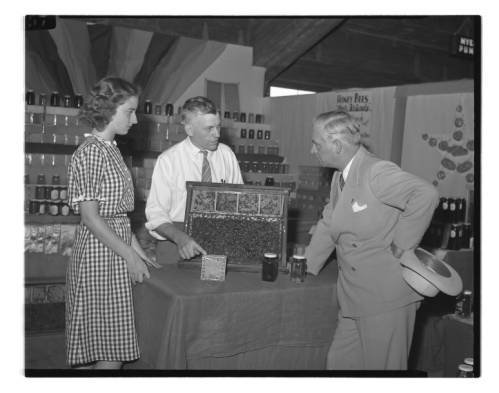
black and white photo of a man presenting bees on a frame to a man holding a hat while a woman in a gingham dress stands nearby
Governor Green at Bee Exhibit — State Fair. August 1946. Illinois State Archives. Eddie Winfred “Doc” Helm Photograph Collection. Courtesy of the Illinois State Archives.
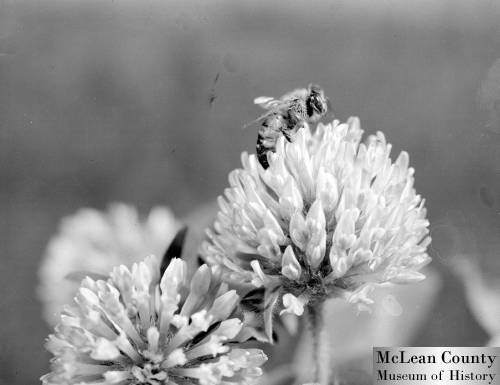
black and white photo close-up of a honey bee on a flower
Honey bees, Chenoa, IL 1948. April 1, 1948. Photographed by Stanley Lantz. McLean County Museum of History. Pantagraph Negative Collection, 1946 – 1949. Courtesy of the McLean County Museum of History.
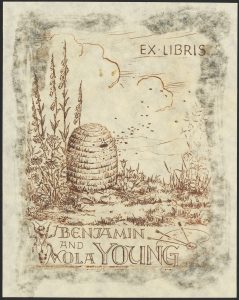
color image of bookplate with beehive on grass
Young, Benjamin Percy; Young, Nola Ayers. 1949. Designed by F. Botel. University of Illinois at Urbana-Champaign Library. John Starr Stewart Ex Libris Collection. Courtesy of the University of Illinois at Urbana-Champaign Library.
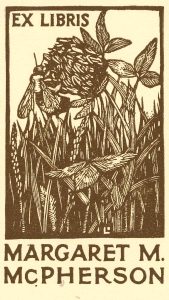
brown ink book plate on cream-aged paper of a bee on a thistle
Margaret M. McPherson. n.d. Designed by Julius J. Lankes. West Chicago Public Library District. Cornelia Neltnor Anthony and Frank D. Anthony Book Plate Collection. Courtesy of the West Chicago Public Library District.
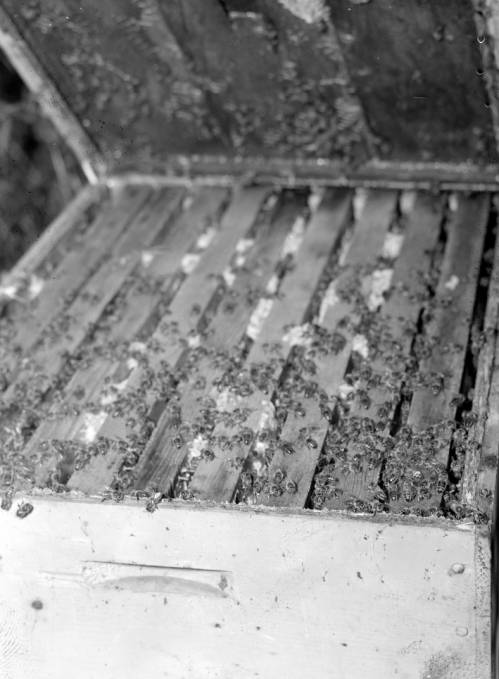
black and white photo of an open bee box with honey bees scurrying over the frames
Roberts, IL beekeeper, 1941. September 10, 1941. Photographed by Charles Menees. McLean County Museum of History. Pantagraph Negatives Collection 1940 – 1945. Courtesy of the McLean County Museum of History.

Want to see more? 

Visit the IDHH to view even more items related to bees.

Ice, Ice, Skating – Gliding into the New Year

As a native Texan, I have always regarded winter sports with a healthy amount of both respect and fear. However, an exception to this innate mindset was made every four years with the performance of the Winter Olympics. For those few weeks, I was awed by the grace of the figure skaters, the fearlessness of the luge racers, and the gravity-defying feats of snowboarders in the half-pipe. With the winter season in full swing here in Illinois, and the 2022 Winter Olympics just around the corner, the IDHH would like to feature a staple winter sport: ice skating. 

Ice skating is believed to have developed in Scandinavia as early as 1000 BCE, using skates initially made from the bones of elk, oxen, reindeer, and other animals. While it is not exactly known when metal blades were introduced in the construction of ice skates , Dutch paintings from the 17th century clearly depict skaters gliding along on metal blades. Gaining in popularity as a recreational pastime in the 1800s, the activity eventually reached North America and a number of skating clubs were established in major cities in the Northern Hemisphere. Toward the end of the century, the sport would be indelibly changed in 1876 with the creation of the first rink using artificially frozen ice –  the Glaciarium in London. The artificial ice rink in Madison Square Gardens opened soon after in 1879 and the innovation of creating artificial rinks led to the rise of various skating sports and a desire for ice shows as popular entertainment. Eventually, ice skating would make its debut in the 1908 Summer Olympics, with speed skating to follow as an event at the first official winter games in 1924. 

Whether a newcomer to skating or a veteran of the ice, please enjoy a few of our favorite ice skating items from the collection:

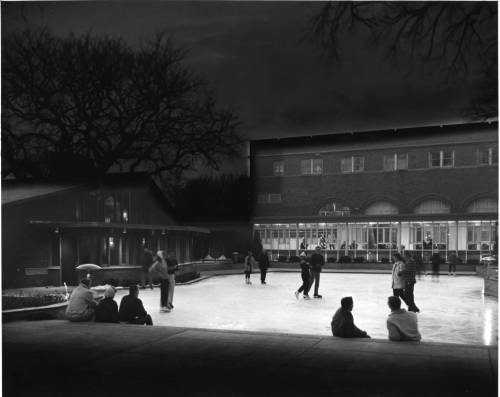
black and white photo of couples ice skating with buildings in the background
Ice skating rink. 1960. Knox College. The Way to Knox. Courtesy of Knox College.
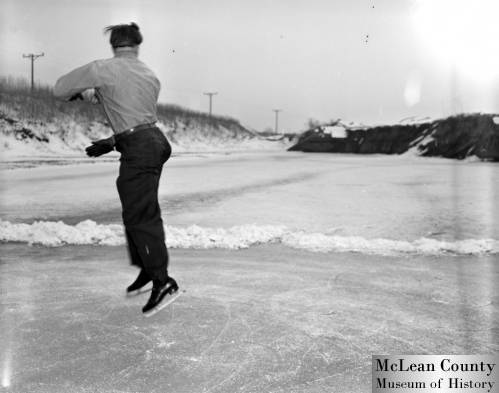
black and white photo of a male ice skate in mid-jump
Al Sherer, ice skating, Bloomington-Normal, IL, 1944. February 17, 1944. Photographed by Gladys Mittelbrusher. McLean County Museum of History. Pantagraph Negative Collection, 1940-1945. Courtesy of the McLean County Museum of History.
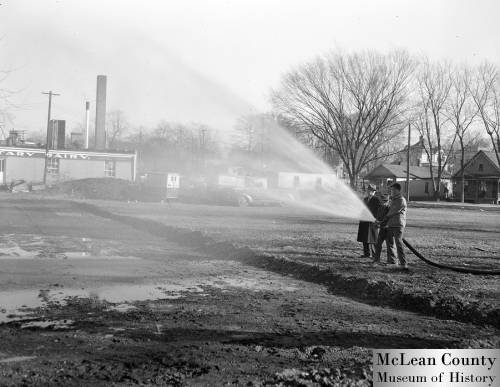
black and white photo of two men spraying water through a large hose onto a muddy patch in a field
Flooding skating rink, 1946. December 17, 1946. Photographed by Phyllis Lathrop. McLean County Museum of History. Pantagraph Negative Collection, 1946 – 1949. Courtesy of the McLean County Museum of History.
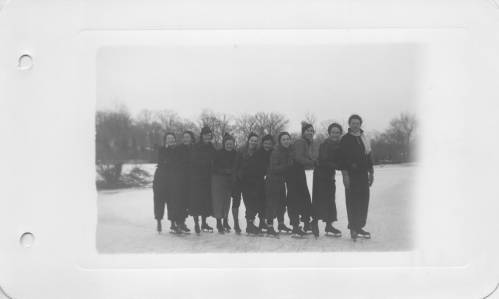
black and white photo of a group of ice skaters posed in a line
Ice-Skating Line – 1937. 1937. University of St. Francis. Sharing Our Past, A Visual History. Courtesy of University of St. Francis.
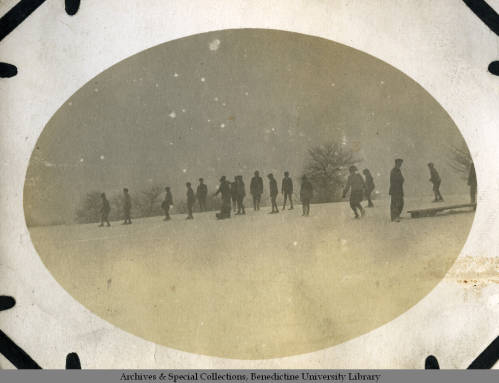
black and white photo yellowed with age of people in the distance preparing to sled down a hill
Slough. 1920. Benedictine University. John Jochman Album. Courtesy of Benedictine University.

Want to see more?

Visit the IDHH to explore other items related to ice skating.

The Great IDHH Baking Blog: Pies

“As American as apple pie.” While the first recorded recipe for apple pie was written in England in 1381, this quotation has become synonymous with Americana and speaks to a country’s love of the versatile baked dish. Centuries before this catchy phrase was featured in advertisements of the Roaring Twenties, colonists of the fledgling United States found their wheat from England unsuited to North American soil and instead channeled their small amount of grain for use in pies rather than bread. With their flourishing New England apple orchards, this environment sowed the seeds for a nation’s embrace of the pie as a culinary favorite and cultural signifier. 

From springtime fairs to end-of-the-year holidays and festivals, it’s difficult to think of an event or season in which some kind of pie would not be welcome. The dessert is so ubiquitous that ten U.S. states claim a pie as their “official” state dessert, state treat, or state pie. Maine even lists two iconic pies for the state, claiming blueberry pie as the state dessert and whoopie pie as the state treat (though the whoopie pie is not quite a pie and more a type of soft cookie). The IDHH’s own state of Illinois proudly lists the pumpkin pie as the state pie and today produces the most pumpkins used for processed pie filling.  

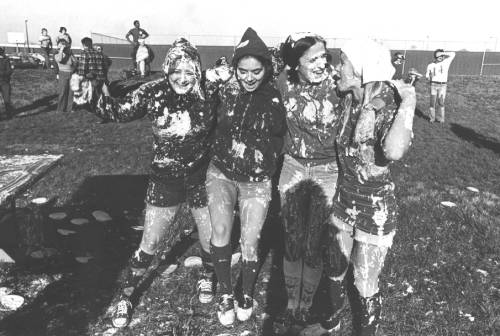
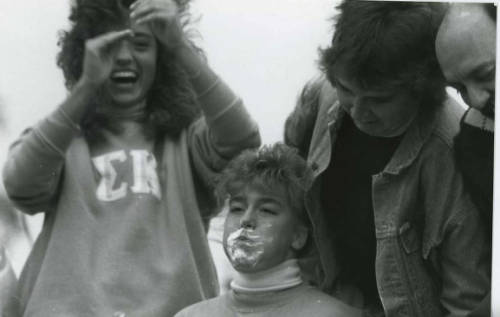
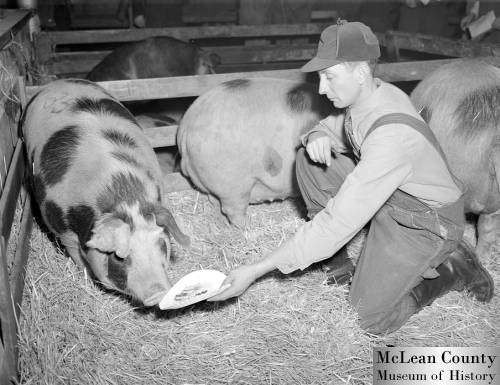
While eating pies may be the more traditional way to enjoy the classic American dessert, some of our favorite items from the collection below show more inventive uses of the dish, from thrown projectile to animal treat:

black and white image of four college women having participated in a pie-throwing contest, covered in pie filling
Campus Photograph Collection: Campus Life. circa 1972-1976. University of Illinois Springfield. Campus Archival Documents. Courtesy of the University of Illinois Springfield.
black and white photo of a seated female college student with pie smeared across her mouth and cheeks while another female students nearby laughs and two adults look on.
Student Life. 1978. Illinois Wesleyan University. IWU Historical Collections. Courtesy of Illinois Wesleyan University.
black and white photo of a farmer holding a plate with a piece of pie on it in front of a pic in a pen.
Hog gets pie, 1947. January 22, 1947. Photograph by Frank Bill. McLean County Museum of History. Pantagraph Negative Collection, 1946 – 1949. Courtesy of the McLean County Museum of History.
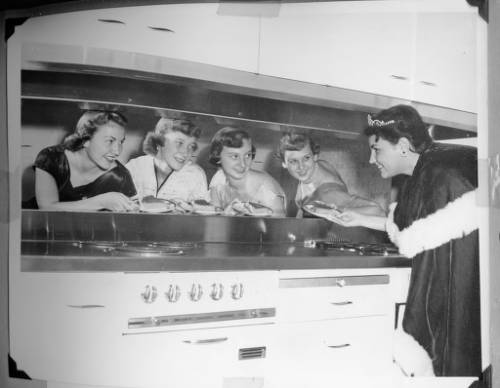
black and white photo of a woman serving pie through an enclosed kitchen to women standing at a window.
Eureka Pumpkin Festival Queen Serves Pie to Attendants, 1955. September 15, 1955. Eureka Public Library District. Pumpkins, Parades and Pies- Eureka’s Pumpkin Festival Past, 1939-1961. Courtesy of the Eureka Public Library District.
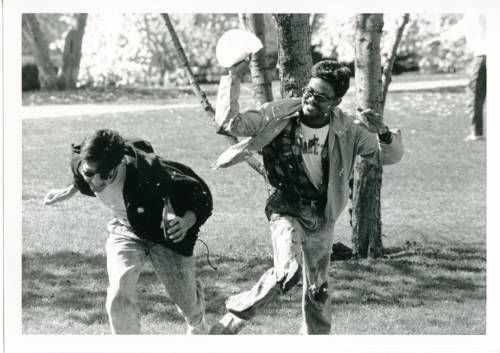
black and white photo of one college student about to throw a pie at another college student that is running away.
Flunk Day pie. circa 1980’s. Knox College. The Way to Knox. Courtesy of Knox College.

Want to see more? 

View more items related to pies on the IDHH.  

View Illinois Highlights blog posts published in 2019 and 2017 featuring the Eureka Pumpkin Festival items from the Eureka Public Library district.

Honoring American Red Cross Giving Day 2021

Since its founding by Clara Barton on May 21, 1881, the American Red Cross has provided services to American armed forces and their families, as well as disaster relief around the world. While they have adapted to meet the changing needs of the people they serve, they have remained true to their mission of serving people in need.  

In 1943, President Roosevelt was the first to proclaim March as American Red Cross Month. Since then, issuing this proclamation has become an annual tradition, where presidents designate March as the month to honor American Red Cross volunteers. March 24 also marks the seventh annual American Red Cross Giving Day, during which the American Red Cross encourages communities to come together and donate to help the American Red Cross provide essential relief to those affected by disasters. 

In honor of American Red Cross Giving Day, the IDHH has collected a few of our favorite images featuring American Red Cross volunteers from our contributors at the Bess Bower Dunn Museum of Lake County, the McLean County Museum of History, and the Graham Hospital School of Nursing: 

black and white photo of four women putting together ditty bag packages.
Red Cross Ditty Bag Project. September 12, 1969. Bess Bower Dunn Museum of Lake County. Fort Sheridan. Courtesy of Bess Bower Dunn Museum of Lake County. 
black and white photo of a reclining woman giving blood.
Red Cross Blood Drive. January 20, 1975. Bess Bower Dunn Museum of Lake County. Fort Sheridan. Courtesy of Bess Bower Dunn Museum of Lake County. 
black and white photo of a woman pinning a badge onto a nurse's aide.
Red Cross Nurses’ aide. January 21, 1943. McLean County Museum of History. Pantagraph Negative Collection, 1940-1945. Courtesy of McLean County Museum of History. 
black and white photo of two women working on Singer sewing machines while another woman oversees them.
Red Cross. September 26, 1941. McLean County Museum of History. Pantagraph Negative Collection, 1940-1945. Courtesy of McLean County Museum of History.
color photo of two women standing in front of a Red Cross van with an awning stretched out of it.
196-.1.14 Fulton County Red Cross nurses Lois Watts. circa 1960s. Graham Hospital School of Nursing. Graham Hospital School of Nursing Library. Courtesy of Graham Hospital School of Nursing. 
black and white photo of two women in nursing uniforms sitting at a table with papers in front of them.
194-.1.1 Red Cross Volunteers. circa 1940s. Graham Hospital School of Nursing. Graham Hospital School of Nursing Library. Courtesy of Graham Hospital School of Nursing. 

View the full Fort Sheridan collection, the full Pantagraph Negative collection, and the full Graham Hospital School of Nursing Library collection on the IDHH. 

View more items related to the American Red Cross on the IDHH. 

Apples

Happy September Y’all. We’re seeing our first 40 degree nights in Central Illinois, and apples are beginning to be harvested. Around Champaign-Urbana, where I’m writing from, hail storms in August significantly damaged the apple crop. One farmer who I talk to at the farmers’ market had ployed to market her hail-damaged apples as “speckled apples”, but this week looked disappointed with just a few lumpy apples.

Here’s two of my favorite pictures in the IDHH from McLean County Museum of History of the over 6,000 taken by Pantagraph photographer Frank Bill in the 1930’s and 1940’s:

black and white photo of young women posing among the leaves of an apple tree.
Girls Pick Apple Bumper Crop. 1942. McLean County Museum of History. Pantagraph Negative Collection (1940-1945). Photograph by Frank Bill.
black and white photo of a row of apple trees in bloom.
Apple Blossoms. 1939. McLean County Museum of History. Pantagraph Negative Collection (1930-1939). Photograph by Frank Bill.

Historic Route 66 in Illinois

“Main Street of America”, Route 66 is probably the most well known road in America. It’s been featured hundreds of times in American literature and film, from symbolizing escape and grief in Steinbeck’s Grapes of Wrath to the backdrop of Radiator Springs just off Route 66 but forgotten after ‘the Mother Road’ (another Steinbeck reference) was bypassed by Interstate 40. 

black and white photo of aerial view of a highway with the neighboring farm land.
Scoop- Aerial Views. 1941. McLean County Museum of History. Pantagraph Negative Collection (1940-1945). Photograph by Frank Bill.

From Illinois, or perhaps most of the country, Route 66 always looks westward- showing the horizon of the spiritual architecture of Americana. This westerly orientation makes sense, when it opened in 1926 as part of the U.S. Highway System, Route 66 began in Chicago and ran diagonally across the state, like a 300 mile asphalt vein through The Prairie State.  You can virtually drive the entirety of “Old U.S. Route 66” in about 3 hours on Google Maps’ street view, but you wouldn’t get the full story of Route 66 before it was largely replaced by the speedier and beefier Interstate 55. Items from our contributors at Towanda Area Public Library, Illinois State Library, Illinois State University, and McLean County Museum of History, capture the spirit of Illinoisan Route 66 as it was in the 1940’s. 

Like most roads, Route 66 repurposed other roads and trails, laying a new physical and administrative infrastructure on top of historic passages and routes far preceding car culture. In the earliest part of the 20th century, people traveled between Chicago and Saint Louis on the “Pontiac Trail ”- a native trail, turned unpaved stagecoach byway that travelled southwest through Springfield and the St. Louis area.  By 1915 it became IL-4, and ran parallel to Chicago Alton Railroad. 

color map of roads in Illinois.
1956-1957 Illinois: Official Highway Map. 1956. Illinois State Library. Illinois State Highway Maps Collection. 

The relationship between railroad and road was hot in Illinois. Railroads connected metropolitan areas, small farm towns along the railroads. Towns grew and farmers needed roads to ship their crop. Dirt roads weren’t enough, the roads of Illinois in 1910 were hardly better than the Illinois roads of 1818 according to historian David Wrone.  The compact prairie sod was all too vulnerable to the elements; quick to become deep mud that a horse drawing cargo had difficulty picking its way through, and according to Donald Tingley, prompted “automobile pioneers [to store] their machines in the barn until spring. In the summer the mud turned into dust almost as deep.” Motorists, farmers, bankers and cyclists alike began organizing, building associations and committees that sought to advocate for better roads, and investigate solutions. The Tice Road Law of 1913 provided state assistance on roadside improvement for any county which was willing to build and maintain their roads. The Illinois Highway Department integrated a system to connect towns through highways. Illinois’ road story received another push in 1916 when the Federal Aid Road Act was passed, granting Illinois roughly three million dollars between 1917 and 1922.

The newness of these paved roads were politically advantageous for Illinois. Minimal construction meant that the route could open to traffic almost immediately in 1926. The flatness of Route 66 made it a popular truck route. The trucking industry stimulated the local economies it drove through, with small outposts of hotels, restaurants and diners, filling stations, roadside attractions to attract attention for money traveling through.

black and white photo of a man posed in front of a cafe and gas station.
Photograph of Fern’s Cafe. 1954. Towanda District Library. Towanda Area Historical Collection.
black and white photo of three men sitting at a cafe counter smoking and drinking coffee.
Photograph of Fern’s Café customers in 1954. Towanda District Library. Towanda Area Historical Collection.

With the outbreak of World War II, the highway’s importance exploded as a road for military convoys and equipment transportation. Much of the original pavement was still in service but in poor condition from heavy truck traffic. The Federal Highway Defense Act sought to modernize the highway system, make repairs where needed, and establish a strategic highway network in preparation for war.


The Federal Highway Defence changed the roads dramatically. Two-lane highways became four-lanes. Route 66’s past as a long vein of county, windy, country roads,  had been central to its character. Landmarks were named after it’s most dangerous parts. Illinois newspapers counted pile-ups, injuries, deaths of travellers. So-called “Dead Man’s Curve” in Towanda– a slim sharp curve, was especially treacherous for speeding drivers from Chicago who misjudged the sharpness they’d have to navigate. New portions circumvented these dangerous parts like these.

black and white photo of road construction workers with machinery on a dirt plane.
Photograph of Construction of northbound lanes on Route 66. 1954. Towanda District Library. Towanda Area Historical Collection.


When car and tourism culture took off in the 1950’s the kitschy infrastructure had been well established with its legacy of trucking, and the roads were now safe enough to travel with your family in tow. 

black and white photo of the exterior of a motel with snow on the ground and a Santa Clause cardboard cutout on the roof.
Rusk Haven Motel on Route 66, Bloomington, Illinois. C. 1950. Illinois State University. Ken-Way Studio Archive.
black and white photo of a man in a phone booth across the street from a cafe with cars parked in front in the background.
Brandtville Cafe with man in phone booth, Bloomington, Illinois. 1955. Illinois State University. Ken-Way Studio Archive. 

So, what did the impact of the interstate highway system have on its predecessors? Even while Route 66 was booming with roadside traffic and tourism in mid-1950’s, planning to make it obsolete was already in legislation. The improvements that had been made in the 1940’s to create a strategic highway network of small roads were left in the dust of Eisenhower’s vision for the Interstate Highway System. Inspired by the Reichschautobahn system, Eisenhower saw a fast and safe highway, as critical for economic growth defense, if it was ever needed. 

1957. Parts of Route 66 were already being chosen for sections of I-55, I-74, or I-190. Route 66 was travelled less and less, left in increasingly worse disrepair- from over-use and then neglect. The mother road was officially removed from the U.S. Highway System on June 27, 1985. Community efforts have since surged attempting to preserve the highway’s particularity and celebrate it’s off-beat culture that lined rural America for three decades. Cities in Illinois began to register stretches of the route under the Register of Historic Places, citing both the engineering and cultural significance that preceded the interstate and knitted together rural communities alongside the road. 

black and white photo close-up of a woman wearing glasses with a gas station out of focus in the background.
Gas station men on Route 66. 1942. McLean County Museum of History. Pantagraph Negative Collection (1940-1945). Photograph by Leonore Campbell.
black and white photo of a stretch of empty highway with a row of trees on the right side.
Highway 1.1944. McLean County Museum of History. Pantagraph Negative Collection (1940-1945). Photograph by Stan Windhorn.

Visit the IDHH for more of Route 66 from our contributors.