Look at the Unbe-leaf-able Fall Foliage

Cooler weather. Baking spices. Warm cider. These things might conjure up a variety of associations and feelings, but for those of us living in the northern United States, they herald the beginning of the autumn or fall season. With the start of November, the IDHH would like to highlight that time of year when the daylight hours wane and sweater weather is in vogue. In the Northern Hemisphere, autumn is usually recognized as the time between the autumnal equinox toward the end of September and the winter solstice toward the end of December. This time of the year has held various significance across cultures and periods, but early associations in the Northern Hemisphere centered around the passing of the year and the importance of the harvest season in areas across medieval Europe. 

While this connection to harvesting continues to be paramount for those working in agriculture, the environmental changes during the fall season have also become a key aspect of tourism for certain areas of the world. In the United States, portions of northern New England, Appalachia, and the upper Midwest offer prime views of leaves changing from their usual green color to vivid hues of orange, red, and yellow in the autumn months. Millions of visitors pour into these areas of the country to witness this stunning natural display – an act referred to as ‘leaf peeping’ in some circles. A phrase used colloquially in the United States since only the 1960s, leaf peeping is an autumn activity enjoyed internationally in the provinces of Ontario and Quebec in Canada, as well as in various parts of Japan.  

Here are a few of our favorite items featuring vibrant fall foliage:
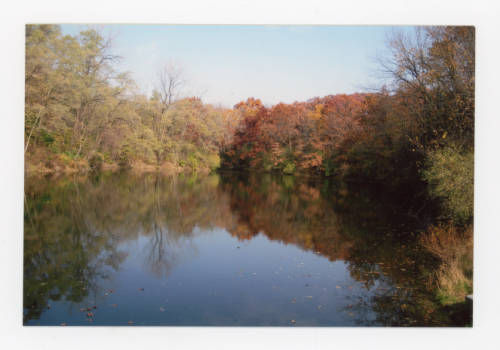
color photo of autumn-colored leaves along a river
Fall color. Circa 1990s. Knox College. Green Oaks Biological Field Station. Courtesy of Knox College.
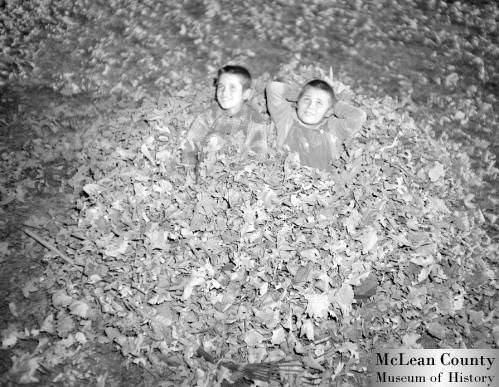
black and white photo of two young boys posing in a pile of leaves
Brothers Walter and Edward Mann raking fall leaves, Bloomington, IL 1947. October 9, 1947. Photographed by Wilma Tolley. McLean County Museum of History. Pantagraph Negative Collection, 1946 – 1949. Courtesy of the McLean County Museum of History.
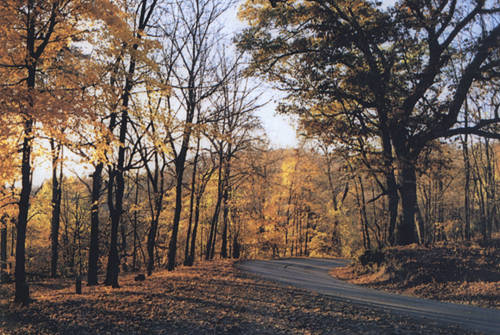
a color image of yellow-leaved trees along an empty street around sunset near the Illinois River
Pere Marquette Park and Lodge, on the Great River Road (IL 100) facing the Illinois River. [n.d.] Photographed by Art Grossmann. Eastern Illinois University. Booth Library Postcard Collection. Courtesy of Eastern Illinois University.
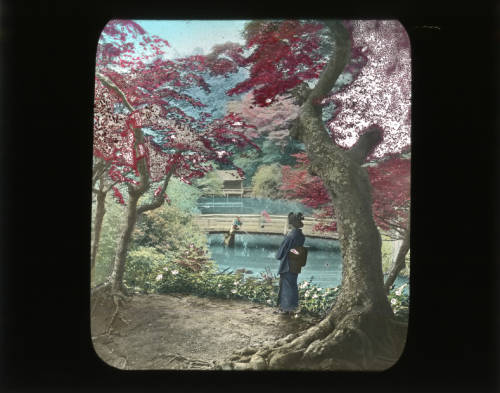
a color lantern slide of maples in autumn in Tokyo with a person in a kimono standing near a bridge over water
Autumn view of maples, Oji, Tokyo. Circa 1880s. Created by Kinbē Kusakabe. Dominican University. Japanese Lantern Slides. Courtesy of Dominican University.
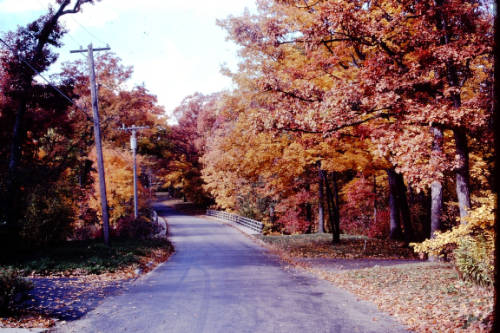
color image of orange, yellow, and red leaves in trees along an empty street in Highland Park, IL
Autumn street. October 1978. Photographed by Henry X. Arenberg. Highland Park Historical Society. Highland Park History. Courtesy of the Highland Park Historical Society.

Want to see more? 

Visit the IDHH to browse even more items related to the fall season.

Magic Lanterns and Glass Slides

So much of our work at the IDHH is focused on photographs, but so often we overlook the history of photography in the 20th century- specifically how photographs and the camera became the way we documented our everyday life.

In celebration of the darkest time of the year and the lights of the winter holidays I want to highlight  lantern and glass slides from Mount Prospect Library’s “Dimensions of Life in Mount Prospect”, The Museum of the Grand Prairie through the University of Illinois at Urbana-Champaign’s “Teaching With Cultural Heritage”, and Highland Park Historical Society’s “George D. Rice Collection”.

color photograph of an early 20th century magic lantern with the lens cover off and a rectangular slide placed in the viewing position, with a box full of slides next to it
Magic Lantern. C.1900. Mount Prospect Public Library. Dimensions of Life in Mount Prospect. Permission to display given by Mount Prospect Public Library.

The Magic Lantern was an early projector.  Originally invented in the 16th century, projectionists would move painted glass slides behind the lens to create performances and shows.  Only lit by candle light, the projection was weak. In the 19th century, small kerosene lamps were mass produced and replaced other, more dangerous illumination methods. Kerosene in part popularized lanterns and put them in churches, schools, homes, fraternal societies and more in the hands of amateur projectionists.

This Magic Lantern from Mount Prospect Public Library’s is a German import from the early 20th century.  With 37 glass slides, it projected scenes onto a wall, and included crayons for creating personal slides for new projections.

color photograph of an early 20th century magic lantern with the lens cover off and a rectangular slide placed in the viewing position
Magic Lantern. C.1900. Mount Prospect Public Library. Dimensions of Life in Mount Prospect.Permission to display given by Mount Prospect Public Library.

Mount Prospect Public Library’s “Dimensions Of Life in Mount Prospect” includes photographs and descriptions of artifacts from residents of Mount Prospect from the late 19th and early 20th centuries. With artifacts ranging from horse-hair mittens, to glass soda pop bottles, the collection shows how the early days of Mount Prospect and the northwest suburbs of Chicago were influenced by its German heritage and American identity before World War II when the village suburb’s population exploded.

The Museum of the Grand Prairie (formerly known as The Early American Museum) has a large collection of painted glass slides that children could use with toy lanterns.

a color lantern slide of a drawing of men doing various activities such as reading a newspaper and getting a shave, that is crackled with age
Magic Lantern Slide: Five Men. C. 1850. Museum of the Prairie, University of Illinois at Urbana-Champaign. “Teaching with Cultural Heritage”.

color lantern slide of a watercolor-style paining of ships along a coast that is crackled with age
Magic Lantern Slide: Ships along the Coast. C. 1850. Museum of the Prairie, University of Illinois at Urbana-Champaign. “Teaching with Cultural Heritage”.

color lantern slide of a drawing of several figures riding pics and donkeys
Magic Lantern Slide: Boys on pigs and donkeys. C. 1850. Museum of the Prairie, University of Illinois at Urbana-Champaign. “Teaching with Cultural Heritage”.

These awesome images would be projected on screens, showing sequences and small cartoonish and kitschy ethnographies and scenes of the everyday from ambiguous places.

Compare these slides to the glass lantern slides from the George D. Rice Collection at the Highland Park Historical Society.

color lantern slide photo of an industrial-style ship traveling through waters with glaciers
Glass Slide: Ships in Glacial Waters. C.1900. Highland Park Historical Society. George D. Rice Collection. Permission to display given by Highland Park Historical Society.

color glass lantern slide of a man walking on a street leading a donkey that is so covered by the hay it is carrying that it is almost invisible
Glass Slide: “A Walking Loaf of Hay”. C. 1900. Highland Park Historical Society. George D. Rice Collection. Permission to display given by Highland Park Historical Society.

black and white glass lantern slide photo of a man in a hat sitting on the porch of a house with white siding
Glass Slide: Man Sitting on the Front Stoop of House. C. 1900. Highland Park Historical Society. George D. Rice Collection. Permission to display given by Highland Park Historical Society.

black and white glass lantern slide photo of one man standing on top of a large pile of hay with other men standing in front of the pile
Glass Slide: Group of Men Standing Near Bale of Hay. C. 1900. Highland Park Historical Society. George D. Rice Collection. Permission to display given by Highland Park Historical Society.

For more photography, the IDHH is always open. You can find more from Mount Prospect Public Public Library’s “Dimensions of Life in Mount Prospect” Artifacts from the Museum of the Prairie via University of Illinois at Urbana-Champaign’s “Teaching with Digital Heritage”¹ at the links above and more on Highland Park Historical Society’s “George D. Rice Collection” on the IDHH and on their website.

¹Editor’s Note, 09/2024: This collection no longer exists.