Spooky Scary Halloween 2024 with the IDHH

The IDHH contains some content that may be harmful or difficult to view. Our cultural heritage partners collect materials from history, as well as artifacts from many cultures and time periods, to preserve and make available the historical record. Please view the Digital Public Library of America’s (DPLA) Statement on Potentially Harmful Content for further information.


As the month of October draws to an end, we enter the festivities of Halloween, Samhain, Allhallowtide, and Día de los Muertos. For some it’s spooky season, a time to delight in the macabre and darker side of life and death (and free candy); for others, it’s a time of religious rites and celebrations, including feasting, prayer and fasting, and remembrance.

Here are a few of our favorite Halloween-related images from IDHH contributors:

image of bookplate with skeleton sitting on a pile of books and reading a book.
John Comstock, Skeleton reader. March 06, 1922. West Chicago Public Library District. Cornelia Neltnor Anthony and Frank D. Anthony Book Plate Collection. Courtesy of the West Chicago Public Library District.
a group of children standing behind their decorated jack o lanterns that are resting on a table
Mount Greenwood Park (0251) Events – Holiday celebrations – Halloween, 1971. 1971. Chicago Public Library. Chicago Park District Records: Photographs. Courtesy of the Chicago Public Library.
stereo card of women bobbing for apples with one women holding an apple in her mouth
Halloween party stereo cards, 1899 [page 1]. 1899. Bensenville Community Public Library. Bensenville Historical Collection. Courtesy of the Bensenville Community Public Library.
image of a boy and a terrier dog touching a jack o lantern
Independence Park (0083) Events – Holiday celebrations – Halloween, undated. Chicago Public Library. Chicago Park District Records: Photographs. Courtesy of the Chicago Public Library.


Want to see more?

Visit the IDHH to view more items related to Halloween, pumpkins, and other spooky things, or to view more items from Bensenville Community Public Library, Chicago Public Library, or the West Chicago Public Library District.

You can also view the IDHH’s previous Halloween-related blog posts:


Memorial to the Remembered: Tombstones and Headstones

October marks that time of the year when we dress up as ghouls and goblins, decorate our homes with spiderwebs and skeletons, and indulge in all manner of frightening things. As a nod to these spine-chilling 31 days, the IDHH is featuring the fascinating use and art of tombstones and other grave markers. As diverse as the great variety of funerary traditions around the world, grave markers serve not only the utilitarian purpose of demarcating the physical space where an individual might lie, but also reflect the social values and traditions of a specific period or people. Cemeteries and other burial places held great significance from the earliest days, as providing a place for the dead was thought to be an important family obligation. This significance would eventually extend to larger communal graveyards and burial places as inclusion in these spaces became exclusive to community members, often excluding foreigners, criminals, and other unwanted groups. 

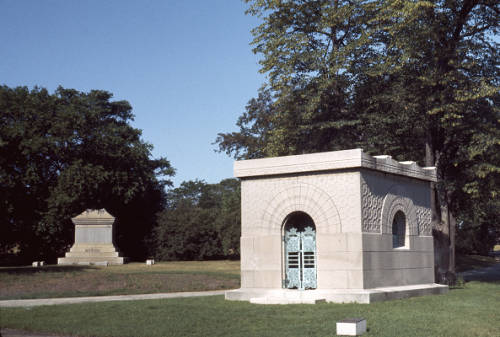
The tombstones and grave markers within these communal spaces have communicated a number of ideas to visitors over time. As a work of art, the craftsmanship and skill in the construction of the tombstones can be an aesthetic pleasure in its own right. Such artistry leads people to create gravestone rubbings with charcoal and to capture graveyard scenes through painting and photography. The construction and grandiosity of these markers may also impart a sense of prestige or wealth, such as in the image below of Carrie Eliza Getty’s large tomb in Chicago. Of course, tombstones also act as a memorial to previous generations, prompting us to seek out the histories of those buried there, like of the Mabie family and their influential 1840s circus show in Wisconsin. Whether viewed as art, icon, or historical marker, tombstones offer a (spooky) glimpse into the values and customs of those who are no longer with us. 

Here are a few of our favorite items featuring tombstones from across the Midwest:
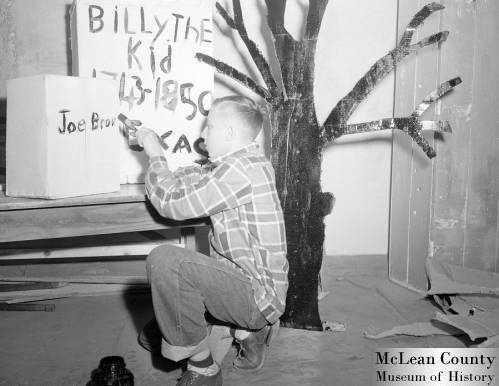
Boy painting tombstone decorations, unspecified location, Central Illinois, 1951 Halloween picture layout. October 29, 1951. Photographed by Gene Smedley. McLean County Museum of History. Pantagraph Negative Collection 1950 – 1959. Courtesy of the McLean County Museum of History.
Carrie Eliza Getty Tomb and Joseph Medill tombstone, Graceland Cemetery. 1976. Photographed by Charles William Brubaker. University of Illinois Chicago. C. William Brubaker Collection. Courtesy of the University of Illinois Chicago.
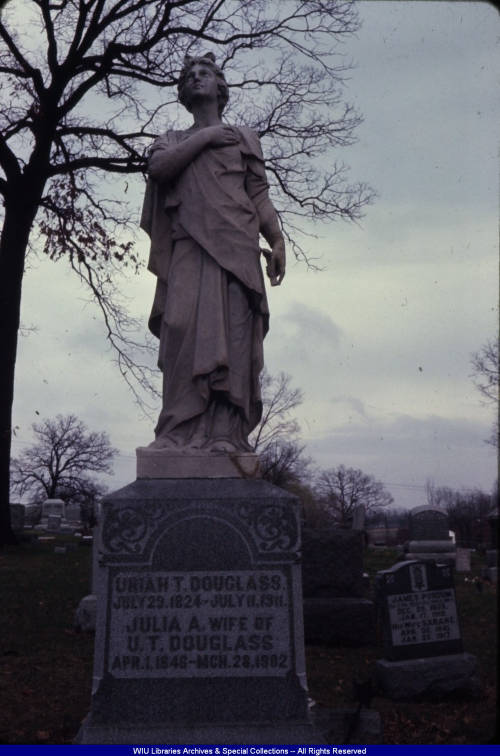
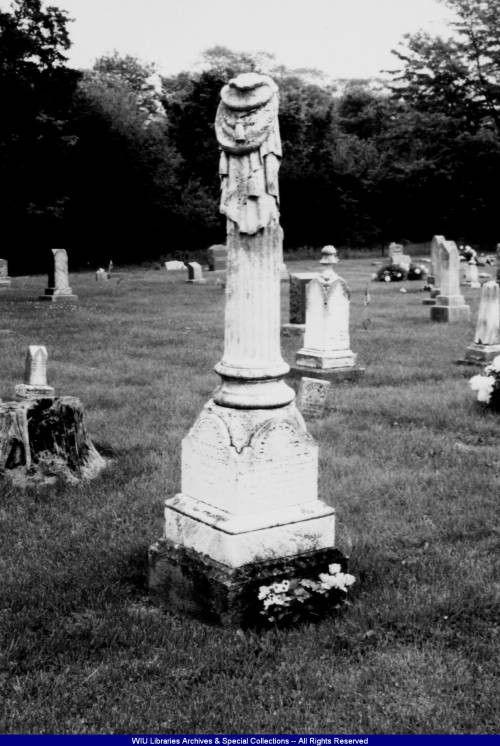
Tombstone of Uriah T. Douglass and Julia A. Douglass in Oakwood Cemetery. [n.d] Western Illinois University. Digital Image Collection. Courtesy of Western Illinois University.
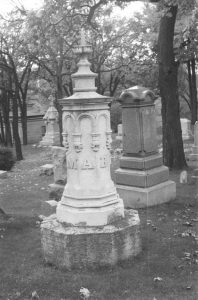
Tombstone. [n.d.] Photographed by Sverre O. Braathen. Illinois State University. Sverre O. Braathen Circus Photo Collection. Courtesy of Illinois State University.
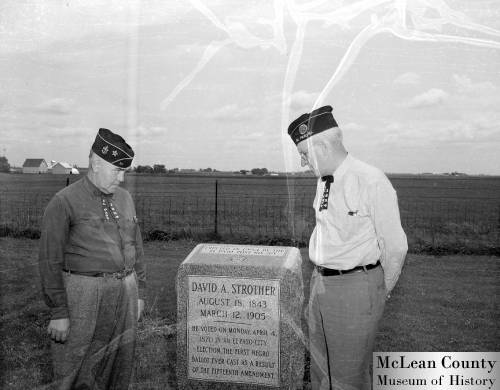
Two veterans looking at tombstone of David A. Strother, first African American to cast a vote in the United States, El Paso, IL, 1954. May 28, 1954. Photographed by Ann Broder. McLean County Museum of History. Pantagraph Negative Collection 1950 – 1959. Courtesy of the McLean County Museum of History.
Scott tombstone Scott’s Cemetery 2002. 2002. Photographed by John Hallwas. Western Illinois University. Digital Image Collection. Courtesy of Western Illinois University.

Want to see more? 

Visit the IDHH to browse even more items related to tombstones and grave markers.