Celebrating the Life of Dr. Martin Luther King Jr.

color photo of Dr. Martin Luther King, Jr., leading a march of people with his arms linked with those next to him.
Civil Rights Demonstration Lead by Dr. Martin Luther King Jr. Montgomery, Alabama March 17th, 1965. Photograph by Declan Haun. Chicago History Museum. Prints and Photographs Collection.Permission to display was given by Chicago History Museum.

Last year, to commemorate the legacy of Dr. Martin Luther King Jr. we turned to the Chicago History Museum and their Prints and Photographs Collection and highlighted Declan Haun’s photojournalism of Dr. King’s activism, including his 1963 “I Have a Dream” speech, the 1965 Selma-Montgomery marches, and the 1966 Chicago Freedom Movement.

To celebrate his life this year, we’re featuring more of Declan Haun’s photography from Chicago History Museum’s Prints and Photographs Collection: this time, looking specifically at some of the more impressive photographs from the Selma to Montgomery March. Haun moved to Chicago in 1963 and documented the fervor of standing up for equality that Dr. King inspired among millions of Americans during the later years of the Civil Rights Movement.  Haun was notorious as a free-lance photojournalist for the strong sense of social conscience for his subjects, translating his compassion into attention to the composition and formal aspects of his photography.

color photo of a crowd of people carrying umbrellas, with two Women of Color in the foreground wearing red and sharing a red umbrella.
Civil Rights Demonstration in Montgomery, Alabalma. 1965. Photograph by Declan Haun. Chicago History Museum. Prints and Photographs Collection. Permission to display was given by Chicago History Museum.
black and white photo of two police officers standing in front of a wooden barrier with a crowd of people behind the barriers.
Selma to Montgomery Rights March. 1965. Photograph by Declan Haun. Chicago History Museum. Prints and Photographs Collection.Permission to display given by Chicago History Museum.

The Selma-Montgomery marches were three separate marches, held along the 54 mile strip of  highway between the small city of Selma to the Alabama State Capitol in Montgomery. It was organized as a voting rights march to counter systemic voter registration obstruction in Alabama and across the greater South. It was also a response to the murder of Jimmie Lee Jackson that February, who was shot by a state trooper during a non-violent march.

The first demonstration on March 7th became violent, when state troopers assaulted unarmed marchers with billy clubs and tear gas when they crossed the Edmund Pettus Bridge. The organizer, Amelia Boynton was beaten unconscious, and the press published a photo of her lying on the bridge.

On Tuesday March 9th, clergy from across America joined the marchers as Dr. King led them towards Montgomery along the same route. The marchers turned around on the Edmund Pettus Bridge, obeying a federal injunction that prevented the march from crossing into the unincorporated part of Dallas county. That night a white mob murdered James Reeb, a minister from Boston who had traveled to Montgomery.

black and white photo of a crowd of people walking along, with two people covering their heads with rain ponchos.
Selma to Montgomery Rights March. 1965. Photograph by Declan Haun. Chicago History Museum. Prints and Photographs Collection. Permission to display given by Chicago History Museum.
color photo of aerial view of a large crowd standing outside, some with umbrellas opened over them.
Civil Rights Demonstration in Montgomery, Alabama.1965. Photograph by Declan Haun. Chicago History Museum. Prints and Photographs Collection.Permission to display given by Chicago History Museum.

Haun’s photographs of the march depict the realness of the events, and retell the story of Dr. King’s impact and the fight for civil rights with details and compassion that could otherwise be overwritten.  Photographs of people assembling along with the necessary and uncurated and often invisible parts of organizing and fighting for rights such as living rooms filled cots and mattresses to house people from out of town aren’t just a statement about the stakes and drive of people, but actual evidence of the energy that went into fighting for civil rights.

black and white photo of a group of people clapping, consisting of Black and white men and women.
Selma to Montgomery Rights March. 1965. Photograph by Declan Haun. Chicago History Museum. Prints and Photographs Collection.Permission to display given by Chicago History Museum.
black and white photo of two people stretched out on public benches with their arms crossed over their eyes.
Selma to Montgomery Rights March. 1965. Photograph by Declan Haun. Chicago History Museum. Prints and Photographs Collection. Permission to display given by Chicago History Museum.
black and white photo of sleeping pallets in the foreground with a group of people standing in the background.
Activity in Alabama during the time of the Selma to Montgomery March, 1965. Photograph by Declan Haun. Chicago History Museum. Prints and Photographs Collection. Permission to display given by Chicago History Museum.

See all of the Chicago History Museum’s materials relating to Dr. King, the Selma to Montgomery Marches, and all of the IDHH’s items on Dr. King and Civil Rights.

Remembering the Life and Legacy of Dr. Martin Luther King, Jr.

We commemorate the life and legacy of Dr. Martin Luther King, Jr. and the activism for justice and equality that his work is a part of and continues to be exigent to this day. The IDHH highlights collections from the Chicago History Museum that include photographs by DC-area journalist, Declan Haun, as well as an interview with an activist who participated in protests in Chicago in response to King’s assassination in 1968.
The Chicago History Museum’s Prints and Photographs Collection includes photographs from King’s “I Have a Dream” Speech on August 28,1963 (the first image below on the left), his involvement in the March 1965 protests against police brutality in Montgomery, Alabama (top right), and images from King’s Chicago Freedom Movement, including a march in 1966 (bottom right). King was a powerful voice in Civil Rights and inspired many others to stand up for equality for African Americans and all People of Color.
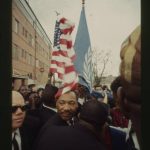
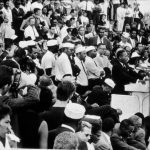
The Chicago History Museum’s Oral History Collection includes transcripts and audio from interviews conducted by the Museum’s Studs Terkel Center for Oral History. Hear from Marilyn Katz who was involved in protests in Chicago in the wake of King’s assassination. Dr. Martin Luther King’s words, ideas, and the people he inspires live on to work toward social justice.
Several IDHH Institutions have put together exhibits in honor of Dr. King, including the Chicago History Museum’s Remembering Dr. King, which focuses on King’s work in Chicago. Some of the exhibit’s images are online in the Chicago History Museum’s Digital Library and in the DPLA. See all of the Chicago History Museum’s materials relating to Dr. King. See all of the Illinois Digital Heritage hub’s items on Dr. King.