The Enduring Legacy of Jane Addams – Women’s History Month

March is Women’s History Month and March 8th marks International Women’s Day. The first National Woman’s Day was observed in the United States on February 28, 1909 by the Socialist Party of America in honor of the 1908 garment workers’ strike in New York. While this was the first official observance of any kind, the movement for women’s rights was born much earlier in 1848, when Elizabeth Cady Stanton and Lucretia Mott held the first women’s rights convention in the US. From that convention in 1848, this celebration of the vital role of women in American history would progress over the next 139 years from an official day to an official week, to finally being a federally designated month in 1987. In honor of Women’s History Month and International Women’s Day, the IDHH is featuring Jane Addams, an agent of change in Illinois history. 

Born in Cedarville, Illinois in 1860, Jane Addams was an influential social reformer and activist who established the historic Chicago settlement house Hull House in 1889 with Ellen Gates Starr. Jane Addams would build Hull House into a hub of social and cultural opportunities for the largely immigrant residents on the Near West side of the city. In addition to her efforts with Hull House, Jane Addams worked with reform groups towards creating the first juvenile-court law, establishing an eight-hour working day for women, and advancing the cause of women’s suffrage. She would eventually help form the Women’s International League for Peace and Freedom in 1919, serving as the inaugural president of the international organization. In recognition of her unwavering dedication to the ideal and objective of world peace, Jane Addams was the co-winner of the 1931 Nobel Peace Prize, the second woman to ever receive the Prize. 

Below are a few of our favorite items featuring Jane Addams and her pioneering work with Hull House:
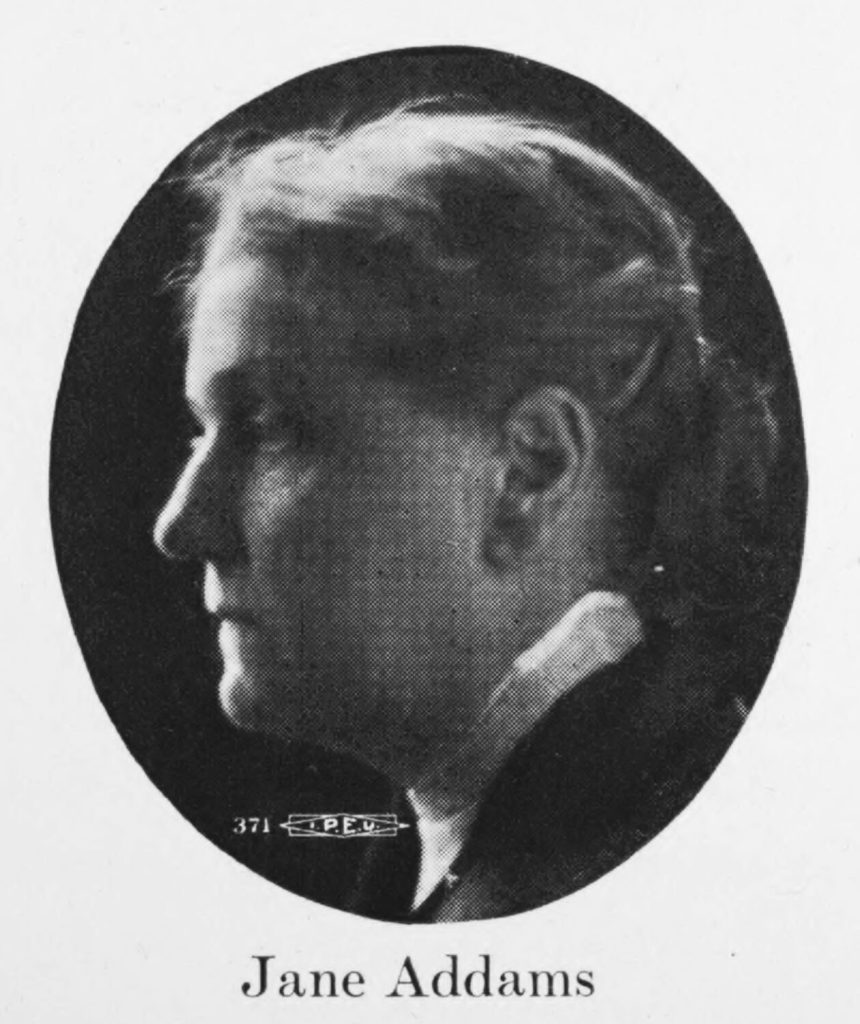
black and white engraving of a woman in profile with the name "Jane Addams" below the image
Jane Addams. 1922. I. P. E. U. [International Photo-Engravers Union of North America 371]. University of Illinois at Urbana-Champaign Library. Picture Chicago. Courtesy of the University of Illinois at Urbana-Champaign Library.
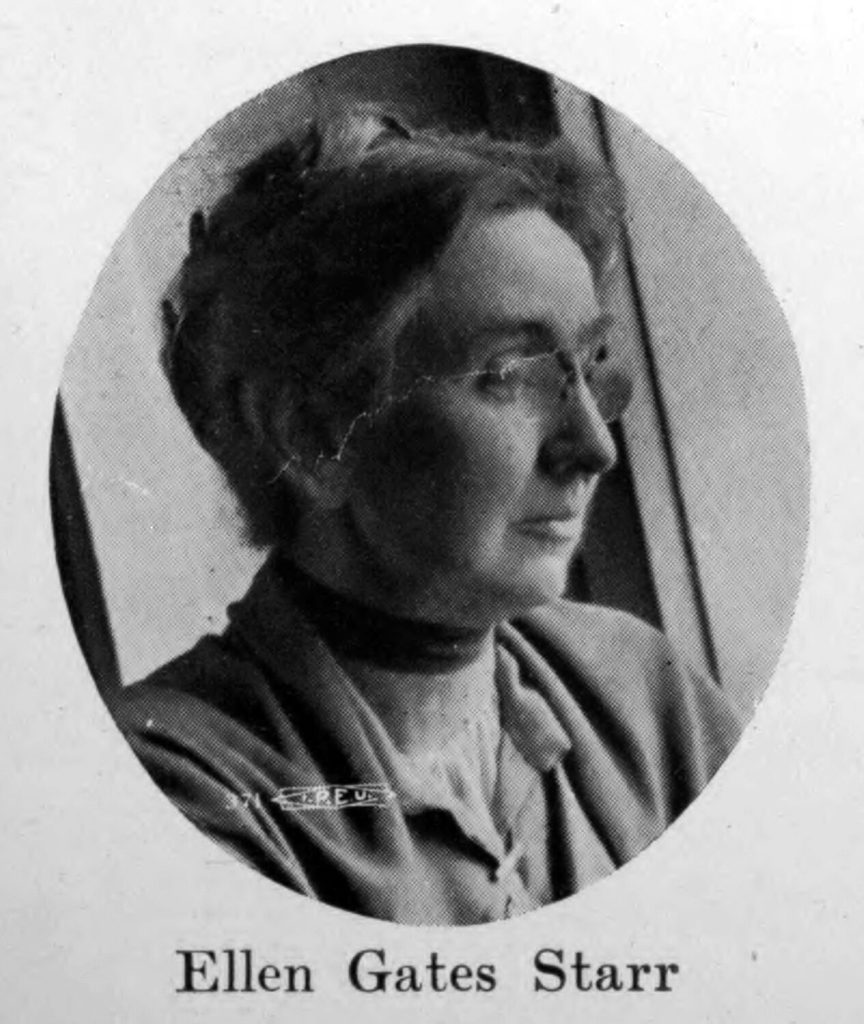
black and white engraving of a woman in profile with the name "Ellen Gates Starr" below the image.
Ellen Gates Starr. 1922. I. P. E. U. [International Photo-Engravers Union of North America 371]. University of Illinois at Urbana-Champaign Library. Picture Chicago. Courtesy of the University of Illinois at Urbana-Champaign Library.
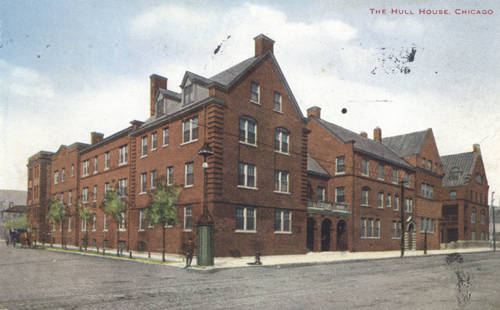
color postcard of the Hull House building.
Hull House, Chicago. June 1, 1915. Eastern Illinois University. Booth Library Postcard Collection. Courtesy of Eastern Illinois University.
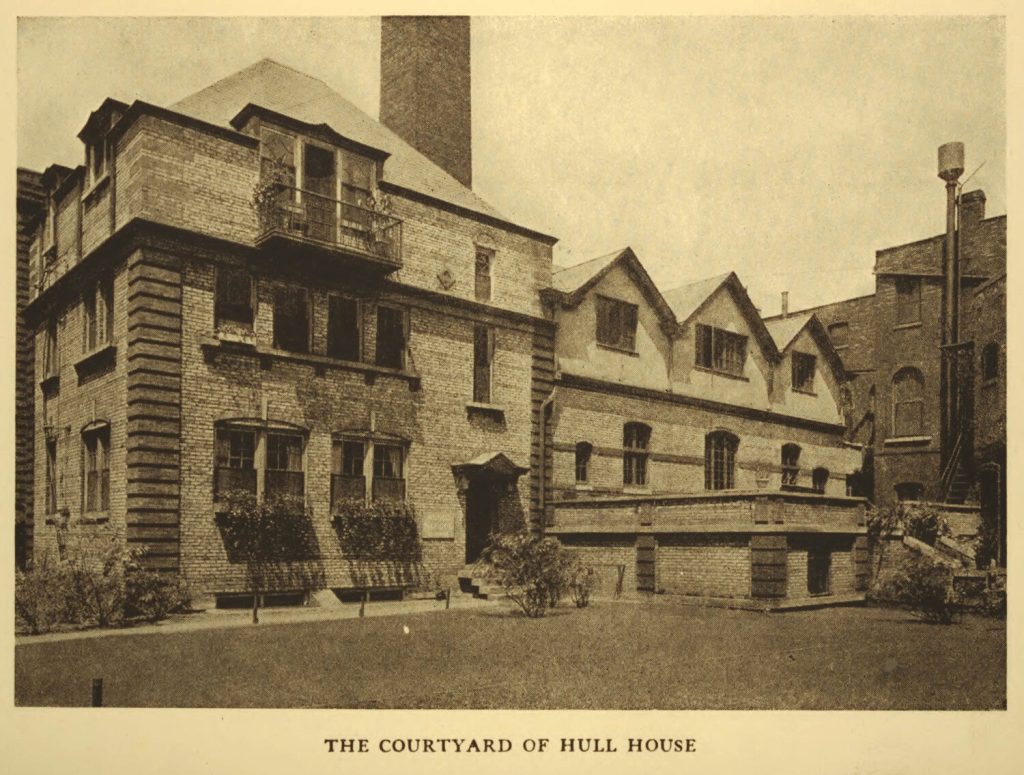
black and white photo on yellowed paper of the courtyard at Hull House, with a brick building in the background.
Courtyard of Hull House. 1920. University of Illinois at Urbana-Champaign Library. Picture Chicago. Courtesy of the University of Illinois at Urbana-Champaign Library.
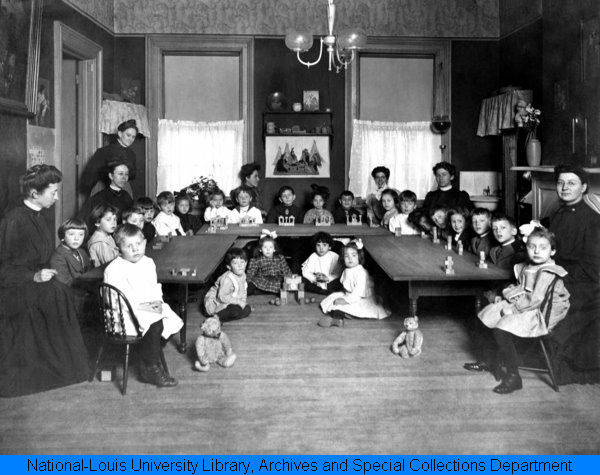
black and white photo of women and children sitting around a u-shaped table and on the floor in late Victorian clothes.
Hull House Kindergarten. circa 1906. National Louis University. Elizabeth Harrison-Chicago Kindergarten Movement. Courtesy of National Louis University.
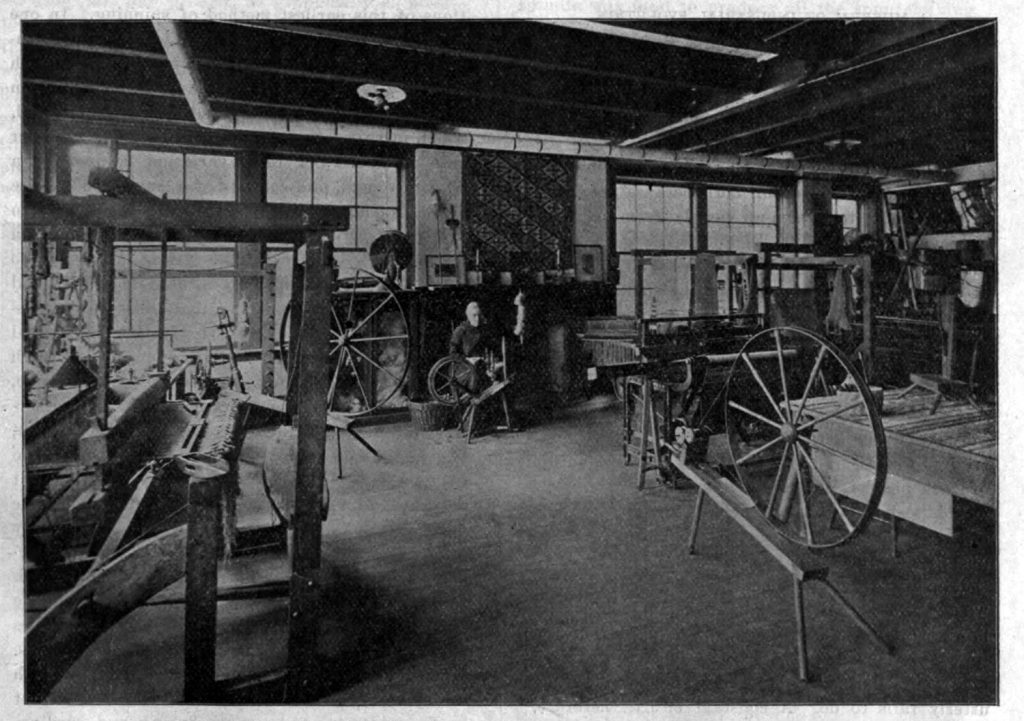
black and white photo of spinning wheels and looms in a textile room.
The Textile Room. May 1902. University of Illinois at Urbana-Champaign Library. Picture Chicago. Courtesy of the University of Illinois at Urbana-Champaign Library.

Want to see more? 

Visit the IDHH to view even more items related to Jane Addams and Hull House, as well as other notable women of Illinois, such as Gwendolyn BrooksMary G. Harris Jones, and Jane Byrne.

Celebrate Women’s Fight for the Vote with Hazle Buck Ewing

In celebration of Women’s History Month, we at the IDHH would like to introduce Hazle Buck Ewing, passionate activist for women’s suffrage and lifelong member of the Bloomington League of Women Voters.

Ewing joined the women’s suffrage movement in 1915, and worked to secure voting rights for women through her writing, her attendance at conferences, and her financial support of the movement. She continued to promote women’s rights after the passage of the 19th amendment by supporting the Equal Rights Amendment and voting in every election beginning in 1920, only stopping when she was too ill to leave her home. She died at the age of 88 on August 29, 1969. 

The Hazle Buck Ewing Women’s Suffrage collection from Illinois State University is comprised of materials created and collected by Ewing during her involvement in the women’s suffrage movement. The collection has over 150 items and includes letters, articles, pamphlets, and photographs that give insight into the efforts made by early 20th-century suffrage activists to secure women the right to vote. 

To celebrate Hazle Buck Ewing and Women’s History Month, here are a few of our favorite items from the collection: 

Image of purple and gold voter ribbon from national woman's party
National Women’s Party Sash and Ribbons, circa 1916-1919. Circa 1916-1919. Illinois State University. Hazle Buck Ewing Women’s Suffrage Collection. Courtesy of Illinois State University.
black and white newspaper clipping of two small children standing in front of a large, lopsided snow person.
Hazle Buck Ewing’s nieces with snow suffragette at home of Nelson L. Buck, December 25, 1915. December 25, 1915. Illinois State University. Hazle Buck Ewing Women’s Suffrage Collection. Courtesy of Illinois State University.
black ink transcript typed on yellow-aged paper of Hazle Buck Ewing's poem "Out West".
Hazle Buck Ewing poem “Out West”. October 1916. Illinois State University. Hazle Buck Ewing Women’s Suffrage Collection. Courtesy of Illinois State University.
black ink typed transcript on yellow-aged paper of two short letters by Hazle Buck Ewing.
Hazle Buck Ewing Letters to Claude Kitchin and Thomas Martin, January 5, 1918 (copy). January 5, 1918. Illinois State University. Hazle Buck Ewing Women’s Suffrage Collection. Courtesy of Illinois State University.
color telegram to Hazle B. Ewing
James Lewis telegram to Hazle Buck Ewing, May 10, 1918. May 10, 1918. Illinois State University. Hazle Buck Ewing Women’s Suffrage Collection. Courtesy of Illinois State University.
color trifold invitation to attend the Victory Convention of the National American Woman Suffrage Association, with the left panel listing available hotels, the middle panel with the mailer information, and the third panel listing the details of the convention.
Invitation to National American Women Suffrage Association and League of Women Voters conference, Chicago, February 12-18, 1920. 1920. Illinois State University. Hazle Buck Ewing Women’s Suffrage Collection. Courtesy of Illinois State University.
black ink typed letter on aged paper with a handwritten signature in blue ink.
Scott W. Lucas Letter to Hazle Buck Ewing, March 14, 1949. March 14, 1949. Illinois State University. Hazle Buck Ewing Women’s Suffrage Collection. Courtesy of Illinois State University.

In August, we celebrated the 100th anniversary of the 19th Amendment, featuring images of women exercising their right to vote from the McLean County Museum of History’s Pantagraph Negative Collection (1940-1945). 

View the complete Hazle Buck Ewing Women’s Suffrage Collection in the IDHH. 

View more items related to women’s suffrage in the IDHH. 

100 Years of the 19th Amendment

On August 18th 1920, women were finally granted the right to vote in the United States. The Susan B. Anthony-style suffragettes are certainly the most known figures behind the fight for women’s votes, but an entire network of suffragettes across the nation organizing in major cities made the demand clear. The Suffragette movement continued its momentum far into the 20th century with women’s voting advocacy groups such as the League of Women Voters (founded in February 1920) establishing chapters nationwide that continue to fight for people’s participation in elections.

To commemorate 100 years of Votes for Women, here are some of our favorite images of women exercising their right from the McLean County Museum of History’s “Pantagraph Negative Collection“.

black and white photo of women voting in booths with curtains, where only their shoes are visible.
Women Voting, 1940. McLean County Museum of History. Pantagraph Negative Collection (1940-1945).
black and white photo of a smiling woman coming out of the voting booth holding her voting paper and her purse.
Women Voting, 1940. McLean County Museum of History. Pantagraph Negative Collection (1940-1945).
black and white photo of women standing in line to vote with a man sitting in front to register people.
Women Voting, 1940. McLean County Museum of History. Pantagraph Negative Collection (1940-1945).
black and white photo of a group of five women talking together at a polling station.
League of Women Voters, Pontiac IL, 1941. McLean County Museum of History. Pantagraph Negative Collection (1940-1945)

In March we made a post about Mary Salome Ott Brand, and her first time at the polls as documented by her son Orson Brand and collected by the Highland Park Public Library.

For more on suffrage visit the IDHH’s holdings.

Women’s History Month: Mary Salome Ott Brand

Happy Women’s History Month. At the IDHH, we’d like to introduce Mary Salome Ott Brand –a childhood immigrant from France and an early settler of the North Shore of Chicago who cast her first ballot to vote at the age of 91. 

In 1913, Illinois became the first state in the nation to grant women the right to the presidential vote. Women’s suffrage had slowly evolved since the 15th amendment in 1870 leading to the ratification of the 19th Amendment in 1920. The right to vote was won in large part by the organizing and lobbying of woman’s clubs in communities across the nation. The diversity of materials in Highland Park Public Library’s Highland Park History Collection shows different elements of women’s history, both at the collective and political while also in the lives of individuals. The collections include women’s club minutes, photographs, and biographies constructed of newspaper clippings and stories transcribed by local historians and family members.

On Election Day 1916, Mary Salome Ott Brand left her house on N. Second Street in Highland Park to vote for the first time. At 91, she was accompanied by her son Orson, who documented his mother’s first time to the polls. 

sepia-tone photo of a woman standing in an open wooden doorway.
Mary Salome Ott Brand, 1825-1921. 1916. Highland Park Public Library. Highland Park History. Photograph by Orson Brand. Permission to display granted by Highland Park Public Library.
sepia-tone photo of a group of men and two women standing in front of a brick building.

Grandma Brand, Age 91. 1916. Highland Park Public Library. Highland Park History. Photograph by Orson Brand. Permission to display granted by Highland Park Public Library. 

The fight for women to vote had been long fought. With Suffragette figures such as Susan B. Anthony well known, the struggle to vote was also fought by women in local communities through woman’s clubs and federations of woman’s clubs. Women in Lake County had been active in the conversation and activism of women’s right to vote. In 1916, The Woman’s Civic Club  –later renamed the Ravina Women’s Club joined forces and merged with the Highland Park Woman’s club in in the 1960s –wrote they were “in favor of full suffrage for the women of Illinois as speedily as possible, therefore favor the adoption of an amendment to the constitution to that end” –meaning presidential suffrage –that would eventually become the 19th ammendment. Highland Park Public Library has several collections from Highland Park area womans’ clubs dating back to the early 20th century, including the Ravina Woman’s Club Records and Highland Park Woman’s Club Records.

Living in the North Shore during the civil war, the great migration, the fight for unions, and the fight for women’s vote, Brand’s life was certainly impacted by the changing political landscape and political awareness. The right to vote, at 91, was certainly reason enough to document.

Here is Brand at the polls.

sepia-tone photo of Mary Salome Ott Brand holding her voting ballot in front of a group of men.
Grandma Brand, Age 91. 1916. Highland Park Public Library. Highland Park History. Photograph by Orson Brand. Permission to display granted by Highland Park Public Library.

In the obituaries that were included in Ms. Brand’s biographical file- along with stories she told a local historian, they universally describe Brand as a life-long resident of Lake County –which she was, after moving there. Photographs of her home continue to document  what life in Lake County was like in the earliest part of the 20th century. For example, this picture taken by George D. Rice –another local documentarian I mentioned in a post in January.

black and white photo of a woman standing on the steps of a house surrounded by a white picket fence while two children sit playing in front of a tree in the yard.

Mary Salome Ott Brand and Children in Front of a House. n.d. Highland Park History. Photograph by George D. Rice. Permission to display granted by Highland Park Public Library.

Compared with her stories of the prairie as it was in the 1840s-60s, the rapid change from prairie to the north Chicago suburbs is immediately apparent. The Highland Park History Collection is definitely unique among the collections within the IDHH  for having so many different forms of historical documentation. Meeting minutes, written local histories, and, of course, photographs build a well-rounded picture of subjects at the micro-local. The biographical files created by local historians in Highland Park and more broadly Lake County cover the lives of women during the early 20th century.  Here is Mary Salome Ott Brand’s assembled biography.

typed notes on a visit to mrs. brand

Biography of Mary Salome Ott Brand. C.1925. Highland Park Public Library. Highland Park History.  Permission to display granted by Highland Park Public Library.

Lastly, here’s a picture of her and her son together: 

sepia-toned studio-style photo of a man standing behind a sitting woman.
Orson Brand and His Mother, Mary Salome Ott Brand. 1916. Highland Park Public Library. Highland Park History. Photograph by Orson Brand. Permission to display granted by Highland Park Public Library.

For more of any of these kinds of documents please visit the IDHH. The papers of women’s social and political organizations are linked above, but here are more of the local biographies created by historians and more photographs by Orson Brand.