The IDHH contains some content that may be harmful or difficult to view. Our cultural heritage partners collect materials from history, as well as artifacts from many cultures and time periods, to preserve and make available the historical record. Please view the Digital Public Library of America’s (DPLA) Statement on Potentially Harmful Content for further information.
As the month of October draws to an end, we enter the festivities of Halloween, Samhain, Allhallowtide, and Día de los Muertos. For some it’s spooky season, a time to delight in the macabre and darker side of life and death (and free candy); for others, it’s a time of religious rites and celebrations, including feasting, prayer and fasting, and remembrance.
Here are a few of our favorite Halloween-related images from IDHH contributors:
John Comstock, Skeleton reader. March 06, 1922. West Chicago Public Library District. Cornelia Neltnor Anthony and Frank D. Anthony Book Plate Collection. Courtesy of the West Chicago Public Library District.Mount Greenwood Park (0251) Events – Holiday celebrations – Halloween, 1971. 1971. Chicago Public Library. Chicago Park District Records: Photographs. Courtesy of the Chicago Public Library.Halloween party stereo cards, 1899 [page 1]. 1899. Bensenville Community Public Library. Bensenville Historical Collection. Courtesy of the Bensenville Community Public Library.Independence Park (0083) Events – Holiday celebrations – Halloween, undated. Chicago Public Library. Chicago Park District Records: Photographs. Courtesy of the Chicago Public Library.
As temperatures warm and days get ever longer, the sounds of bees buzzing past and birds chirping in the trees indicate not only the arrival of summer, but also the height of the plant pollination period. June 1st marked the beginning of National Pollinators Month, recognizing these creatures and the crucial role they play in the larger system of plant reproduction and proliferation. Pollinators come in all shapes and sizes, encompassing such diverse animals as insects, birds, and even some mammals. These animals travel from one flower or plant to another, carrying pollen as they go, and fertilizing flora with each new plant they visit. The symbiotic dynamic between these plants and pollinators is vital to both groups, as pollinators eat the pollen or nectar for its nutritional content, while the plants rely on the pollinators to spread their pollen, aiding in reproduction.
The importance of this intricate process and the players within it has captivated human populations for centuries as butterflies, hummingbirds, and other pollinators have been ascribed cultural significance and symbolism in various communities around the world. Such cultural significance persists today as we create entertainment like The Bee Movie that foregrounds pollinators, hold events such as the Aurora Pollinator Festival that highlight the role of pollinators, and design outdoor environments that offer ideal conditions for these animals. Indeed, as our climate changes there is a greater need than ever to create pollinator-friendly landscapes using pollinator-friendly practices. By providing habitats conducive to pollinator animals, we can simultaneously safeguard this essential process and beautify the natural world around us.
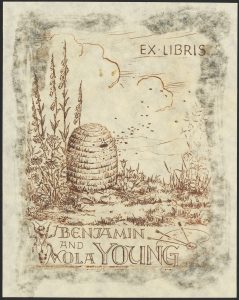
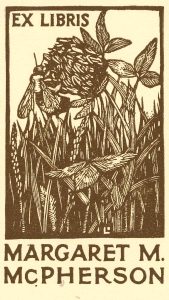
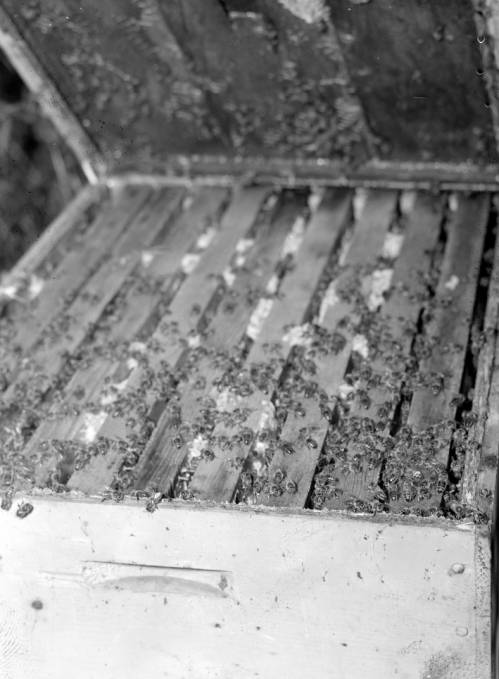
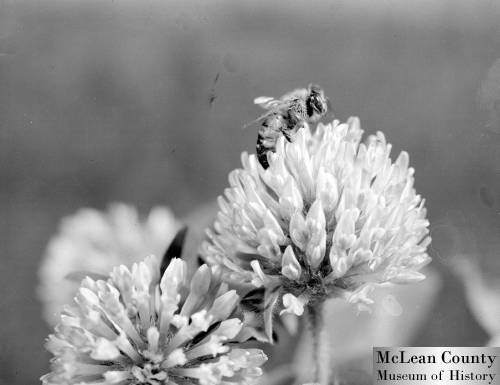
Below are a few of our favorite items featuring one of the most popular pollinators – the honey bee:
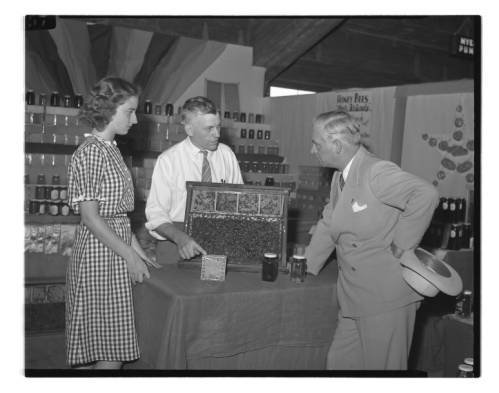
Governor Green at Bee Exhibit — State Fair. August 1946. Illinois State Archives. Eddie Winfred “Doc” Helm Photograph Collection. Courtesy of the Illinois State Archives. Honey bees, Chenoa, IL 1948. April 1, 1948. Photographed by Stanley Lantz. McLean County Museum of History. Pantagraph Negative Collection, 1946 – 1949. Courtesy of the McLean County Museum of History.Young, Benjamin Percy; Young, Nola Ayers. 1949. Designed by F. Botel. University of Illinois at Urbana-Champaign Library. John Starr Stewart Ex Libris Collection. Courtesy of the University of Illinois at Urbana-Champaign Library.Margaret M. McPherson. n.d. Designed by Julius J. Lankes. West Chicago Public Library District. Cornelia Neltnor Anthony and Frank D. Anthony Book Plate Collection. Courtesy of the West Chicago Public Library District.Roberts, IL beekeeper, 1941. September 10, 1941. Photographed by Charles Menees. McLean County Museum of History. Pantagraph Negatives Collection 1940 – 1945. Courtesy of the McLean County Museum of History.
Want to see more?
Visit the IDHH to view even more items related to bees.
Happy Halloween from the IDHH. Tonight we’re staying in and looking back through our most chilling collections from our contributors. If you’re feeling the boundary between this and other worlds thinning tonight, and looking for a little more, we recommend starting with the Cornelia Neltor Anthony and Frank D. Anthony Book Plate Collection at West Chicago Public Library District. The Cornelia Neltor Anthony and Frank D. Anthony Book Plate Collection includes over 6000 individual book plates collected over 12 years by Cornelia Neltor Anthony before she donated her collection in 1935. At one point considered the second largest collection, just behind the Library of Congress’, the book plates show the more eerie side of individual book collecting. Used to claim ownership of a book, to both deter book thieves and provide instructions for those who come across lost books. Here among the ex-libris are depictions of reading and what books contain, including dark and stormy nights:
It was a dark and stormy night. Waves and lightning were shaking the castle. From the library of Winward and Hazel Prescot. Designed by Charles William Sherborn. 1911.West Chicago Public Library District. Cornelia Neltnor Anthony and Frank D. Athony Book Plate Collection. Permission to display given by West Chicago Public Library District.
Reading by candlelight:
Reading through the night, the pages lit by candlesticks. From the library of Phoebe C. Greeley’s collection, designed by Julia Collins Stohr. 1926. West Chicago Public Library District. Cornelia Neltnor Anthony and Frank D. Anthony Book Plate Collection. Permission to display given by West Chicago Public Library District.
or other scenes with archaic and occult moods:
When the storm cleared a full moon rose behind the tower. Book plate from Helen Banks, designed by Charles Searle McDonald, 1922. West Chicago Public Library District. Cornelia Neltnor Anthony and Frank D. Anthony Book Plate Collection. Permission to display given by West Chicago Public Library District.
Including fantastic and macabre images of reading:
Goblin turns the page. From the Library of Charles S. Dixwell, designed by G. H. McCall. 1928.West Chicago Public Library District. Cornelia Neltnor Anthony and Frank D. Anthony Book Plate Collection. Permission to display given by West Chicago Public Library District.
Fool’s nightmare. Designed and owned by Dana Willard Stockbridge, 1922.West Chicago Public Library District. Cornelia Neltnor Anthony and Frank D. Anthony Book Plate Collection. Permission to display given by West Chicago Public Library District.
Here come the bats. From L. Jirku’s library, designed by Vaclav Rytir, 1913. West Chicago Public Library District. Cornelia Neltnor Anthony and Frank D. Anthony Book Plate Collection. Permission to display given by West Chicago Public Library District.
Book plates pull together the arcane and the scientific, blending what appeals to contemporary readers, including mysticism. These images provide commentary on the purpose of the book, and attitudes people have with reading, including their desires and daydreams. Not all books are spell books, but some spells are to protect them.
A Sator Square embedded in religious and mystic signs and tools. From the library of Henry Van Arsdale, designed by Jay Chambers, 1921. West Chicago Public Library District. Cornelia Neltnor Anthony and Frank D. Anthony Book Plate Collection. Permission to display given by West Chicago Public Library District.
These book plates also include a healthy dose of melancholy and death. Pulling from mythic and christian symbolism, and literature itself. The owl symbolizing knowledge, wisdom, magic and skepticism, and the skull as memento mori- the reminder of both death and memory, heighten the fear factor.
The night turned melancholic with my reading, “in all things terrible, love brings trouble and sadness”. Designed and owned by Georges Goury. C.1923. West Chicago Public Library District. Cornelia Neltnor Anthony and Frank D. Anthony Book Plate Collection. Permission to display given by West Chicago Public Library District.
At the end of the night my library did not look the same, and reminded me all the while of what’s to come. From the Library of Dr. Herbert D. Mandelbaum, designed by Walter M. Aikmen, 1917. West Chicago Public Library District. Cornelia Neltnor Anthony and Frank D. Anthony Book Plate Collection. Permission to display given by West Chicago Public Library District.
The owl was still there. From the Library of Theodore Lund, designed by Anne M. Danielsen. C. 1949. West Chicago Public Library District. Cornelia Neltnor Anthony and Frank D. Anthony Book Plate Collection. Permission to display given by West Chicago Public Library District.
But looked different too. From the Library of Irene Andrews, designed by J.W. Jameson. 1932. West Chicago Public Library District. Cornelia Neltnor Anthony and Frank D. Anthony Book Plate Collection. Permission to display given by West Chicago Public Library District.