Happy Black History Month. As I’ve written before, so much of the work we do at the IDHH is focused on how people document history. For Black History Month, we’ve been thinking of ways that the community members can engage in the conversation of Black history, and the African American experience by visiting museums in Illinois and exploring digital resources. We’ll have another post coming later this month that highlights a collection, but for the meantime here are a few notable collections relevant to Black history and culture available at the IDHH as well as some resources that we hope will help build context with our collections when thinking about the African American experience.
Galesburg, the largest city in Knox County Illinois, was the first city in the nation settled as an anti-slavery society. Founded in 1837, and a known site on the underground railroad, Galesburg hosted the fifth Lincoln-Douglas Debates (written about previously here). Even though Galesburg welcomed African Americans as early as the 1840s the struggle for equal rights played out in the city just as it did in other communities across the nation. Struggle and Progress- African Americans in Knox County, Illinois from Knox College brings together photographs, documents, manuscripts, and newspaper clippings to document the struggle for civil rights in Knox County while illustrating the culture and everyday life of African Americans in Knox County.
The Amos Kennedy Collection at the University of Illinois at Urbana-Champaign’s Rare Books and Manuscripts Library contains work from the printmaker, paper maker, teacher, and book artist based in York, Alabama. His books, postcards, posters, and paper-based sculpture address race freedom, equality and violence. His work often includes proverbs from people of Africa alongside images, and poetry from African American poets.
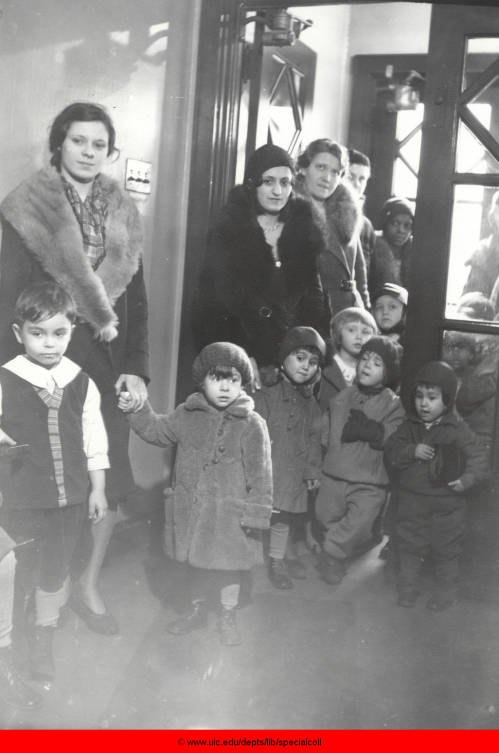
The University of Illinois at Chicago’s Chicago Urban League Photos gathers over 20 years of the social service, research, and advocacy organization’s history. Founded in 1910, the Chicago Urban League’s focus has evolved from social services to speaking up for the need for employment, Black owned business, and affordable housing and equitable education. CUL’s relationship with UIC’s School of Sociology brought community studies and statistical tools to the front of the conversation in shaping public policy.
The career of Eugene B. Redmond, the Poet Laureate of East St. Louis, started in East Saint Louis at the birth of the Black Arts Movement. As it developed over the next 30 years into a critical and poetic voice responding to life in the U.S., Redmond carefully documented and collected artifacts relating to the movement. The EBR African American Cultural Life digital collection is a selection of the 10,000 photographs, posters, and pamphlets from the Eugene B. Redmond Collection at Southern Illinois University- Edwardsville’s Lovejoy Library. The digital collection includes photographs of poetry readings, conversation with Black poets, events, and art.
Our contributors’ collections are gems in their own right. There are so many other collections though that interrogate and contextualize Black History, that give even more life to what we have on the IDHH. Here are a few more:
The Voices Remembering Slavery: Freed People Tell Their Stories project at the Library of Congress. In twenty-three interviews, recorded between 1932 and 1975, former slaves recount their stories as slaves and then as three people. They have much to say about their experience living as African Americans well into the 20th century. Similar to Born Into Slavery: Slave Narratives from the Federal Writer’s Project, 1936-1938, a large collection of more than 2,300 first person accounts of slavery collected as part of the Federal Writers’ Project, Voices Remember Slavery is unique and notable for the songs interviewees sang.
The Museum of Science and Industry is celebrating the contributions of African Americans in science, technology, medicine and art. Focusing specifically on the past since 1970 “50 Years of Black Creativity” runs through the end of the month. Springfield and Central Illinois African American History Museum collects and displays the legacies of African Americans in Central Illinois.
Decatur’s The African-American Cultural and Genealogical Society of Illinois, is one of the only institutions in Illinois that specializes in African American Genealogy. A field typically challenged because of the institution of slavery and it’s violence in breaking families, which made record keeping nearly impossible. Here’s another article on African-American Genealogy from PBS.