Celebrating Women’s History in IDHH Collections

The IDHH contains some content that may be harmful or difficult to view. Our cultural heritage partners collect materials from history, as well as artifacts from many cultures and time periods, to preserve and make available the historical record. Please view the Digital Public Library of America’s (DPLA) Statement on Potentially Harmful Content for further information.


In recognition of Women’s History Month, the IDHH would like to highlight several collections from our contributors and curated searches of IDHH items that tell different stories about the history of women in Illinois:

    • Jane Addams: explore photographs and documents related to Jane Addams, social reformer, and settlement and women’s suffrage activist, who co-founded Chicago-settlement Hull House in 1889 and was awarded the Nobel Peace Prize in 1931.
    • Gwendolyn Brooks: explore photographs related to Gwendolyn Brooks, Poet Laureate of Illinois and the first African American poet to win the Pulitzer Prize.
    • The Creative Woman (Governors State University): a collection containing issues of GSU’s quarterly feminist journal The Creative Woman,  which featured articles, essays, and creative writings on the lives and experiences of women.
    • The Woman’s Study Club of Joliet (Lewis University): a collection containing documents and records of the Women’s Study Club of Joliet, a club with the goal of educating women members which grew from the Columbian Clubs and The Woman’s Building organized by Bertha Palmer for the 1893 Chicago World’s Columbian Exposition.

You can also visit the IDHH’s Digital Exhibits to learn about the life and career of two turn-of-the-twentieth-century Illinois women: Rachel Crothers, a playwright from Bloomington, Illinois, and Fanny Butcher,  Literary Editor at the Chicago Tribune.

You can also view the IDHH’s previous posts with topics related to Women’s History Month:

The Enduring Legacy of Jane Addams – Women’s History Month

March is Women’s History Month and March 8th marks International Women’s Day. The first National Woman’s Day was observed in the United States on February 28, 1909 by the Socialist Party of America in honor of the 1908 garment workers’ strike in New York. While this was the first official observance of any kind, the movement for women’s rights was born much earlier in 1848, when Elizabeth Cady Stanton and Lucretia Mott held the first women’s rights convention in the US. From that convention in 1848, this celebration of the vital role of women in American history would progress over the next 139 years from an official day to an official week, to finally being a federally designated month in 1987. In honor of Women’s History Month and International Women’s Day, the IDHH is featuring Jane Addams, an agent of change in Illinois history. 

Born in Cedarville, Illinois in 1860, Jane Addams was an influential social reformer and activist who established the historic Chicago settlement house Hull House in 1889 with Ellen Gates Starr. Jane Addams would build Hull House into a hub of social and cultural opportunities for the largely immigrant residents on the Near West side of the city. In addition to her efforts with Hull House, Jane Addams worked with reform groups towards creating the first juvenile-court law, establishing an eight-hour working day for women, and advancing the cause of women’s suffrage. She would eventually help form the Women’s International League for Peace and Freedom in 1919, serving as the inaugural president of the international organization. In recognition of her unwavering dedication to the ideal and objective of world peace, Jane Addams was the co-winner of the 1931 Nobel Peace Prize, the second woman to ever receive the Prize. 

Below are a few of our favorite items featuring Jane Addams and her pioneering work with Hull House:

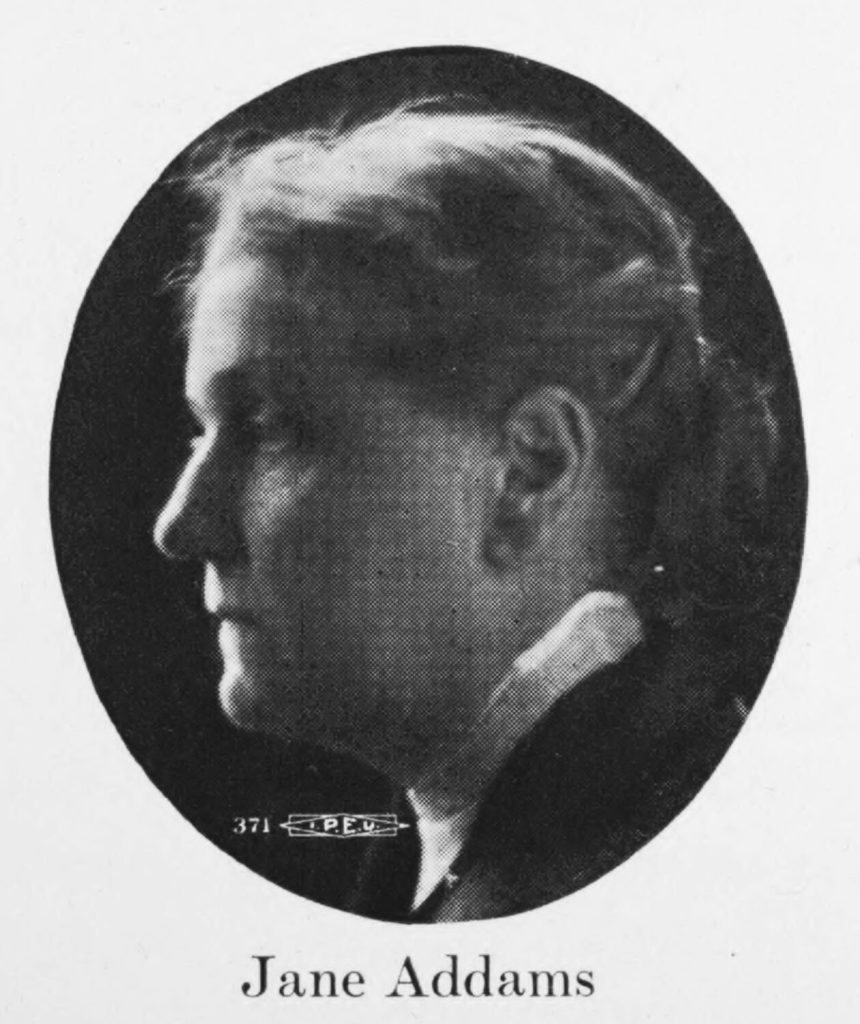
black and white engraving of a woman in profile with the name "Jane Addams" below the image
Jane Addams. 1922. I. P. E. U. [International Photo-Engravers Union of North America 371]. University of Illinois at Urbana-Champaign Library. Picture Chicago. Courtesy of the University of Illinois at Urbana-Champaign Library.
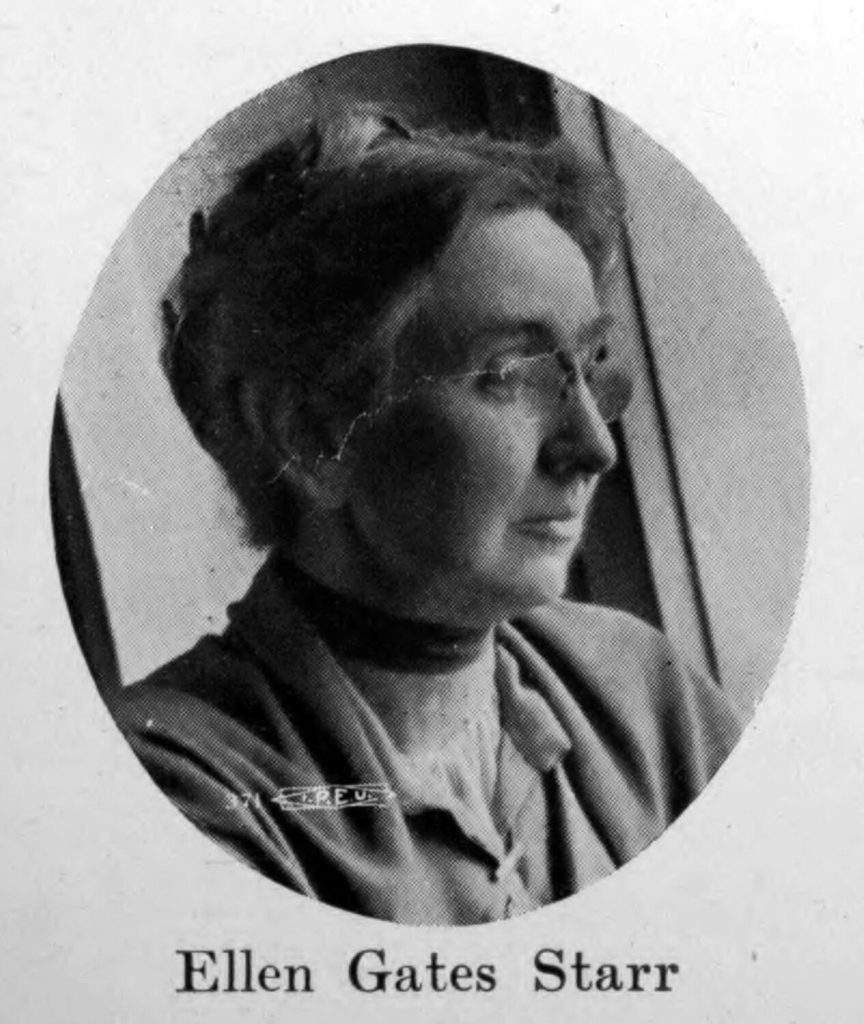
black and white engraving of a woman in profile with the name "Ellen Gates Starr" below the image.
Ellen Gates Starr. 1922. I. P. E. U. [International Photo-Engravers Union of North America 371]. University of Illinois at Urbana-Champaign Library. Picture Chicago. Courtesy of the University of Illinois at Urbana-Champaign Library.
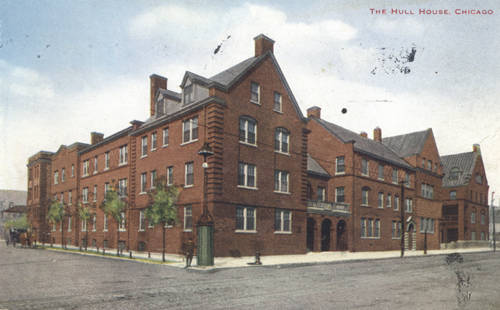
color postcard of the Hull House building.
Hull House, Chicago. June 1, 1915. Eastern Illinois University. Booth Library Postcard Collection. Courtesy of Eastern Illinois University.
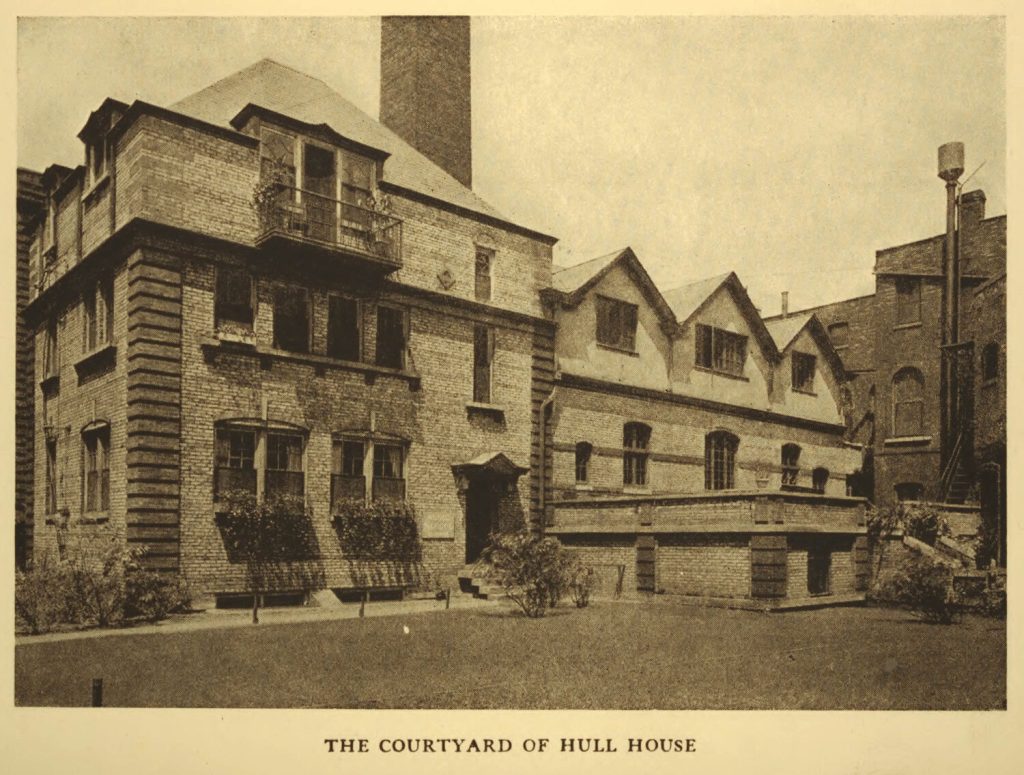
black and white photo on yellowed paper of the courtyard at Hull House, with a brick building in the background.
Courtyard of Hull House. 1920. University of Illinois at Urbana-Champaign Library. Picture Chicago. Courtesy of the University of Illinois at Urbana-Champaign Library.
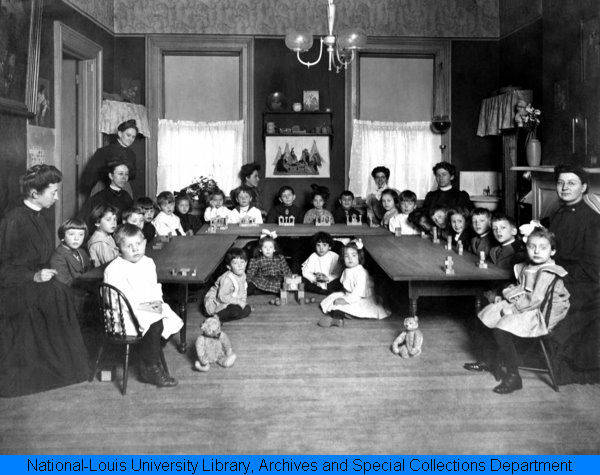
black and white photo of women and children sitting around a u-shaped table and on the floor in late Victorian clothes.
Hull House Kindergarten. circa 1906. National Louis University. Elizabeth Harrison-Chicago Kindergarten Movement. Courtesy of National Louis University.
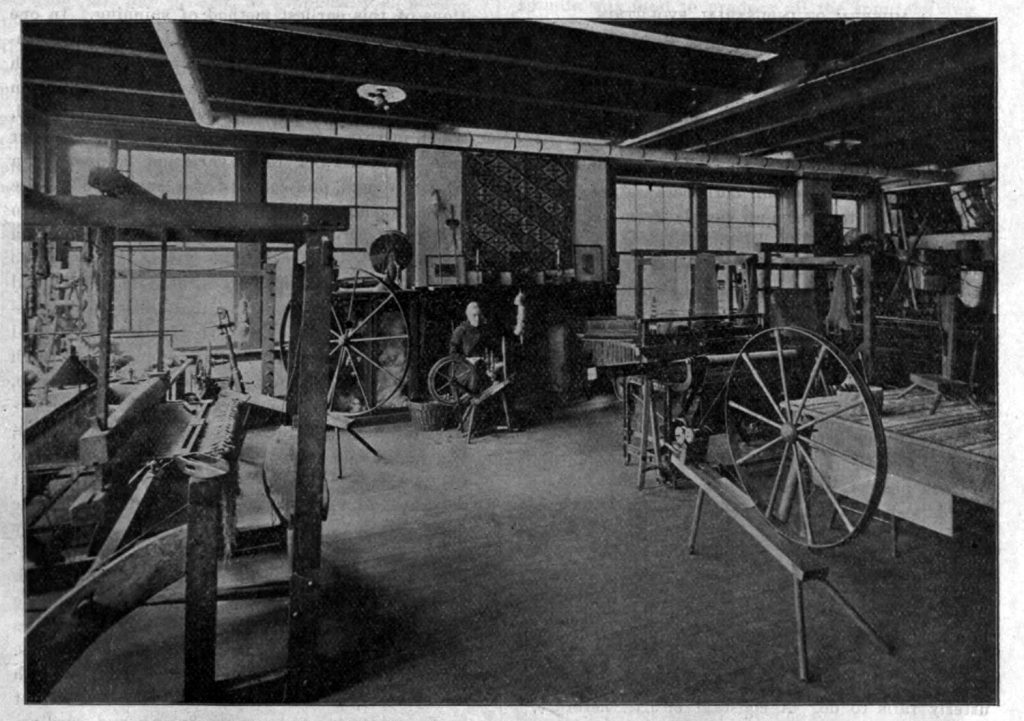
black and white photo of spinning wheels and looms in a textile room.
The Textile Room. May 1902. University of Illinois at Urbana-Champaign Library. Picture Chicago. Courtesy of the University of Illinois at Urbana-Champaign Library.

Want to see more? 

Visit the IDHH to view even more items related to Jane Addams and Hull House, as well as other notable women of Illinois, such as Gwendolyn Brooks, Mary G. Harris Jones, and Jane Byrne.

Modeling the Settlement House: 132 Years of Chicago’s Hull House

In 1889, Jane Addams and Ellen Gates Starr co-founded Hull House on the West Side of Chicago. Based on the model of Toynbee Hall in the East End of London, Hull House was a secular settlement house, where middle-class women would volunteer their time to provide social and educational opportunities for working-class people, many of whom were newly-arrived European immigrants.  

Aside from offering educational and artistic programs to the community, Hull House also offered medical care and social services. In fact, Hull House continued providing social services in multiple locations throughout Chicago up until 2012, even when the organization moved from its original location in the 1960s. Hull House became the model upon which other settlement houses were based, and influenced legislation on child labor laws, occupational health and safety provisions, education, immigration rights, and pension laws. Though most of the original complex was demolished in the mid-1960s for the construction of University of Illinois-Chicago, the Hull mansion still stands, and was designated as a U.S. National Historic Landmark on June 23, 1965. 

To celebrate the accomplishments and legacy of Hull House, the IDHH would like to share a few of our favorite related items from Eastern Illinois University and University of Illinois at Chicago: 

color postcard of the front of the Hull House in Chicago, IL
Hull House, Chicago. June 1, 1915. Eastern Illinois University. Booth Library Postcard Collection. Courtesy of Eastern Illinois University. 
sepia-toned image of two girls sitting on an old swing while other children stand nearby
Two girls on the Hull-House playground. circa 1895. University of Illinois at Chicago. Seven Settlement Houses-Database of Photos. Courtesy of University of Illinois at Chicago. 
black and white image of young girl sketching on an art pad in front of a dumpster in an alley
Girl sketching on pad near Hull-House. circa 1920s. University of Illinois at Chicago. Seven Settlement Houses-Database of Photos. Courtesy of University of Illinois at Chicago. 
black and white image of mothers standing in line holding the hands of their young children
Mothers and children in a Hull-House entranceway. circa 1920s-1930s. University of Illinois at Chicago. Seven Settlement Houses-Database of Photos. Courtesy of University of Illinois at Chicago. 
black and white image of adults learning to folk dance
Adult folk dancing class at Hull-House. circa 1950s. University of Illinois at Chicago. Seven Settlement Houses-Database of Photos. Courtesy of University of Illinois at Chicago. 
black and white image of boys and girls standing outside closed doors at the Hull House
Boys and girls waiting at the Hull-House. circa 1960. University of Illinois at Chicago. Seven Settlement Houses-Database of Photos. Courtesy of University of Illinois at Chicago. 

View the full Booth Library Postcard Collection and the Seven Settlement Houses-Database of Photos Collection on the IDHH.  

View more items related to Hull House on the IDHH.