The Great IDHH Baking Blog: Pies

“As American as apple pie.” While the first recorded recipe for apple pie was written in England in 1381, this quotation has become synonymous with Americana and speaks to a country’s love of the versatile baked dish. Centuries before this catchy phrase was featured in advertisements of the Roaring Twenties, colonists of the fledgling United States found their wheat from England unsuited to North American soil and instead channeled their small amount of grain for use in pies rather than bread. With their flourishing New England apple orchards, this environment sowed the seeds for a nation’s embrace of the pie as a culinary favorite and cultural signifier. 

From springtime fairs to end-of-the-year holidays and festivals, it’s difficult to think of an event or season in which some kind of pie would not be welcome. The dessert is so ubiquitous that ten U.S. states claim a pie as their “official” state dessert, state treat, or state pie. Maine even lists two iconic pies for the state, claiming blueberry pie as the state dessert and whoopie pie as the state treat (though the whoopie pie is not quite a pie and more a type of soft cookie). The IDHH’s own state of Illinois proudly lists the pumpkin pie as the state pie and today produces the most pumpkins used for processed pie filling.  

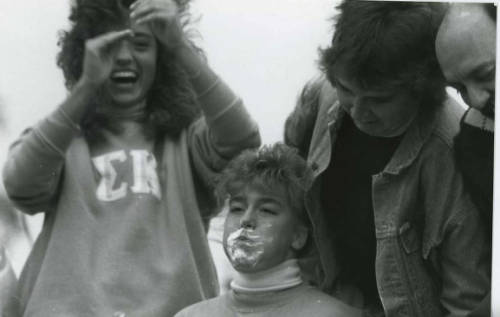
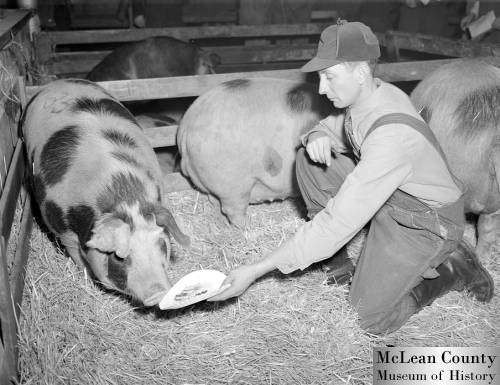
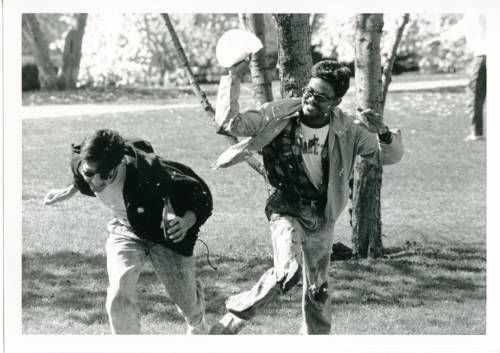
While eating pies may be the more traditional way to enjoy the classic American dessert, some of our favorite items from the collection below show more inventive uses of the dish, from thrown projectile to animal treat:

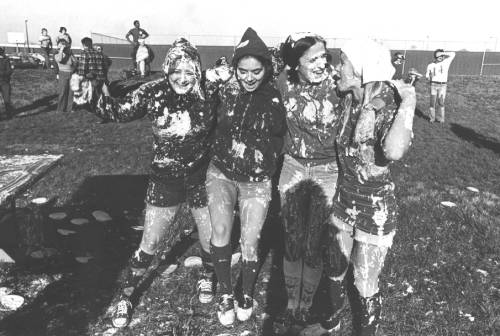
black and white image of four college women having participated in a pie-throwing contest, covered in pie filling
Campus Photograph Collection: Campus Life. circa 1972-1976. University of Illinois Springfield. Campus Archival Documents. Courtesy of the University of Illinois Springfield.
black and white photo of a seated female college student with pie smeared across her mouth and cheeks while another female students nearby laughs and two adults look on.
Student Life. 1978. Illinois Wesleyan University. IWU Historical Collections. Courtesy of Illinois Wesleyan University.
black and white photo of a farmer holding a plate with a piece of pie on it in front of a pic in a pen.
Hog gets pie, 1947. January 22, 1947. Photograph by Frank Bill. McLean County Museum of History. Pantagraph Negative Collection, 1946 – 1949. Courtesy of the McLean County Museum of History.
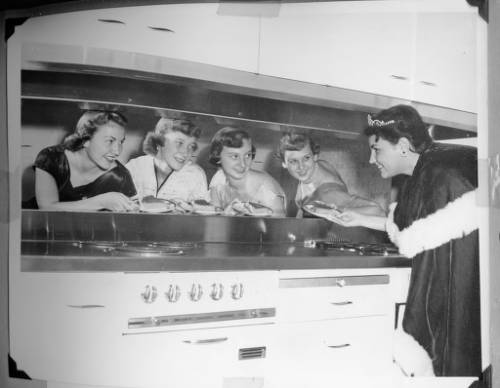
black and white photo of a woman serving pie through an enclosed kitchen to women standing at a window.
Eureka Pumpkin Festival Queen Serves Pie to Attendants, 1955. September 15, 1955. Eureka Public Library District. Pumpkins, Parades and Pies- Eureka’s Pumpkin Festival Past, 1939-1961. Courtesy of the Eureka Public Library District.
black and white photo of one college student about to throw a pie at another college student that is running away.
Flunk Day pie. circa 1980’s. Knox College. The Way to Knox. Courtesy of Knox College.

Want to see more? 

View more items related to pies on the IDHH.  

View Illinois Highlights blog posts published in 2019 and 2017 featuring the Eureka Pumpkin Festival items from the Eureka Public Library district.

Celebrating the Month of May with May Day

While perhaps now best known as an international distress signal, May Day’s origins as a festival to celebrate the coming of spring date back to as early as the 2nd century AD. From the Roman festival Floralia to the Germanic festival of Walpurgis Night to the Celtic festival of Beltane, elements of modern-day May Day can be seen in the feasts, celebrations, and use of flowers as decorations and gifts that originated in those festivals. May Day is currently recognized as an official holiday in 66 countries, and has also been known as International Workers Day since the 19th century as a way of recognizing the 19th century labor movement for workers’ rights. 

The most well-known May Day traditions, as observed in Europe and North America and featured in the third book of Maud Hart Lovelace’s Betsy Tacy series, are the crowning of the May Queen, the giving of May baskets, and the dance around the maypole. May Day traditions have fallen out of fashions in the recent decades, but here at the IDHH, we’ve chosen to highlight some of these past May Day celebrations from Western Illinois University, Knox College, the North Suburban Library District, the Towanda District Library, and the University of St. Francis to show how May Day traditions used to be celebrated. 

black and white photo of a large group of people around a May Pole
May Day Celebration WIU May 1907. circa 1910-1912. WIU Libraries Archives & Special Collections. Digital Image Collection. Courtesy of Western Illinois University. 
black and white image of people twirling around May Day poles in celebration of May Day
May Day celebration. 1920. Knox College Special Collections and Archives. Harold Way Photograph Collection. Courtesy of Knox College. 
black and white photo of a group of people in festive clothing performing a May Day dance.
Harlem Consolidated School May Festival dance, 1922. 1922. North Suburban Library District. North Suburban Library District Local History Collection. Courtesy of North Suburban Library District. 
black and white photo of two young women, on with a flower crown, in long white dresses holding flower bouquets
Photograph of May Day Festival at Towanda School around 1939. circa 1939. Towanda District Library & Towanda Area Historical Society. Towanda District Library – Towanda Area Historical Collection. Courtesy of Towanda District Library & Towanda Area Historical Society. 
black and white image of a crowd of people in formation for May Day parade
May Day at St. Francis – 1952. 1952. University of St. Francis. Sharing Our Past, A Visual History. Courtesy of University of St. Francis. 

View the full Digital Image CollectionHarold Way Photograph CollectionNorth Suburban Library District Local History CollectionTowanda Area Historical Collection, and the Sharing Our Past, A Visual History Collection on the IDHH. 

View more items related to May Day celebrations on the IDHH.